


Shoiab Mohmmad Bhat
“Ambedkar’s journey proves that even the most difficult beginnings can lead to extraordinary change. It is a story of resilience, courage, and unwavering determination.”
It was the year 1901, in British India under the Bombay Presidency. A ten-year-old boy stood waiting with his brother and sister at Masur Railway Station. The long day was slowly turning into evening, and the fading light made the platform quieter with every passing moment.
As daylight faded into darkness, a station master came closer and asked gently, “Everyone has already left. Why are you still here?”
Without hesitation, the young boy replied politely that they had to go to Koregaon. They were waiting for their father, who worked there, or perhaps his peon, who was supposed to come and receive them.
At first, the station master seemed kind and concerned for the children left alone at the station. But when he learned that they belonged to the Mahar community, his behaviour suddenly changed. The warmth in his voice faded, and he quietly stepped back, leaving the children helpless and without offering any help.
With no one to assist them, the children later managed to hire a bullock cart to continue their journey. Yet their difficulties did not end there. When the cart driver discovered their caste, he demanded double payment and refused to sit in the cart with them. Afraid that he might be “polluted,” he chose to walk beside the cart instead.
For young Bhimrao, this painful experience remained unforgettable. It revealed how deeply discrimination and untouchability were rooted in society.
This was not the only such experience in his life. Even in the classroom, he was forced to sit in a corner on a rough mat, away from the other students. No one would go near that place. Sometimes even the school sweeper avoided cleaning the spot where he used to sit, simply because he was considered an untouchable.
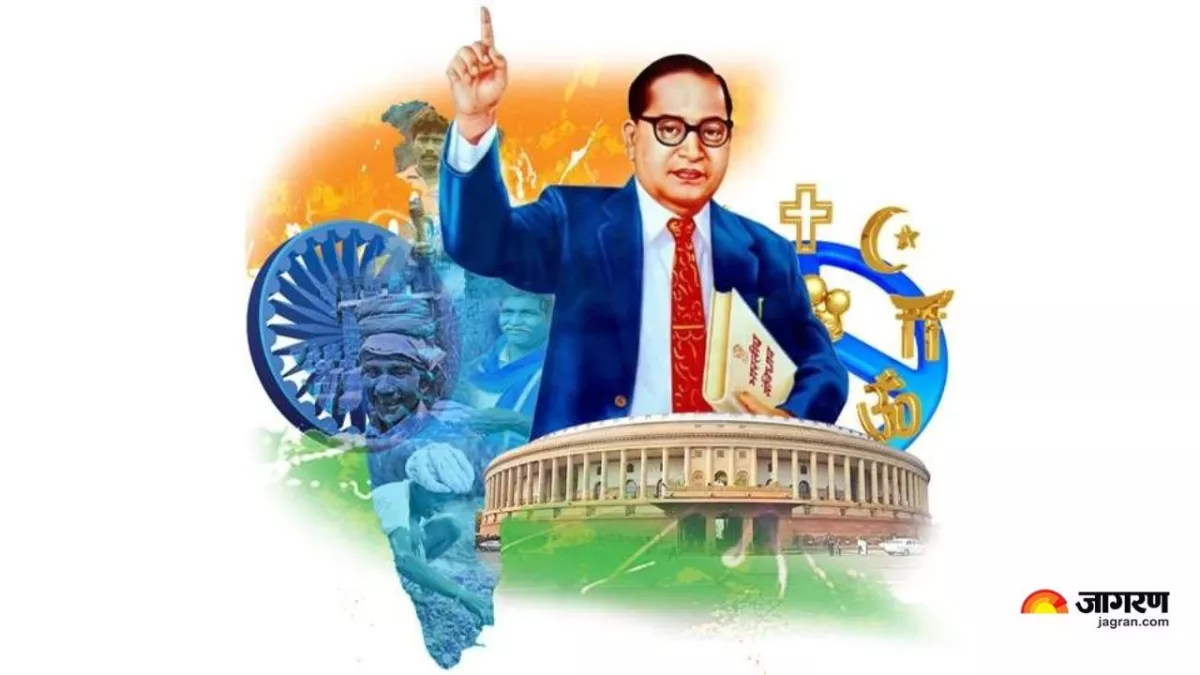
Yet, history was about to take a dramatic twist. That boy who had to endure insults and discrimination became the voice of many Dalits. B. R. Ambedkar emerged as the architect of the Indian Constitution, which guarantees equality and basic rights to all citizens of the country.
The life of Dr Ambedkar is a classic example of success against all odds. He was born on 14 April 1891 to Bhimabai and Ramji Maloji Sakpal in Mhow. His father, who was in the Indian Army, believed that education could bring about a radical transformation for him and his offspring.
However, there were numerous obstacles in the way of his quest for education. Having been born into the Mahar caste, Ambedkar often found himself at the receiving end of discrimination right from childhood. This happened time and again when he had to face situations that were totally different from those experienced by the privileged class of children at school.
One of the most important influences in his life was a teacher named Krishna Keshav Ambedkar. Unlike many others, this teacher recognised his intelligence and dedication. He encouraged Bhimrao to continue his studies and supported him at a time when society offered very little encouragement to children from oppressed communities. It was through this teacher that Bhimrao adopted the surname “Ambedkar,” a name that would later become known across the world.
Education soon became the strongest weapon in his struggle. When his family moved to Mumbai, he studied at Elphinstone High School, one of the most respected institutions of that time. He was the only student from an “untouchable” community in the school. Yet he continued to work hard and focus on his studies. His father played a crucial role in shaping his discipline, often waking him early so he could study in a peaceful environment.
Dedication and perseverance helped Ambedkar reach another great milestone when he passed the matriculation exam. In the lives of most individuals belonging to his community, such an achievement was more than just an educational one; it acted as a source of hope and optimism. It proved that through education, one could transcend social barriers and restrictions.
However, Ambedkar’s pursuit of knowledge had no bounds. He went on to complete his further education under a scholarship awarded by Sayajirao Gaekwad III of the Baroda State. This experience paved the way for his future advanced studies in foreign countries.
Ambedkar travelled to the United States and studied at Columbia University in New York City. There, he earned advanced degrees and expanded his understanding of economics, politics, and society. His academic journey later took him to London, where he studied law and economics. By this time, he had become one of the most highly educated Indians of his generation.
Despite his remarkable achievements, Ambedkar soon realised that discrimination in India had not disappeared. Even a person with a world-class education could still be judged by caste. Yet instead of accepting this injustice, he chose to challenge it with knowledge, courage, and determination.
He started teaching Political Economy at the Sydenham College of Commerce & Economics, located in Mumbai. His lectures were greatly admired by both his students and other intellectuals, earning him recognition as a brilliant intellectual. However, teaching was not enough for him. He wanted to raise awareness about what had long been suppressed.
For this purpose, he started the Marathi newspaper, Mook Nayak. Through this publication, Ambedkar raised issues faced by oppressed communities and demanded equality and justice. His writings and speeches encouraged people to question discrimination and stand up for their rights.
The life of Dr Ambedkar offers many powerful lessons. It shows that education can become a tool for liberation, that courage can challenge deeply rooted injustice, and that determination can transform personal suffering into social change.
The boy who once faced humiliation at a railway station eventually became a leader who spoke for millions. His ideas, writings, and leadership continue to guide the nation even today. Whenever the rights of people are threatened, the principles written in the Constitution remind us of the values he stood for-justice, equality, and human dignity.
R. Ambedkar’s journey proves that even the most difficult beginnings can lead to extraordinary change. His life remains a lasting inspiration for anyone who believes that knowledge, courage, and perseverance can shape a better and more just society.

Comments are closed.