

Mohammad Arfat Wani
“The Urdu short story has always served as a mirror to society, reflecting not only its visible realities but also its hidden wounds. Through this form, writers have explored moral conflicts, social contradictions, and the delicate workings of the human mind. Dr. Abdul Majid Bhaderwahi stands firmly within this tradition of reflective and socially conscious storytelling.”
In the vast and diverse tradition of Urdu literature, the short story occupies a special and respected place. It is through this form that writers have most effectively explored the complexities of human life, social contradictions, moral conflicts, and the delicate workings of the human mind. The Urdu short story has always served as a mirror to society, reflecting both its visible realities and its hidden wounds.
Within this literary tradition, Kashmir has made a significant contribution by producing writers who have captured social realities with sensitivity, restraint, and intellectual depth. These writers have often drawn from lived experiences, cultural memory, and ethical reflection to present human emotions in their most subtle and profound forms. Among such distinguished literary figures stands Dr. Abdul Majid Bhaderwahi, whose name commands respect not only for his strong and resonant literary voice but also for his authority in the field of Urdu fiction.
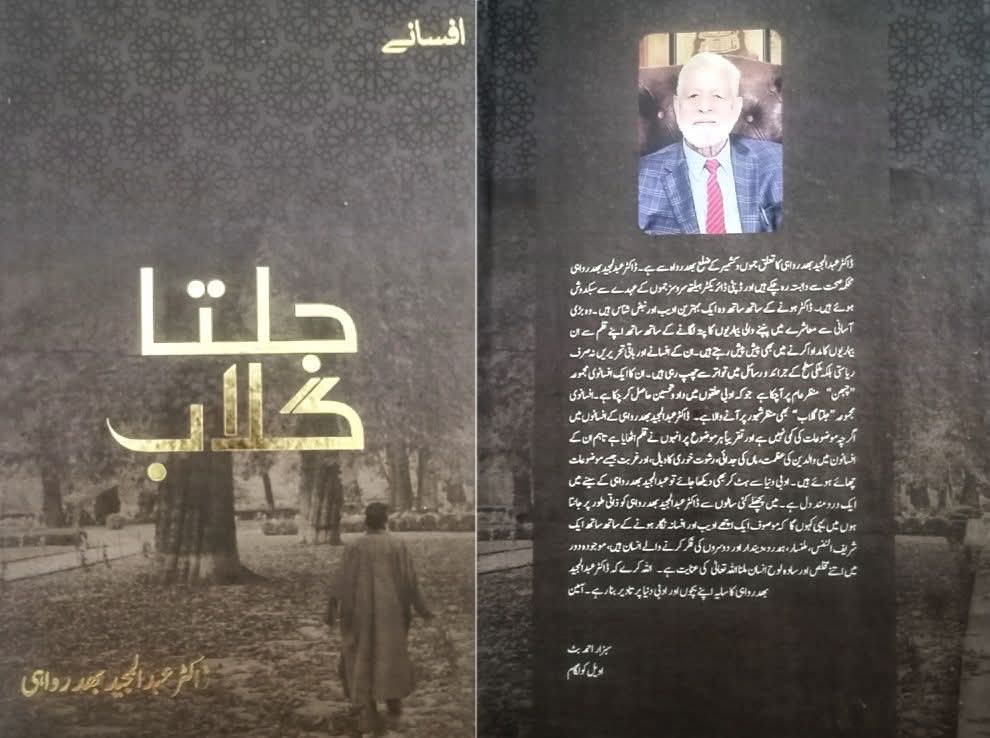
Born on 3rd May 1942 in the scenic region of Bhaderwah in Jammu and Kashmir, Dr. Bhaderwahi received his early education in his hometown. He later pursued his studies at AIPS and completed his graduation from Punjab. Professionally, he dedicated several decades of his life to the Health Department, serving people with sincerity, compassion, and professional integrity.
His long career culminated in his appointment as Deputy Director of Health, a position that reflected both his competence and his commitment to public service. However, it was not only medicine that shaped his personality. As a physician, he came face to face with intense human suffering, emotional trauma, social hypocrisy, and ethical dilemmas. Hospitals and clinics exposed him to the harsh realities of life—poverty, neglect, injustice, and moral compromise. These experiences left a deep impression on his mind and gradually shaped his literary consciousness, providing him with rich material and emotional insight for his fiction.
Unlike many writers whose literary inclination appears early in life as an inherited or accidental gift, Dr. Bhaderwahi’s journey into Urdu fiction was guided by inner passion, disciplined observation, and intellectual commitment. He began writing short stories seriously after 1990, at a stage when many consider creative experimentation to be past its peak. Yet, his entry into literature was marked by maturity and clarity of vision. Within a short period, he earned recognition among serious readers and critics of Urdu literature. His stories began appearing in almost all leading literary journals and magazines, and his work soon found its way into respected collections such as Sulgta Shehar, Tapish, and Jalta Gulab, among more than eight published books. His prose stands out for its smooth flow, refined language, and intellectual richness. He writes with restraint, yet his words carry weight. His stories explore human psychology, social injustice, ethical conflicts, and the many-layered realities of everyday life, leaving a lasting impact on the reader.
His latest collection, Jalta Gulab, published in 2025, marks another important milestone in his literary journey. This book reflects years of observation, emotional engagement, and artistic discipline. Compiled by Wali Mohammad Asir Kashtawari, published by Pixel Media, Srinagar, and printed in 500 copies by Fawzia Computer Center, Jammu, the collection is gradually finding its way to serious readers of Urdu fiction. With wider accessibility, Jalta Gulab is expected to reach a broader audience and secure its place as a significant contribution to contemporary Urdu literature.
Literary critics and scholars have widely acknowledged the depth and relevance of Dr. Bhaderwahi’s work. Shamshad Kralwari observes that his short stories present a truthful portrayal of the darker aspects of social life, including fractured relationships, domestic tensions, and the silent suffering within homes. He particularly highlights the sensitive yet powerful depiction of women’s oppression, exploitation, and social restrictions, which appear repeatedly in Bhaderwahi’s narratives. Wali Mohammad Asir Kashtawari describes him as a doctor by profession and a cheerful human being by temperament, whose literary identity as a short story writer has been built through dedication, fluency, and intellectual seriousness. Mohammad Yousif Tang points out that despite dealing with the darker sides of human nature, Bhaderwahi never abandons hope. Instead, he searches for goodness within moral decay and transforms his stories into symbols of positive change, reflecting the compassion of a healer and the insight of a psychologist.
Noor Shah emphasizes that Dr. Bhaderwahi’s personal decency, refined speech, and reformative outlook are reflected in his fictional characters, who often pass through suffering and bitterness only to emerge with greater emotional awareness. Bashir Ahmad Khateeb draws parallels between Bhaderwahi’s boldness, irony, and brevity and the legacy of Saadat Hasan Manto, while also noting his strong social and religious consciousness. Dr. Mushtaq Ahmad Wani considers his stories a source of enlightenment that encourages self-awareness, cultural understanding, and social justice. Dr. Reyaz Tawheedi views his pen as both critical and reformative, while Parvez Manoous highlights how his stories bring together Kashmir’s cultural beauty and social bitterness within a single narrative frame. Taken together, these perspectives underline the fact that Jalta Gulab is not merely a collection of stories but a broad canvas of human life, moral struggle, psychological complexity, and social inequality.
The stories in Jalta Gulab display remarkable thematic depth and narrative control. In “Mere Mehboob,” love is intertwined with confession and repentance, showing that when ego collapses, forgiveness becomes the highest moral act. “Mehboob Ka Intizar” transforms love into a form of worship, where patience and longing gain spiritual meaning. “Keechar Mein Khila Kanwal” challenges class-based prejudice and asserts that purity of character is independent of social background. “Aakhri Tamanna” explores existential pain by focusing on desires that awaken in the final moments of life, while the title story “Jalta Gulab” presents sacrifice as something that continues to spread its fragrance even after being burnt. In “Maqdur,” destiny is shown not as blind fate but as something shaped by courage and choice, whereas “Asliyat” forces readers to confront the gap between outward appearance and inner truth.
Several stories mourn crushed dreams and social injustice. “Jagti Aankhon Ka Khwab” reflects dreams suffocated by societal restrictions, while “Bhool Kisi Ki, Saza Kisi Ko” exposes the cruelty of a system where the innocent often suffer for the mistakes of others. “Khamoshi Ki Zuban” symbolizes the gradual death of conscience, and “Ikhlaq Ki Qeemat” reminds readers that true inheritance lies in moral character rather than material wealth.
Other narratives expand these concerns further. Stories such as “Badgumani” examine suspicion within domestic spaces, while “Jhoota Intiqal” satirizes society’s hollow rituals surrounding death. “Zindagi Ke Daire” reflects the tension between superstition and rational thought, and “Sharab Aur Jhoot” portrays both physical and spiritual decline. “Tabadlay Ke Baad” examines differences in temperament and status, while “Tujhe Zameen Pe Utara Gaya Mere Liye” presents love as a divine decree. Stories like “Tilawat Ka Inaam” and “Mukhless Dost” emphasize spirituality and humanity beyond religious and social divisions.
Themes of social apathy and institutional indifference appear in “Dost Aur Bhabi” and “Interview,” while the emotional bond between mother and child is beautifully portrayed in “Khawab Aur Maa.” “Dastak” and “Aahon Ka Asar” awaken moral awareness and show how actions eventually return to shape human destiny. “Ah-e Sahar Gahi” depicts repentance as a force capable of transforming lives.
Stories such as “Kachay Aam” highlight human empathy, “Ajnabi Hum Dono” questions socially constructed relationships, and “Pehanchi Wahi Pe Khak Jahan Ka Khamir Tha” celebrates the unbreakable bond between individuals and their roots. “Yunhi Koi Mil Gaya” captures the unexpected beauty of chance encounters, while “Tuhfa-e-Mohabbat” reflects humility and generosity. “Dam-e-Sayaad” turns hope into healing, “Nazar-e-Inayat” symbolizes patience and trust, and “Bhadda Mazaq” exposes how small, careless actions can cause deep harm in modern society.
The later stories intensify the moral critique. “Khud Sipardagi” questions human dignity, “Sifarish” exposes the killing of merit, and “Ye Aansoo Mere Dil Ki Zuban Hain” presents emotions as a universal language. “Tameer-e-Masjid Ke Liye” examines sincerity versus intention, while the concluding stories address divine mercy, despair, accountability, and self-reform. Themes of hunger, emotional wounds, suppressed voices, broken dreams, women’s suffering, class oppression, and the erosion of personal relationships are powerfully woven throughout the collection.
In the final analysis, Jalta Gulab stands as a deep and essential contribution to Urdu fiction. It demonstrates Dr. Abdul Majid Bhaderwahi’s mastery over themes of conscience, ethics, social justice, and the many shades of love and human relationships. Each story acts as a mirror, reflecting the emotional, moral, and intellectual struggles hidden within society. The collection transcends regional and linguistic boundaries, inviting readers not only to read but to observe, reflect, and feel. Jalta Gulab is more than a book; it is a literary journey, a social document, and a celebration of human emotion—a timeless treasure that deserves a lasting place in the history of Urdu short stories.
Author Mohammad Arfat Wani, a passionate writer, social activist, and nursing student from Kuchmulla Tral, is also a B.Sc. Nursing student at Ramzaan College of Nursing & Paramedical Sciences, Galander Pampore, Email: wania6817@gmail.com)

Comments are closed.