Goa, November 21: Cinema should question social hierarchies and confront the marginalisation of vulnerable communities rather than offer easy moral conclusions, veteran Kannada filmmaker Girish Kasaravalli said during a session at the 57th International Film Festival of India (IFFI) in Goa on Saturday.
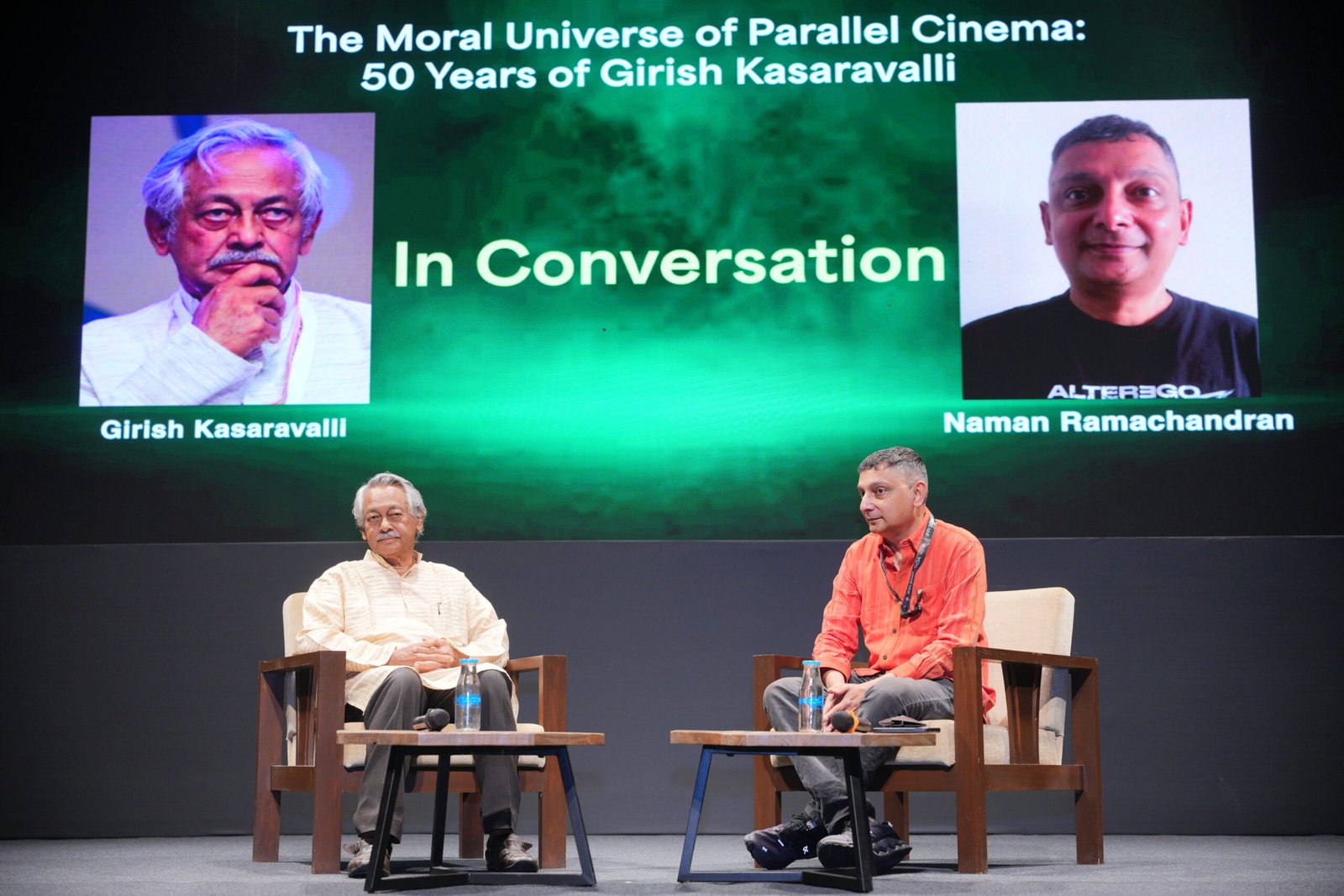
Speaking at an ‘In Conversation’ session titled The Moral Universe of Parallel Cinema: 50 Years of Girish Kasaravalli at Kala Academy, Kasaravalli reflected on his five-decade cinematic journey and the recurring themes of caste, religious dominance, social exclusion and the process of “othering” in his films.
Tracing his career from his 1977 debut Ghatashraddha to acclaimed works such as Tabarana Kathe, Thaayi Saheba and Dweepa, the 14-time National Film Award-winning filmmaker questioned the conventional distinction between commercial and art-house cinema.
“There is nothing called ‘only entertainment’. Even entertainment is a political form,” he said, arguing that every cinematic expression carries an ideological position and either supports or challenges prevailing social ideas.
Discussing the evolution of New Kannada Cinema, Kasaravalli emphasised the need for an indigenous cinematic language rooted in India’s social and cultural realities rather than borrowed frameworks.
“Style is not imposed on a film; it comes from within the content itself,” he said, adding that the vision behind a story was more important than its plot.
He said cinema should encourage audiences to think rather than dictate what is right or wrong. Referring to writer U.R. Ananthamurthy’s philosophy of ending every answer with a “but”, he said filmmakers should avoid simplistic conclusions.
“To say through a film that ‘this is right, this is wrong’ itself is wrong. I don’t make easy judgments, because that forces the audience to think,” he said.
The discussion also touched upon the portrayal of women in his films. Referring to Dweepa, Kasaravalli spoke about the resilience of its protagonist, Nagi, and her pragmatic approach to adversity, recalling her words: “Let me make the present pleasant.”
On his creative process, he said he preferred detailed scripts to storyboards, allowing collaborators to translate his visual imagination onto the screen.
“Cinema is germinated in my mind, but it is executed by others,” he said, highlighting the collaborative nature of filmmaking and describing cinema as an experience rather than merely a vehicle for statements.
Concluding the session, Kasaravalli invoked the philosophy of Cuban filmmaker Julio García Espinosa’s ‘imperfect cinema’, urging Indian filmmakers to remain rooted in their own cultural and visual identities instead of measuring their work against external standards.
“Why should I be ‘perfect’ by someone else’s standards? I should be loyal to my own milieu,” he said.
The session was moderated by film journalist, critic and author Naman Ramachandran. (PIB)


Comments are closed.