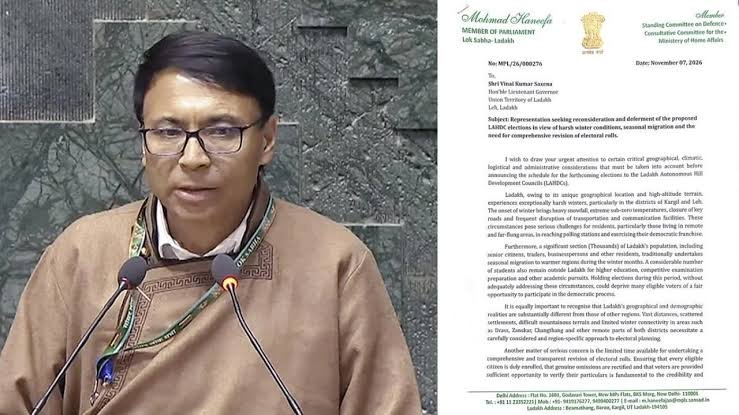
LEH, November 11: Ladakh Lok Sabha MP Mohammad Haneefa Jan has urged Union Home Minister Amit Shah to defer the December 4 elections to the eight Ladakh Autonomous Hill Development Councils (LAHDCs) until after May next year, citing harsh winter conditions, seasonal migration and concerns over the time provided for revision of electoral rolls.
In a representation submitted to the Home Minister on Wednesday, Haneefa said holding elections during winter could prevent a significant section of the electorate from exercising its franchise, particularly residents of remote and snowbound areas, senior citizens, women, persons with disabilities and students pursuing education outside the Union Territory.
He said Ladakh’s geographical, climatic and demographic conditions required special consideration while deciding the election schedule. He urged the Centre to direct the concerned authorities to reschedule the polls, preferably after May, when weather conditions are more favourable for travel and voter participation.
Clarifying that his demand was not against elections or the democratic process, the MP said he wanted to ensure that every eligible voter, including those temporarily residing outside Ladakh, had a fair opportunity to participate.
“An election is not meaningful simply because polling takes place; it is meaningful when every eligible citizen gets a fair and reasonable opportunity to cast their vote,” he said in the representation.
Haneefa pointed to the possibility of heavy snowfall, sub-zero temperatures and road closures disrupting transportation during winter. He said these conditions could create difficulties for voters, election officials and candidates, particularly in remote areas such as Drass, Zanskar and Changthang, where settlements are scattered and winter connectivity is limited.
He also highlighted the seasonal movement of residents to Jammu, Delhi, Chandigarh, Mumbai, Bengaluru and other cities for employment, business and other requirements. Many, he said, remain registered voters in their native constituencies but may find it difficult to return to Ladakh for polling in December.
The MP raised similar concerns about students pursuing higher education and preparing for competitive examinations outside the Union Territory. He said many travel to Jammu, Srinagar, Delhi, Chandigarh, Rajasthan and Bengaluru for studies and coaching for examinations such as NEET, JEE and civil services, with their movement increasing around late November and early December.
Another concern flagged in the representation was the reportedly four-day period provided for revision and publication of electoral rolls. Haneefa said the exercise required adequate time for verification of voter details, correction of errors and omissions, public participation and disposal of objections.
He urged the Election Commission to consult elected representatives, recognised political parties and other stakeholders before proceeding with the polls, maintaining that the schedule should take into account seasonal migration, geographical conditions and educational circumstances.
The representation comes amid opposition from political parties, religious organisations and civil society groups over the winter election schedule and the recently completed delimitation exercise.
Kargil and the newly created Sankoo district observed a shutdown on November 10 following a call by the Kargil Democratic Alliance (KDA), an umbrella grouping of political parties, religious organisations, trade bodies and civil society groups. The alliance also announced a candlelight march under the banner of “Save Democracy”, raising objections to the election timing and alleged irregularities in the delimitation exercise.
In Leh, the Ladakh Apex Body (LAB) and other organisations have also opposed the delimitation exercise and the winter election schedule. The Ladakh Buddhist Association, Ladakh Gonpa Association and Ladakh Nambardar Association have announced a boycott of the forthcoming panchayat and municipal elections, citing dissatisfaction with the delimitation process and other issues.
LBA president Chering Dorjay Lakrook, who also heads the LAB, has questioned the newly finalised 100-constituency arrangement and raised concerns over assurances relating to policy issues.
The forthcoming elections will cover eight councils — Leh, Kargil, Nubra, Sham, Changthang, Zanskar, Drass and Sankoo — following the expansion of Ladakh’s administrative structure from two districts to eight. Earlier, the region had two hill councils, one each in Leh and Kargil, with 26 elected constituencies apiece.
The delimitation exercise has increased the number of elected constituencies to 100 across the eight councils. The administration has also approved 33 per cent reservation for women, with 36 seats reserved for female candidates.
The LAHDCs were established under the Ladakh Autonomous Hill Development Councils Act, 1997, to provide elected local institutions with powers relating to development planning and administration.
The Ladakh administration has defended the election timeline, citing the need to constitute the councils in time for preparation of the next financial year’s budget.
Chief Secretary Ashish Kundra, while briefing the media on November 10, said timely constitution of the councils would allow the newly elected bodies to use January, February and March for budget preparation.
Responding to concerns over winter polling, Kundra said Deputy Commissioners had been instructed to ensure adequate facilities at polling stations, including heaters and separate queues for senior citizens. He also appealed to youth, women, senior citizens, religious organisations and government employees to participate in the elections.
The administration has maintained that the newly elected councils would retain their existing statutory powers and additionally exercise powers envisaged for district panchayats under the 73rd Constitutional Amendment.


Comments are closed.