Bandipora, November 10: Krishi Vigyan Kendra (KVK) Bandipora has successfully experimented with cultivating Nadru (lotus stem) in paddy fields, raising hopes of expanding the traditional crop beyond marshy land and creating additional income opportunities for farmers.
The scientists at the institution, who had earlier cultivated Nadru in marshy areas, tried growing it in paddy fields this year to assess whether the aquatic crop could be raised under comparatively less expensive conditions.
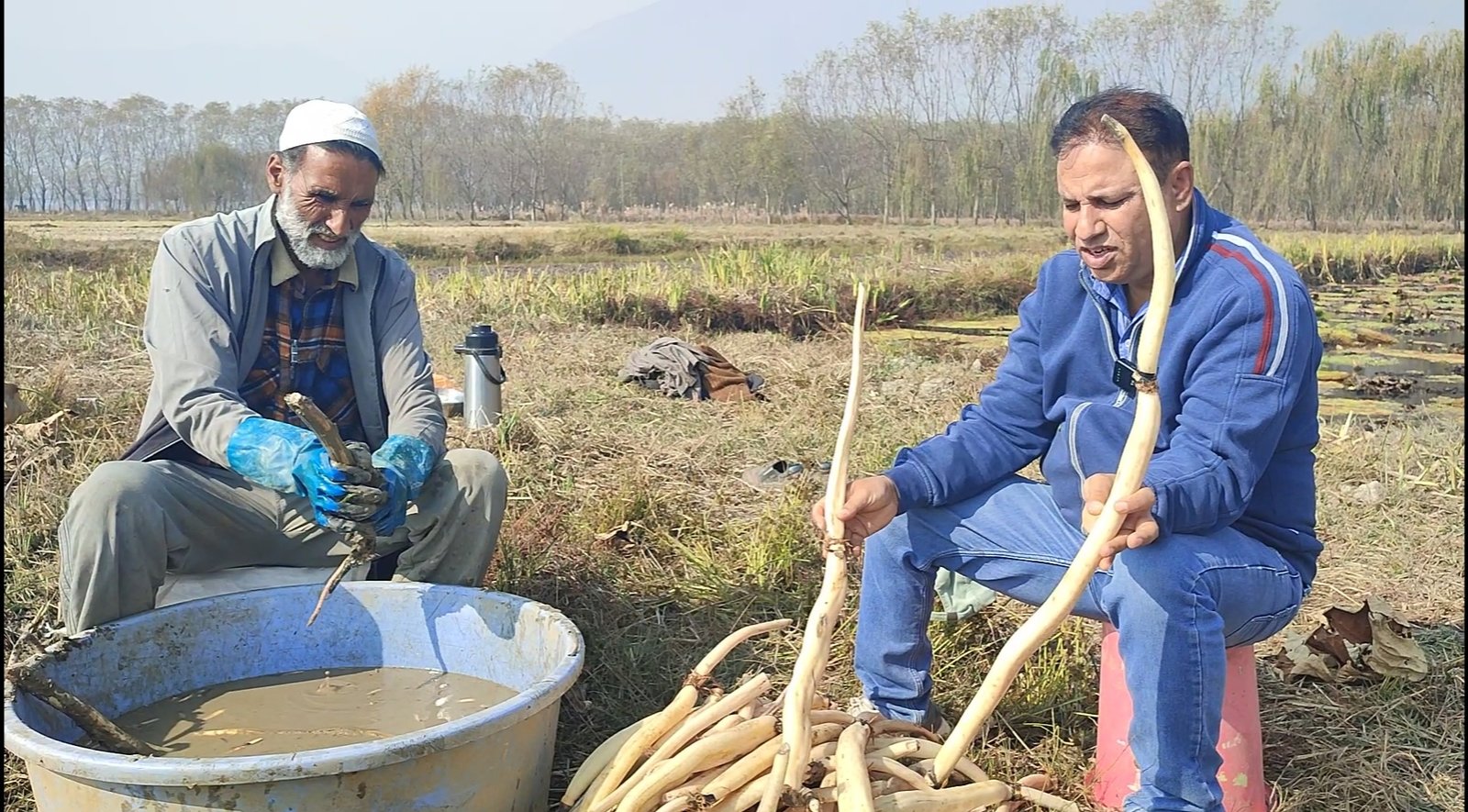
Talking to Kashmir Convener, Head of KVK Bandipora Dr Tariq Sultan said the experimental cultivation had yielded a satisfactory harvest this week, with lotus stems attaining a good size.
“We had good irrigation in the paddy field at KVK and obtained eight to 10 quintals of Nadru per kanal,” Sultan said, adding that the institution would assess the harvest and compare it with production in marshy land.
He said even a yield of five to six quintals per kanal in other paddy fields would make the cultivation economically attractive compared to paddy.
According to Sultan, the lotus stems harvested from the experimental field weighed around half a kilogram each, while those cultivated in marshy land last year averaged 700 to 750 grams.
He said after completing the harvest, the scientists will study the whole process again and make an assessment that would help determine the feasibility of expanding Nadru cultivation in paddy fields and other areas where water availability was relatively limited.
The experiment is expected to open new avenues for farmers in Bandipora, particularly around Wular Lake, where Nadru cultivation has declined in recent years.
Wali Mohammad, a farmer from Patushai village, said the cultivation could benefit farmers if paddy fields produced a good Nadru harvest.
He said the crop could generate better returns than paddy, provided its cultivation proved economically viable.
Last year, KVK Bandipora successfully revived Nadru cultivation in Wular Lake after more than two decades, creating employment opportunities for local residents and encouraging farmers to explore the crop.
The revival, first in over 20 years, was celebrated as a milestone in the conservation of Wular Lake and a significant boost for the local economy especially for the people living along the banks of the asia’s largest fresh water lake.
Tariq Sultan said the initiative was aimed at promoting Nadru cultivation among farmers around Wular Lake, where the traditional crop had virtually disappeared in recent years owing to pollution.


Comments are closed.