Pampore, November 5: Warning that changing weather patterns, prolonged dry spells and inadequate irrigation are threatening Kashmir’s heritage saffron cultivation, SKUAST-K Director Extension Prof. Rihana Habib Kant has called for urgent irrigation interventions and sustainable farming practices to protect the crop and secure farmers’ livelihoods.
Prof. Kant said saffron growers needed at least four to five timely irrigations during the crop cycle, particularly in September, October and November, when adequate soil moisture was essential for corm development, flowering and subsequent leaf growth.
Speaking to Kashmir Convener during an interaction with growers in Galander, Pampore, she said declining rainfall, particularly during August, September and October, had adversely affected saffron cultivation, with prolonged dry spells disrupting the traditional agricultural cycle.
She explained that adequate rainfall before flowering was essential for proper corm development and a healthy harvest. Earlier, farmers received sufficient rainfall during August and September, but changing weather patterns had made irrigation increasingly important.
She said irrigation was equally crucial after harvesting, particularly towards the end of November, when saffron corms develop leaves. Adequate moisture during this stage supports leaf growth and the subsequent development of corms.
“Farmers need at least four to five timely irrigations during the saffron crop’s life cycle. Irrigation during September, October and November is particularly crucial,” she said.
Referring to the government’s earlier borewell scheme, Prof. Kant said it had failed to deliver the desired results, stressing the need for fresh and effective irrigation schemes to support saffron growers.
She suggested sprinkler systems, rain guns and drip irrigation as possible solutions, adding that farmers’ concerns would be conveyed to policymakers and the government for appropriate intervention.
Besides climate-related challenges, she flagged growing porcupine attacks in saffron fields, saying farmers had raised serious concerns about crop damage.
She said measures such as fencing, green protective covers and sound-based deterrent systems had been explored to keep porcupines away. However, since porcupines are protected under wildlife laws, non-lethal preventive measures were necessary.
Prof. Kant said the damage caused by these animals was adding to farmers’ distress and required practical solutions.
Another concern she highlighted was the sale of saffron corms outside Jammu and Kashmir, describing the practice as undesirable given the crop’s heritage value to the region.
She explained that corms transported outside the Union Territory often failed to multiply successfully under the conditions in which they were subsequently cultivated, resulting in the loss of valuable planting material.
She said these concerns had been discussed with growers and would be brought to the attention of policymakers to ensure appropriate measures for safeguarding Kashmir’s saffron heritage.
Protecting a heritage crop
Describing saffron as more than a commercial crop, Prof. Kant said it represented the cultural and agricultural identity of Pampore and Kashmir and needed to be protected through sustainable farming practices.
She said the university was promoting natural and organic farming, balanced fertiliser application and judicious use of chemicals under the Khet Bachao Abhiyaan.
These practices, she said, were also important in the context of the ‘One Health’ concept, which recognises the link between agricultural practices and the health of consumers as well as people directly engaged in farming and horticulture.
She maintained that Kashmir saffron was largely cultivated through natural farming practices without harmful chemicals, retaining its organic character.
Prof. Kant said saffron also had significant medicinal value and considerable future potential, adding that the university wanted production to increase while ensuring better returns for growers.
“We want saffron production in Kashmir to increase, farmers to remain encouraged rather than distressed, and effective measures to be taken to protect and sustain saffron cultivation for future generations,” she said.
Intercropping to boost farm income
Looking beyond conventional cultivation practices, Prof. Kant said SKUAST-K’s Saffron Research Station at Pampore was exploring innovative methods, including high-density saffron cultivation and intercropping, to improve productivity and farmers’ income.
She said research was underway to explore intercropping saffron with crops such as almonds and cumin (zeera), with particular interest in assessing the feasibility of growing saffron and cumin together.
“We want to see if saffron and cumin intercropping proves successful at our Saffron Research Station in Pampore. If the results are encouraging, we will promote this model across the entire saffron-growing belt so that farmers can earn additional income from the same piece of land,” she said.
She said both saffron and cumin were high-value crops and their successful cultivation together could provide farmers with an additional income stream from the same land.
The model could also reduce growers’ financial compulsion to sell saffron corms, allowing them to generate better returns while retaining valuable planting material.
Prof. Kant said the Saffron Research Station, headed by Prof. Amjad M. Hussani, was working on several research initiatives to address growers’ concerns and strengthen saffron cultivation.
Field interaction under Khet Bachao Abhiyaan
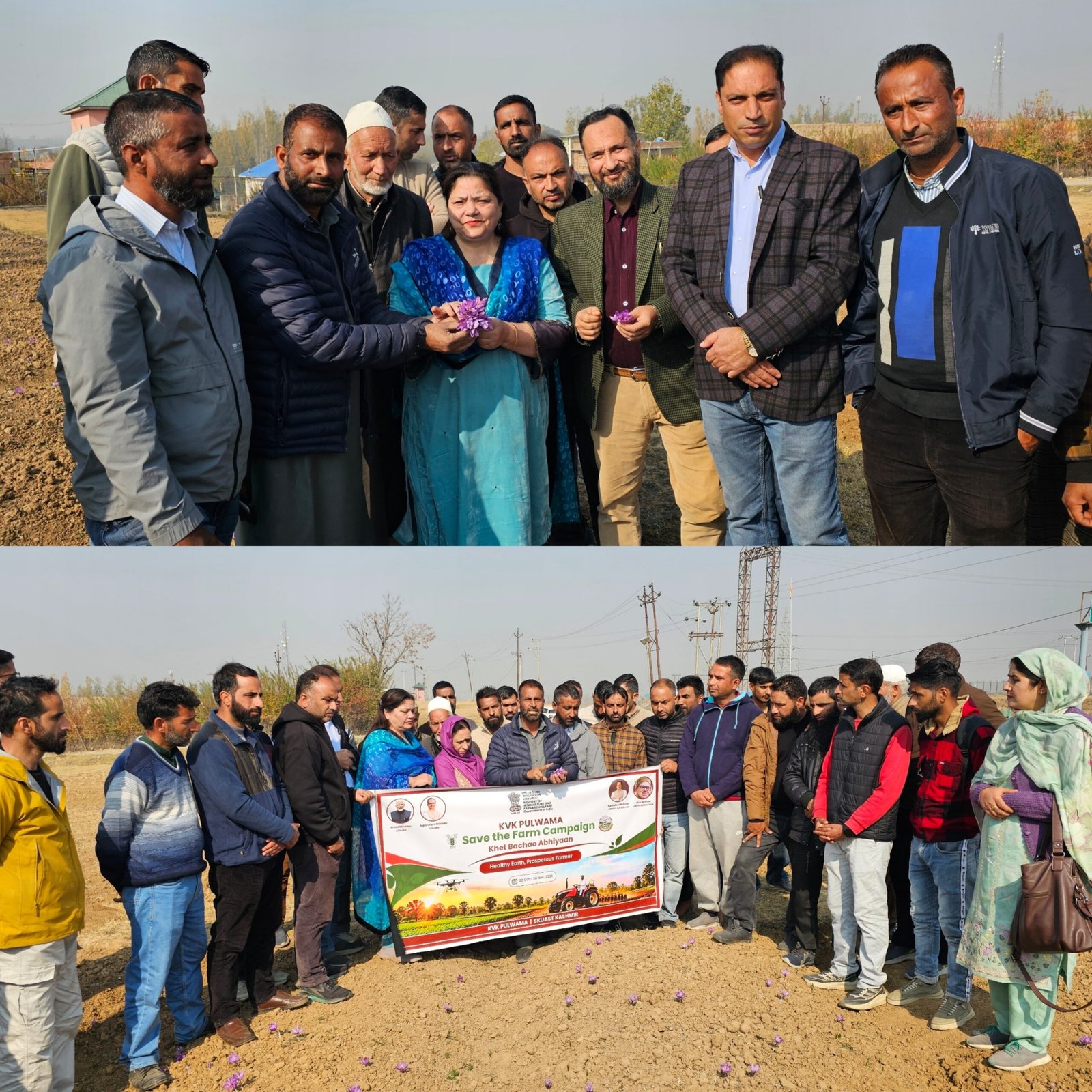
Prof. Kant made these remarks during a one-day awareness-cum-demonstration programme organised by SKUAST-K’s Krishi Vigyan Kendra (KVK) Malangpora in the saffron fields of Pampore under the ongoing Khet Bachao Abhiyaan.
The programme aimed to promote improved scientific cultivation practices, enhance productivity and conserve traditional saffron-growing areas.
Head of Saffron Research Station, Pampore, Prof. Amjad M. Hussani, In-charge Head of KVK Malangpora, Prof. Zaffar Afroz Badri, besides other university officials, scientists and experts, attended the programme.
During the visit, Prof. Kant and the scientists interacted with growers at Galander, took stock of the ongoing harvesting activities and discussed the challenges confronting the farming community.
She said the campaign was significant not only for protecting agricultural land but also for conserving heritage crops such as saffron, which give Pampore and Kashmir their distinct identity.
She added that SKUAST-K would continue working on innovative farming practices and practical solutions to ensure better returns and long-term economic security for saffron growers.


Comments are closed.