Hyderabad, Oct 09: Seeking to shed its image as a summer-only destination, the Jammu and Kashmir Government is pitching the Union Territory as a year-round travel option for tourists from southern India, with the Tourism Department participating as a Partner State at the Travel and Tourism Fair (TTF) Hyderabad 2026.
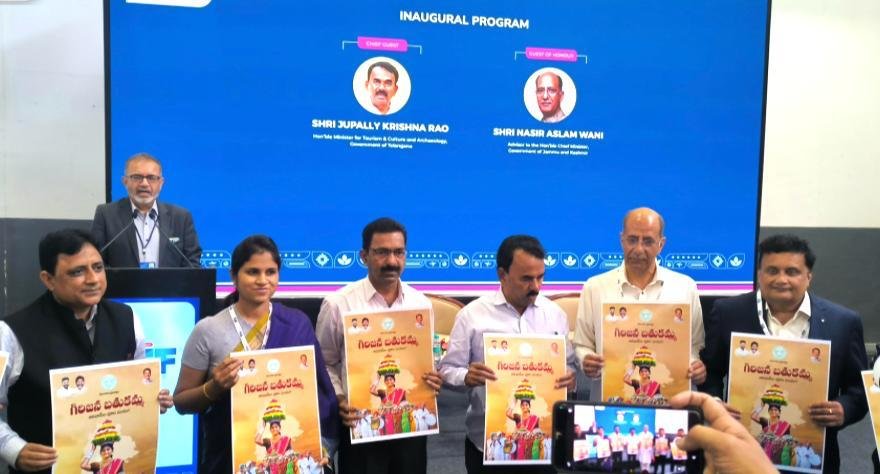
The three-day fair was jointly inaugurated by Telangana Tourism Minister Jupally Krishna Rao and Nasir Aslam Wani, Advisor to the Chief Minister of Jammu and Kashmir, who attended as Guest of Honour, a tourism official told Kashmir Convener.
Through a specially curated pavilion, J&K Tourism is showcasing its landscapes, cultural traditions, spiritual and heritage destinations and lesser-explored locations — an exercise aimed at expanding its footprint in Telangana, Andhra Pradesh and neighbouring markets. A key focus is the Kashmir Marathon, along with customised travel experiences built around the winter and spring seasons. Premium hospitality facilities, holiday packages and emerging destinations are also on display.
The delegation, led by Advisor to CM Nasir Aslam Wani, includes Vikas Gupta, Director of Tourism, Jammu; Vishal Sadothra, Assistant Director of Tourism, Jammu; and Mohammad Sajid Kirmani, Assistant Tourist Officer, Hyderabad. Around 30 representatives from J&K’s travel and tourism associations are holding B2B meetings with travel operators and destination management companies.
The outreach is part of a broader strategy to diversify tourism products, decongest established destinations and position the Union Territory as a year-round attraction, the official said.
Chief Minister Omar Abdullah, who holds the Tourism portfolio, has outlined an approach focusing on pilgrimage, heritage, adventure, eco, rural, cultural, wellness and leisure tourism, alongside infrastructure upgrades.
According to official data accessed by Kashmir Convener, Kashmir’s tourism sector staged a sharp summer rebound in 2026, recording over eight lakh visitors between May and July. The figures signal a strong recovery from the steep decline triggered by the April 2025 Pahalgam terror attack, though the year-on-year surge is partly inflated by the unusually low base recorded last year.
Kashmir received 8,07,008 tourists during May-July 2026, compared with 1,76,751 in the same period in 2025 — a jump of approximately 357 per cent. May alone saw 2,19,449 arrivals, climbing to 3,20,000 in June, with July recording 2,66,363 visitors.
Domestic travellers drove the bulk of this recovery, rising from 1,74,128 to 8,02,871. Foreign tourist arrivals also increased, though from a much smaller base — from 2,623 to 4,137.
Sonamarg emerged as a standout destination, drawing 6,17,269 visitors in the first eight months of 2026. This included 3,73,348 domestic tourists, 8,947 foreign visitors and 2,34,974 local travellers from within Jammu and Kashmir. May and June were the peak months, with 75,085 and 84,223 visitors respectively.
Gulmarg has also seen heavy footfall, with the iconic Gondola cable car remaining the primary draw. Officials reported hotel occupancy crossing 85 per cent during peak periods, with tourists queuing from morning to evening for the ride to Apharwat peak at nearly 14,000 feet. Local pony owners and shopkeepers reported a significant uptick in earnings, with one telling reporters that the Gondola has given us our life back.
Chief Minister Omar has made diversification and outreach central to his recovery strategy. On World Tourism Day in September, he invited travellers from across India and abroad to explore what he described as J&K’s unparalleled range of experiences — from adventure sports and leisure retreats to pilgrimage circuits, destination weddings and unexplored treks.
The Chief Minister’s southern outreach reflects a deliberate effort to tap into South India’s outbound tourism and film industries as growth markets.
He has also emphasised sustainable and community-centred tourism, stating that local communities and youth must remain at the centre of the sector’s growth. His public messaging has consistently stressed responsible eco-tourism alongside infrastructure expansion.


Comments are closed.