

Suhail Khan
Srinagar, Oct 09: Jammu and Kashmir Chief Minister Omar Abdullah on Friday made a renewed pitch for transforming the Union Territory into a hub for Global Capability Centres (GCCs), invoking a two-decade-old exchange between former Chief Minister Mufti Mohammad Sayeed and Infosys founder N R Narayana Murthy to underline how the region’s investment climate has changed.
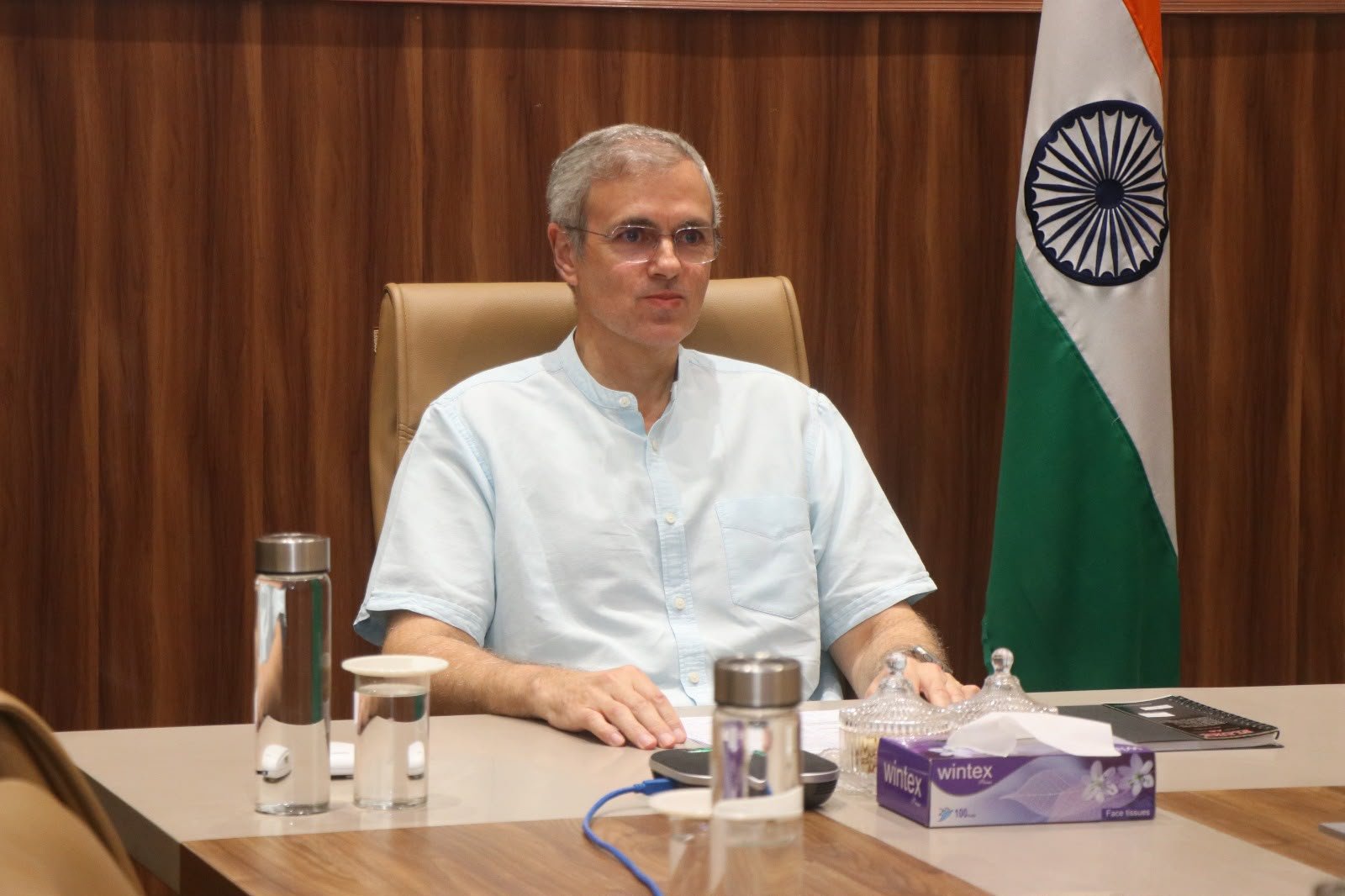
Addressing the J&K Global Capability Centres Summit 2026 virtually, being held at the Indian Institute of Management (IIM) Jammu, CM Omar said the region’s skilled workforce, educational institutions and improving connectivity made it a viable competitor to Tier-II and Tier-III cities for technology-driven investment.
The two-day event, organised by IIM Jammu in partnership with the Jammu and Kashmir Government and NASSCOM, has brought together over 300 industry leaders, policymakers and academics to explore opportunities for developing the region into a hub for technology and knowledge-based industries.
Recalling an investment event organised by NASSCOM in Srinagar during 2002-2005, CM Omar Abdullah said Mufti Sayeed had urged Narayana Murthy to set up an Infosys presence in Jammu and Kashmir. “Narayan Murthy Sahib replied… you give me six days of peace and calm and on the seventh day I’ll come and invest,” Abdullah recounted.
“Thankfully today, we don’t count our periods of calm in days, we don’t count them in weeks, we don’t even count them in months. I think it’s safe to say that we count them in blocks of years,” he said.
The Chief Minister acknowledged that Jammu and Kashmir continued to face a “perception problem” rooted in the past three decades, but asserted that it did not reflect the current reality. He said his government was working to change the narrative through economic development and investment across manufacturing, agriculture, tourism and emerging sectors.
CM Omar Abdullah was candid about the region’s late entry into the GCC sector. “Coming late to the party is disappointing, but it is not always disadvantageous. We can learn from the experiences of others. We don’t have to reinvent the wheel. We just have to use it better,” he said.
He said Jammu and Kashmir was not in a position to compete immediately with established hubs such as Bengaluru, Hyderabad and Chennai, but could position itself alongside emerging destinations like Jaipur, Pune and Mohali. The rising cost of doing business in metropolitan cities, he noted, had created opportunities for alternative destinations.
“We have to make Jammu and Kashmir a place that is competitive, a place that is attractive to do business, a place where you can make money, and a place where we can compete with the Tier 2 and Tier 3 cities around the country,” he said.
Highlighting the region’s human capital, CM Omar Abdullah named IIM Jammu, IIT Jammu, Shri Mata Vaishno Devi University, the University of Jammu, the University of Kashmir and the Islamic University of Science and Technology as institutions producing talented young professionals who were often compelled to seek employment outside the region due to limited local opportunities.
He cautioned against setting unrealistic targets for attracting GCC investment. “We’d be quite happy to have one, first GCC. One will lead to five. Five will lead to ten. And the story will grow from there,” he said, stressing that the immediate priority was to establish a strong foundation for sustainable growth.
The Chief Minister cited the passage of comprehensive Ease of Doing Business legislation during the recent Assembly session, which has received the Lieutenant Governor’s assent, as evidence of the government’s commitment to simplifying procedures for investors. He said implementation on the ground would be critical and the government would review and improve processes as needed.
CM Omar Abdullah also assured prospective investors of single-window facilitation and a policy framework intended to establish a sustainable GCC ecosystem in Jammu and Kashmir.
The comments come against the backdrop of the Chief Minister’s sustained focus on skill development and employment generation beyond government jobs. In September, addressing students at Kashmir Government Polytechnic, he had said, “We cannot give government jobs to everyone. If we have to prepare our children for the future, we have to give them the skills to compete in the job market, whether in Jammu and Kashmir, elsewhere in the country or abroad.
Comments are closed.