


Dr Rizwan Rumi
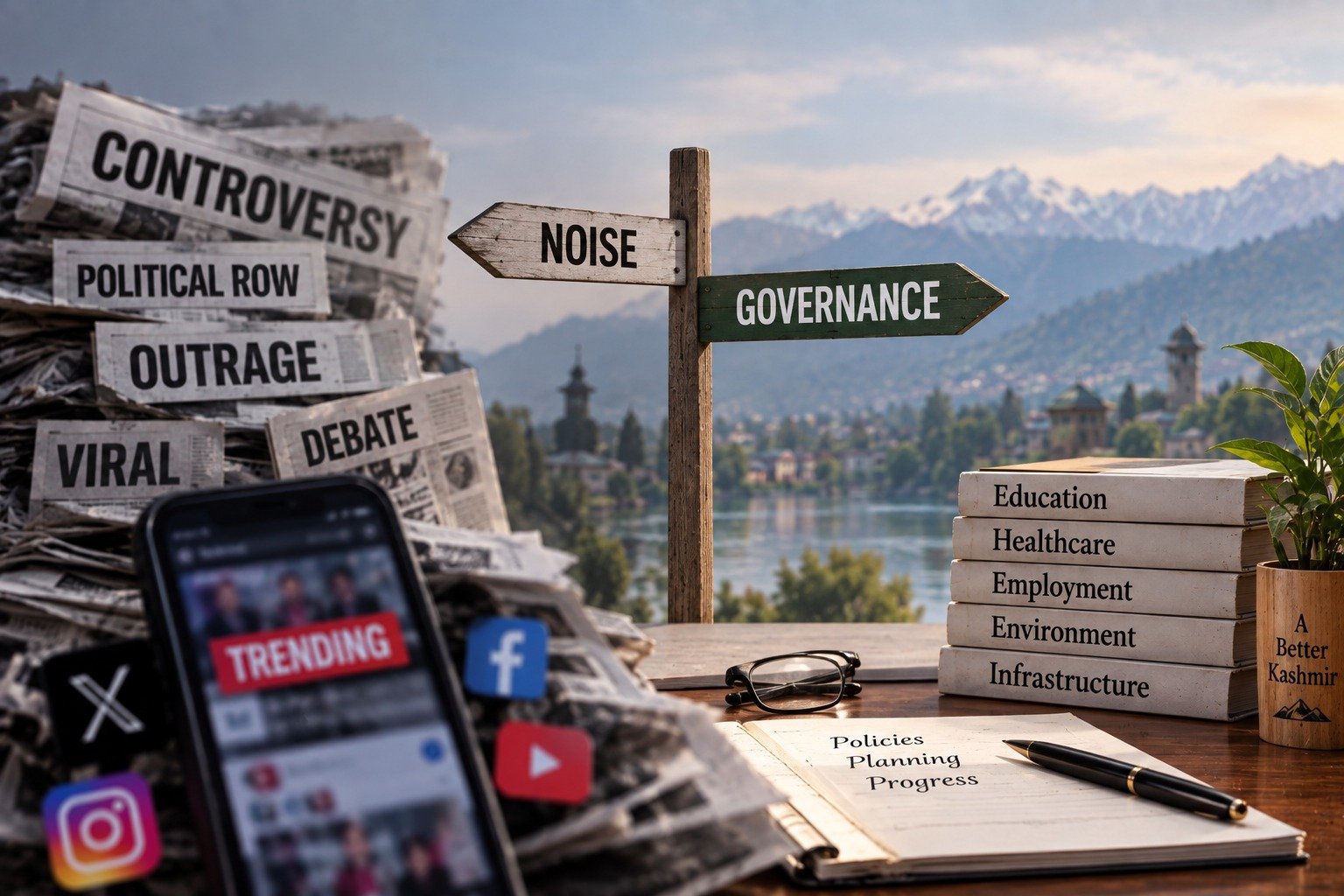
“The politics of noise thrives on immediacy. The politics of accountability thrives on records. One asks us to react; the other asks us to remember.”
Kashmir has never suffered from a shortage of things to debate. What it increasingly suffers from is a shortage of sustained attention to the things that actually matter.
Every few days, a new controversy enters the public sphere. A statement is made, a phrase is interpreted, a video circulates, a political response follows, and soon the entire public conversation moves in one direction. Television panels discuss it. Social media amplifies it. Political spokespersons respond to it. Ordinary citizens take sides. For a few days, the controversy becomes the centre of public attention.
And then, almost as quickly as it arrived, it disappears—only to be replaced by another.
This is the politics of noise.
The problem is not that controversies should never be discussed. Public statements deserve scrutiny, politicians must be held accountable for their words, and citizens have every right to question those in power. The deeper problem begins when controversy becomes a substitute for governance, when outrage occupies the space that should belong to serious public debate.
A society cannot build its future by debating only what is trending today.
The real questions are often quieter.
How many young people are waiting for meaningful employment? How effectively are our schools preparing children for a rapidly changing world? Are public healthcare institutions equipped to meet the needs of ordinary families? What is happening to our rivers, wetlands, forests and agricultural land? Are our towns being planned for people or merely expanded through uncoordinated construction? What happens to students after they complete their degrees? Why do so many educated young people continue to feel uncertain about their future?
These questions rarely generate the same excitement as a political controversy.
That is precisely the problem.
Noise is attractive because it is immediate. Governance is difficult because it is slow.
A controversial statement can become viral within minutes. A policy requires months, sometimes years, to produce visible results. A political argument needs only a microphone and an audience. Fixing a broken public institution requires planning, resources, monitoring and accountability.
The difference is fundamental.
One produces attention.
The other produces outcomes.
In the age of social media, the politics of noise has acquired an even more powerful ally. Algorithms reward emotion. Anger travels faster than explanation. A carefully considered argument may receive a fraction of the attention given to an inflammatory clip lasting thirty seconds.
As a result, public discourse increasingly rewards reaction rather than reflection.
People often respond before they read. They share before they verify. They condemn before they understand the context. Political communication has consequently become less about explaining policies and more about managing perceptions.
This does not mean that citizens are incapable of serious discussion. It means that the environment in which public discussion takes place increasingly encourages superficiality.
There is another dimension to this problem.
Political parties, governments and opposition groups all understand the power of public attention. Whenever attention shifts towards a symbolic controversy, political energy follows it. A debate about language, clothing, identity, slogans or political statements can consume an extraordinary amount of public space.
Meanwhile, the less dramatic business of governance continues in the background.
Budgets are allocated. Projects are announced. Schools function—or fail to function. Hospitals struggle—or improve. Roads deteriorate. Waste accumulates. Water bodies become more polluted. Young people continue searching for opportunities.
But these realities rarely become national or even regional spectacles.
Perhaps because there is no single villain.
There is no easy hashtag for institutional weakness.
There is no dramatic television debate about the importance of maintaining a drainage system.
There is little viral excitement in discussing teacher training, primary healthcare, municipal planning or environmental regulation.
Yet these are precisely the subjects that determine the quality of ordinary life.
The danger of political noise is therefore not simply that it distracts us for a few days. The deeper danger is that it changes our definition of what politics itself means.
Politics should ultimately be about improving people’s lives.
It should be about schools where children learn well, hospitals where patients are treated with dignity, roads that are safe, institutions that are transparent, employment opportunities that allow young people to build independent lives, and public spaces that remain accessible and clean.
Instead, politics can sometimes become a competition over who can dominate the conversation.
And domination of conversation is not the same thing as achievement.
A government should not be judged only by how effectively it responds to criticism. It should also be judged by what it delivers when nobody is shouting.
An opposition should not be judged only by how effectively it exposes government failures. It should also be judged by whether it offers credible alternatives.
The media, too, has a responsibility. Journalism must certainly report controversy, but it must not allow controversy to become the entire news agenda. The media’s role is not merely to tell society what people are talking about. It is also to tell society what it should be talking about.
This distinction has become particularly important in an age when the boundary between news and virality is increasingly blurred. What receives the most clicks is not necessarily what deserves the most attention. A sensational statement may generate millions of views, while a carefully researched report on public education or environmental degradation may receive comparatively little engagement.
If public attention becomes the only measure of importance, society risks confusing popularity with significance.
A functioning democracy requires something more demanding: an informed citizenry capable of looking beyond the immediate.
Citizens should be able to ask not only, “Who said this?” but also, “Why does this matter?” Not only, “Who is responsible?” but also, “What can be done?” Not only, “What is trending?” but also, “What remains unresolved?”
These questions can change the character of public debate.
There is also a danger in allowing political disagreements to become personal. Once politics becomes a matter of identity and loyalty, facts themselves can become secondary. People begin defending statements simply because someone from their preferred political camp made them, while rejecting the same argument if it comes from an opponent.
That is not healthy democratic engagement.
A mature political culture should allow citizens to acknowledge a valid point even when it comes from someone they disagree with. It should also allow them to criticise their own political representatives when necessary.
Democracy becomes weaker when every political discussion is reduced to “us versus them.”
Kashmir, like every society, deserves better than that.
We cannot build a healthy public culture if every disagreement becomes an opportunity for insult, outrage and political mobilisation. Nor can we expect meaningful governance when public pressure is strongest on symbolic issues and weakest on institutional performance.
Perhaps we need to change the questions we repeatedly ask our political representatives.
Instead of asking only which leader made the most controversial statement, we should ask what measurable progress has been made in education.
Instead of discussing political rhetoric endlessly, we should examine employment opportunities and the quality of skills being created.
Instead of allowing environmental issues to become seasonal debates, we should ask whether our rivers, wetlands, forests and tourist destinations are being protected through consistent enforcement.
Instead of celebrating announcements, we should ask what happened after the announcement.
How much was promised?
How much was delivered?
What remains incomplete?
Who is responsible?
And when can citizens expect results?
These are not exciting questions.
They are important questions.
The difference matters.
The politics of noise thrives on immediacy. The politics of accountability thrives on records.
One asks us to react.
The other asks us to remember.
And perhaps remembering is one of the most important forms of democratic responsibility.
Governments change. Political alliances change. Public controversies disappear. But records remain. Policies have consequences. Decisions affect communities long after the headlines have moved elsewhere.
This is why public memory must extend beyond the news cycle.
A society that forgets yesterday’s promises will repeatedly hear tomorrow’s promises without asking what happened to the old ones.
The media, therefore, has a particularly important role in preserving that memory. Journalism should not merely chase the next controversy; it should return to old announcements, examine unfinished projects, question delayed commitments and track whether public promises have translated into public outcomes.
That kind of journalism may be less glamorous, but it is arguably more valuable.
The same applies to citizens.
We cannot blame politicians for exploiting public attention while eagerly rewarding every provocation with thousands of shares, comments and reactions.
Every time we amplify an unnecessary controversy, we participate in deciding what occupies public space.
Every time we ignore a serious issue because it is less entertaining, we also contribute to the shrinking of serious public debate.
Perhaps it is time to ask a simple question before reacting to the next viral political statement:
Will this matter to us six months from now?
If the answer is no, perhaps we should spend at least some of our collective energy on questions whose answers might actually change lives.
This does not mean becoming indifferent to politics. On the contrary, it means becoming more serious about politics.
We need a politics that can discuss disagreement without turning every disagreement into a crisis.
We need a public culture in which politicians can be criticised without personal hatred, governments can be questioned without political tribalism, and citizens can disagree without treating one another as enemies.
Most importantly, we need to restore the distinction between public interest and public spectacle.
Kashmir has enough unresolved challenges to keep serious policymakers occupied for years. Our young people deserve more than political theatre. Our children deserve better educational opportunities. Our elderly deserve accessible healthcare. Our environment deserves protection beyond slogans. Our towns deserve thoughtful planning. Our farmers deserve policies that recognise the risks they face. Our small businesses and young entrepreneurs need an environment in which effort can translate into opportunity. And ordinary citizens deserve institutions that work without requiring them to make noise first.
The measure of governance should therefore not be how many controversies a government survives.
It should be how many problems it quietly solves.
A road repaired properly does not need a political slogan.
A school that genuinely improves learning does not need a television debate.
A hospital that treats patients with dignity does not need a viral campaign.
A clean river does not require a political speech.
Good governance often works quietly.
Perhaps that is why it is so easily overshadowed by noise.
But citizens should not allow visibility to become the measure of value. Some of the most important work in public life happens without cameras, hashtags or applause.
The challenge before Kashmir is therefore not simply to reduce political controversy. Disagreement is natural, and political debate is necessary. The challenge is to ensure that controversy remains a part of democratic discussion rather than becoming its entire substance.
We need to recover the ability to hold two thoughts at once: to care about what a politician says and still ask what that politician is doing; to discuss identity and culture while also discussing employment and education; to debate political statements while refusing to lose sight of healthcare, environment and public services.
A mature society does not have to choose between political awareness and substantive governance.
It needs both.
Perhaps the greatest political maturity is not the ability to win every argument, but the ability to recognise which arguments are worth having.
Because ultimately, noise fades.
A viral controversy disappears. A political statement is forgotten. Today’s outrage becomes tomorrow’s old news.
But a good school remains.
A functioning hospital remains.
A clean river remains.
A meaningful job remains.
And a young person given a genuine opportunity remembers it for a lifetime.
The real test of public life, therefore, is not how loudly we can argue, how quickly we can react or how effectively we can manufacture attention.
It is whether, beneath all the noise, we are actually making society better.
“The future of Kashmir cannot be built on the politics of noise. It must be built on the politics of work, accountability and results.”
Comments are closed.