

The Grain We Grow Must Have a Place to Go

S Ahmad


India’s agricultural story is often told through the numbers of production. A record harvest is celebrated as a sign of progress, food security and the strength of the country’s farmers. But there is another question that deserves equal attention: after the grain is produced, where does it go?

That question may appear simple, but it lies at the heart of India’s agricultural economy.

According to the Third Advance Estimates for 2025-26, India’s foodgrain production is estimated at 376.563 million tonnes, an increase of nearly 18.8 million tonnes, or 5.3 per cent, over the previous year’s estimated production of 357.732 million tonnes. Such an increase is a remarkable achievement. It reflects the continuing contribution of millions of farmers, improvements in agricultural practices, irrigation, technology and public investment.

But higher production creates a corresponding responsibility.

Every additional tonne of grain needs to be cleaned, dried, transported, stored, protected and eventually marketed or distributed. If storage capacity does not grow alongside production, the benefits of higher agricultural output can be weakened by post-harvest losses, distress sales, transportation costs and inefficient supply chains.

This is why India’s emerging effort to build a decentralised grain storage network through cooperatives deserves much greater attention.

The issue is not merely about constructing more warehouses.

It is about changing where agricultural infrastructure exists, who controls it and how closely it is connected to the farmer.

For decades, India’s foodgrain storage architecture has relied heavily on large, centralised facilities operated by the Food Corporation of India and state agencies. These institutions remain indispensable to the country’s food security system. But a vast agricultural country cannot depend only on storage facilities located far from where crops are produced.

Grain should not have to travel long distances simply to find a place where it can safely wait for the right market.

That is the logic behind decentralisation.

For a farmer, harvest is not necessarily the end of the agricultural cycle. It is often the moment when a new economic pressure begins.

A farmer who has harvested wheat, rice, maize, pulses, oilseeds or another crop must quickly decide what to do with the produce. If adequate storage is unavailable, selling immediately may become the only practical option.

And immediate sale does not always mean a good sale. When large quantities of produce arrive in markets simultaneously, prices can weaken. A farmer without storage has little bargaining power because the crop must be sold before it deteriorates.

This is where storage becomes more than an infrastructure issue.

Storage is an economic instrument.

A warehouse gives a farmer time. Time to wait for a better price. Time to negotiate. Time to avoid selling immediately after harvest. Time to access credit against stored produce. Time to decide whether to sell locally or enter a larger market.

Without storage, the farmer often sells according to necessity. With storage, the farmer has at least some possibility of selling according to strategy.

That difference can have a direct impact on farm income.

India has developed substantial centralised storage capacity, but the country’s agricultural geography demands a more distributed approach.

Production is spread across thousands of villages, districts and agro-climatic regions. Moving grain from a farm to a distant warehouse, and later transporting it back towards consumption centres or fair price shops, adds costs at every stage.

Fuel, handling, loading, unloading and transportation all have economic and environmental consequences.

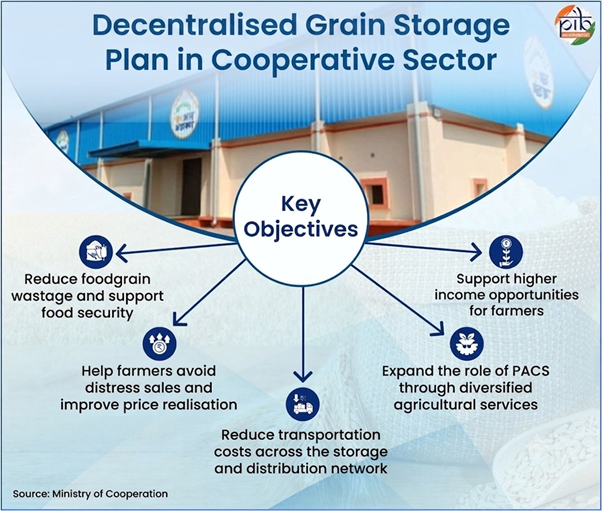
A decentralised storage facility located closer to the production centre can shorten this chain.

That is the basic promise of the Decentralised Grain Storage Plan in the Cooperative Sector, launched as a pilot on May 31, 2023.

The initiative is particularly significant because it places Primary Agricultural Credit Societies, or PACS, at the centre of the model.

PACS already occupy a unique position in rural India. They operate close to farmers and have traditionally been associated with short-term agricultural credit. The new model seeks to broaden their role so that they become much more than lending institutions.

The PACS of the future can potentially become a village-level agricultural service centre where farmers can access storage, machinery, processing, procurement and other services under one roof.

That is a much larger idea than building a godown.

Why PACS Matter

The success of any rural infrastructure programme depends partly on whether farmers can actually access it.

A sophisticated warehouse located far away may be technically efficient, but it may not be economically convenient for a small farmer.

PACS, by contrast, already have a local institutional presence.

If properly strengthened, they can bring infrastructure closer to the farmer.

Under the decentralised storage model, PACS can establish grain storage facilities along with procurement centres, primary processing units, Fair Price Shops and Custom Hiring Centres.

Instead of arranging immediate transportation to a distant warehouse, the produce could be taken to a nearby cooperative facility. It could be cleaned, sorted and dried. It could then be stored securely. If the farmer needs liquidity, the stored produce could potentially support access to credit. Machinery required for the next agricultural operation could be hired from the same cooperative.

The farmer would therefore be interacting with an agricultural ecosystem rather than a collection of disconnected services.

That is precisely the kind of rural infrastructure India needs.

The importance of decentralised storage extends beyond individual farmers.

India operates one of the world’s largest food security programmes under the National Food Security Act, 2013, covering around 80 crore people.

Ensuring that food reaches such a large population requires a reliable supply chain.

Food security does not begin at the ration shop.

It begins much earlier—with production, procurement, storage and transportation.

When grain is stored closer to production centres, it can reduce unnecessary movement and potentially reduce losses associated with repeated handling and transportation. Local storage can also strengthen the ability of procurement and distribution systems to respond to regional requirements.

This does not mean centralised storage will become unnecessary.

Large storage infrastructure is essential for national reserves and large-scale food management. Decentralised storage can complement it by bringing capacity closer to farms and local markets.

The future of Indian food security should therefore be seen as a network rather than a single warehouse system.

One of the most interesting features of the decentralised storage initiative is that it does not attempt to create an entirely new financial architecture.

Instead, it seeks to bring together existing government schemes.


India’s expanding agricultural production and food security efforts have increased the importance of decentralised grain storage infrastructure across the country. The Decentralised Grain Storage Plan in Cooperative Sector, launched in 2023, is designed to improve storage, processing, procurement, and distribution systems through Primary Agricultural Credit Societies (PACS). The Plan adopts an integrated, cooperative-led approach by converging existing government schemes. It is supported through institutional coordination and financial support mechanisms. Beginning with pilot projects across 11 states/PACS with 9,750 MT of storage capacity, the initiative has expanded steadily. As of July 2026, godown construction had been completed in 313 PACS across the country, creating more than 1.80 LMT of storage capacity. The framework also emphasises quality standards, transparency and operational viability.


The Agriculture Infrastructure Fund supports post-harvest infrastructure through financing and interest subvention. The Agricultural Marketing Infrastructure scheme provides capital subsidy support for eligible storage facilities. The Sub-Mission on Agricultural Mechanization supports Custom Hiring Centres and access to machinery. The Pradhan Mantri Formalisation of Micro Food Processing Enterprises scheme supports the development and formalisation of micro food-processing enterprises.

The significance of this convergence is easy to overlook.

Government schemes often operate in separate administrative compartments. Farmers, however, do not experience agriculture in compartments.

A farmer needs credit, machinery, storage, processing, transportation and market access as part of one economic activity.

If public programmes can be integrated around that reality, their combined impact can be substantially greater.

A PACS with a warehouse, machinery rental facility, processing unit and procurement centre is therefore potentially much more valuable than a PACS performing only one function.

Perhaps one of the most important aspects of the model is the connection between storage and credit.

Farmers often sell immediately because they need cash.

If stored produce can support access to institutional finance, the economic equation begins to change.

The example of Nerpingalai PACS in Amravati, Maharashtra, is particularly instructive.

The cooperative has constructed a 3,000-metric-tonne warehouse under the decentralised storage initiative with support from the AMI and AIF schemes. Around 300 farmers are storing nearly 32,000 bags of soybeans there.

More importantly, the cooperative has provided advances of around ₹4.50 crore against stored produce.

This is where storage becomes transformative.

The warehouse is no longer simply a place where grain is kept.

It becomes a mechanism through which farmers can obtain liquidity without immediately selling their crop.

The PACS itself also gains an additional economic foundation through rental and interest income.

The example reportedly indicates annual rental income of around ₹7.68 lakh and interest income of nearly ₹54 lakh.

Such models can strengthen the cooperative institution while simultaneously helping farmers. That is the kind of alignment public policy should seek.

The Economics Must Work

Good intentions do not automatically produce sustainable infrastructure.

A warehouse must remain financially viable after the ribbon-cutting ceremony.

This is why the government’s effort to improve project economics is important.

The subsidy under the AMI scheme has been enhanced from 25 per cent to 33.33 per cent. The margin money requirement has been reduced from 20 per cent to 10 per cent, while cost norms for godown construction have also been revised.

From Pilot to Scale

The journey from policy announcement to physical infrastructure is often where government initiatives face their greatest test.

The decentralised storage plan has now moved beyond the pilot phase.

During the pilot, godown construction was completed in 11 PACS across 11 states, creating 9,750 metric tonnes of storage capacity.

The states included Maharashtra, Uttar Pradesh, Gujarat, Rajasthan, Madhya Pradesh, Uttarakhand, Tamil Nadu, Telangana, Assam, Karnataka and Tripura.

By July 2026, 1,012 PACS or cooperative societies had been identified under the plan, while godown construction had been completed in 313 PACS, creating more than 1.80 lakh tonnes of storage capacity.

These numbers matter because they indicate that the initiative is beginning to move from demonstration to implementation.

But scale must not come at the expense of quality.

The country does not need thousands of poorly maintained warehouses.

It needs a network of reliable, scientifically designed and professionally managed storage facilities.

Quality Cannot Be Compromised

Grain storage is not simply about putting bags inside a building.

Moisture, temperature, ventilation, pests, structural integrity and handling practices all affect grain quality.

A warehouse that fails to protect its contents is not infrastructure; it is a liability.

The decentralised model therefore provides for compliance with Warehousing Development and Regulatory Authority standards, appropriate design for local environmental conditions, durable construction materials and adequate ventilation.

Regular inspections and quality audits are equally important.

There is also a need for transparency in construction and expenditure. The involvement of Project Management Consultants and monitoring by cooperative institutions can help create accountability.

But ultimately, the strongest safeguard will be local ownership.

When PACS members understand that the warehouse belongs to their cooperative and contributes to its financial health, they have a direct stake in ensuring that it is maintained properly.

The Cooperative Can Become the Rural Service Hub

The deeper significance of this initiative may lie not in storage itself but in what storage can enable.

A PACS equipped with a warehouse can potentially become a platform for a wider range of agricultural services.

A Custom Hiring Centre can give small farmers access to machinery without requiring them to purchase expensive equipment.

A primary processing unit can clean, sort and dry produce before it reaches the market.

A procurement centre can connect farmers to institutional procurement systems.

A Fair Price Shop can support local distribution.

Storage can provide farmers with greater control over the timing of sale.

Together, these functions can strengthen the local agricultural value chain.

This is particularly important for small and marginal farmers who cannot individually invest in warehouses, processing machinery or expensive farm equipment.

Cooperation can allow them to access infrastructure collectively.

That is the economic principle at the heart of the cooperative movement.

What About Jammu and Kashmir?

For Jammu and Kashmir, the decentralised storage concept has particular relevance.

The region has a geographically diverse agricultural economy. Farmers operate in plains, foothills, mountain valleys and remote areas where transportation can itself become a major challenge.

In such a landscape, distance matters.

A farmer in a remote area may not have the same access to markets as a farmer located close to a major mandi. Seasonal road disruptions, transportation costs and limited local processing facilities can further reduce bargaining power.

Decentralised storage, if carefully adapted to local conditions, could therefore help create stronger agricultural nodes closer to production centres.

But implementation in Jammu and Kashmir should not simply copy a model designed elsewhere.

Local crop patterns, climatic conditions, road connectivity, land availability and market demand must determine where facilities are created and what capacities they require.

A one-size-fits-all approach would defeat the purpose of decentralisation.

The objective should be local infrastructure for local agricultural realities.

Storage Can Help Change the Farmer’s Relationship With the Market

The most powerful agricultural reforms are those that change bargaining power.

A farmer who must sell immediately has limited leverage.

A farmer who can store has more choices.

A farmer who can process has greater value addition.

A farmer who can access institutional credit has greater liquidity.

A farmer who can collectively market produce through a cooperative may have greater negotiating strength.

This is why storage should not be treated as an isolated infrastructure project.

It should be viewed as one component of a larger effort to improve the farmer’s position within the agricultural value chain.

India has made enormous progress in increasing production.

The next challenge is to ensure that farmers capture a larger share of the value created after production.

The Real Test Will Be at the Village Level

National targets and investment figures are important, but the ultimate test of the decentralised storage programme will be local.

Can a farmer actually reach the warehouse easily?

Can produce be stored safely?

Is the rental charge affordable?

Can the farmer obtain credit against stored produce without excessive paperwork?

Is the quality of grain maintained?

Does the cooperative disclose its accounts?

Are farmers treated fairly?

Does the facility generate enough income to maintain itself?

Are women farmers and smallholders able to access it?

These are the questions that will determine whether the programme becomes a genuine agricultural reform or remains another infrastructure initiative.

The government can provide financial support and institutional architecture.

But cooperative members must ultimately make the system work.

That requires training, professional management and transparency.

From Food Security to Farmer Security

India’s food security story has historically focused on ensuring that citizens have access to sufficient food.

That remains essential. But the next stage of agricultural policy must also focus on farmer security.

A country cannot have lasting food security if the people who produce its food remain economically vulnerable.

Storage can contribute to that larger objective. It can reduce post-harvest losses. It can reduce unnecessary transportation. It can give farmers more flexibility in deciding when to sell. It can support access to credit. It can strengthen cooperatives. It can create rural employment. It can encourage local processing and value addition.

In other words, a warehouse can become an economic institution.

That is the larger opportunity before India.

The Grain Economy of Tomorrow Must Be More Local, Connected and Cooperative

India’s agricultural economy is growing. Production is increasing. Food security requirements remain enormous. Markets are becoming more complex. Climate variability is creating new uncertainties. Farmers need better infrastructure and stronger bargaining power.

Against this backdrop, decentralised grain storage is not a minor administrative reform.

It represents a different way of thinking about agricultural infrastructure.

Instead of asking only how much grain India can produce, we must ask whether the country has the infrastructure to retain its value after harvest.

Instead of building only large warehouses at distant locations, we must create a network that reaches the villages where agriculture actually happens.

Instead of viewing PACS merely as rural credit societies, we can develop them into integrated agricultural service centres.

Instead of treating storage as a passive facility, we can make it part of a system involving procurement, processing, credit, machinery and markets.

The figures already show considerable progress. More than a thousand PACS have been identified, hundreds of godowns have been completed and storage capacity is expanding.

The challenge now is to deepen and improve that expansion.

The ultimate measure of success will not be the number of warehouses constructed.

It will be the number of farmers who are able to avoid distress sales, the reduction in post-harvest losses, the efficiency gained in foodgrain transportation, the strength of rural cooperatives and the additional income generated within villages.

India has spent decades learning how to grow more food.

The next chapter must teach us how to store it better, preserve its value and ensure that those who grow it benefit more from it.

The grain we grow should not become a burden the moment it leaves the field.

It should become an asset.

And for millions of Indian farmers, a well-managed village-level warehouse may be the simple piece of infrastructure that gives them something agriculture has too often denied them: the freedom to wait, the power to choose and the opportunity to earn better from what they have worked so hard to produce.


The article is based on the inputs and background information provided by the Press Information Bureau (PIB). Author is Writer, Policy Commentator. He can be mailed at kcprmijk@gmail.com

Comments are closed.