

S Ahmad
India’s farms have sustained agricultural growth, but long-term productivity depends on healthy soils and resilient ecosystems. Regenerative agriculture offers a pathway to restore soil vitality, improve biodiversity, and strengthen resilience against climate stresses. Across the country, farmers are adopting practices such as natural farming, agroforestry, micro-irrigation, integrated farming systems, and scientific soil management. Government support has accelerated this transition. As of March 2026, natural farming clusters covered 8.80 lakh hectares and enrolled 18.19 lakh farmers. About 109 lakh hectares have been brought under Per Drop More Crop as of May 2026. In addition, 25.89 crore Soil Health Cards have been generated since inception, as of March 2026. These efforts are helping build a more productive, resource-efficient, and environmentally responsible future for Indian agriculture.
India’s agricultural story is one of remarkable resilience. Despite the pressures of climate variability, fragmented landholdings, rising input costs, water stress and changing market conditions, the agriculture and allied sectors have continued to expand. During FY16-FY25, the sector recorded a decadal growth of 4.45 per cent, the highest among previous decades. Behind this performance are millions of farmers who return to their fields every season, adapting to uncertainty while carrying the responsibility of feeding a growing population.
But growth alone cannot be the measure of agricultural success.
The more important question is whether India can sustain this growth without weakening the natural systems on which farming ultimately depends. A productive farm is not merely a piece of land that produces a crop. It is a living ecosystem of soil, water, microorganisms, plants, insects, livestock and human effort. When any of these foundations are progressively degraded, productivity may eventually become more expensive, more uncertain and more vulnerable to climate shocks.
This is why the conversation around the future of Indian agriculture must increasingly move from productivity alone to regeneration.
Across the country, farmers are confronting a difficult reality. The same field is cultivated year after year, often under increasingly intensive production systems. In many areas, prolonged dependence on chemical inputs, declining organic matter, soil degradation, groundwater stress and inadequate crop diversification have placed pressure on the ecological health of farmland. At the same time, erratic rainfall, prolonged dry spells, heatwaves, floods and other extreme weather events are making agricultural outcomes less predictable.
For a large smallholder farmer, this is not an abstract environmental concern. If soil loses its ability to retain moisture, the farmer needs more irrigation. If nutrient efficiency declines, more fertiliser may be required. If biodiversity diminishes, pest pressures can increase. If weather becomes unpredictable, a single crop can expose an entire household to significant economic risk.
The challenge, therefore, is not simply to produce more from agriculture. It is to restore the capacity of agricultural ecosystems to produce sustainably.
That is the promise of regenerative agriculture.
From Sustaining the Soil to Restoring It
Regenerative agriculture is a holistic approach centred on restoring soil health, improving biodiversity and strengthening the resilience of farming systems. It shares several principles with sustainable agriculture but goes a step further. While sustainability generally seeks to maintain resources and minimise damage, regeneration seeks to actively improve the condition of the natural systems on which production depends.
Its basic principles are straightforward: minimise unnecessary soil disturbance, maintain soil cover, keep living roots in the ground, integrate livestock where appropriate, reduce dependence on chemical inputs and increase biodiversity.
These principles recognise a fundamental truth that modern agriculture can sometimes overlook: soil is not an inert medium into which seeds and fertilisers are placed. It is a living system.
Healthy soil contains organic matter, microorganisms, nutrients, air and water. It supports root development, improves moisture retention and contributes to nutrient cycling. When soil health improves, the farm becomes better equipped to withstand stress. When it deteriorates, farmers can become increasingly dependent on external inputs to maintain productivity.
Regenerative agriculture seeks to reverse this cycle.
Practices such as cover cropping, mulching, green manuring, crop rotation, intercropping, agroforestry, integrated farming, natural farming and efficient irrigation are not isolated interventions. Properly combined, they can create farming systems in which resources are used more efficiently and ecological functions are strengthened.
This is particularly important for India, where agricultural conditions vary dramatically across regions. A regenerative model cannot mean one rigid package of practices imposed uniformly on every farm. The needs of a rainfed farmer in a dryland region are different from those of a rice grower in a water-abundant area. A horticulture farmer in the Himalayan region faces different challenges from a cotton farmer in central India.
Regeneration must therefore be location-specific, knowledge-intensive and farmer-centric.
Water: The First Test of Agricultural Resilience
No discussion on regenerative agriculture can ignore water.
India’s agricultural future is closely tied to its ability to produce more with less water. Climate change is intensifying this challenge by altering rainfall patterns and increasing the frequency of both drought-like conditions and excessive rainfall.
Micro-irrigation offers one practical response. Drip, sprinkler and related systems deliver water more precisely, reducing wastage and improving water-use efficiency. Drip irrigation can supply water directly to plant roots, while sprinkler systems enable more uniform distribution across fields.
The importance of such technologies goes beyond saving water. Efficient irrigation can reduce energy consumption, lower cultivation costs and protect farmers from the economic consequences of water stress.
The Per Drop More Crop (PDMC) initiative represents an important policy intervention in this direction. Implemented since 2015-16, the programme provides financial assistance for micro-irrigation, with 55 per cent support for small and marginal farmers and 45 per cent for other farmers. By May 2026, around 109 lakh hectares had been covered, with ₹26,325 crore in central assistance released.
But infrastructure alone will not solve the water challenge. Water efficiency must become part of a larger farm-management philosophy that includes soil-moisture conservation, crop planning, appropriate land preparation and water-conscious cropping patterns.
A healthy soil itself is a water-management asset. Soils rich in organic matter can retain more moisture, reduce runoff and help crops withstand short periods of rainfall deficiency.
This is where water policy and soil policy meet.
Rebuilding Soil Health
India’s experience with intensive agriculture demonstrated the extraordinary potential of science, irrigation, improved seeds and fertilisers to raise food production. But the next agricultural transition must be more nuanced. It must combine productivity with resource efficiency.
Nitrogen management is a good example.
Using the right fertiliser, in the right quantity, at the right time and in the right manner can improve nutrient-use efficiency while reducing losses. Techniques such as deep placement of fertiliser, leaf-colour-based nitrogen assessment, legume intercropping and biological inputs can help farmers make more precise decisions.
The Soil Health Card Scheme, launched in 2015, is an important instrument in this process. It provides plot-wise information on soil conditions and recommendations relating to fertilisers, bio-fertilisers, organic inputs and soil treatments. As of March 13, 2026, 25.89 crore Soil Health Cards had been generated since inception.
The larger significance of the scheme is that it changes the way farmers think about fertiliser use. Instead of treating every field in the same way, soil testing encourages decisions based on actual nutrient conditions.
That is the essence of regenerative farming: replace blanket input use with informed resource management.
Soil restoration also requires increasing organic matter. Green manuring, cover cropping and mulching are among the simplest tools available.
Green manure crops can add organic matter and nutrients to the soil. Cover crops protect exposed soil from erosion and support nutrient cycling. Mulching with crop residues or other organic material can conserve moisture, moderate soil temperatures, suppress weeds and encourage microbial activity.
These practices may appear modest individually. Their cumulative impact, however, can be substantial.
Natural Farming and the Return of Ecological Intelligence
Regenerative agriculture also creates space for traditional knowledge.
Natural farming, rooted in India’s traditional agricultural practices, relies on locally prepared biological inputs such as Beejamrut, Jeevamrut, GhanJeevamrut, Neemastra and Dashparni. It encourages practices including mulching, multi-cropping, continuous soil cover, minimal soil disturbance, traditional seed use and integration of livestock.
The objective is not to romanticise the past or reject modern agricultural science. Rather, the opportunity lies in combining traditional ecological knowledge with contemporary research, testing and extension systems.
The National Mission on Natural Farming, launched in 2024, seeks to create a support ecosystem for farmers transitioning towards natural farming. It provides an output-based incentive of ₹4,000 per acre per year for two years, covering up to one acre per farmer, and envisages 10,000 need-based Bio-input Resource Centres.
As of March 5, 2026, 18,786 natural farming clusters had been formed, covering 8.80 lakh hectares, with 18.19 lakh farmers enrolled. More than 33,000 Community Resource Persons had also been trained.
These numbers indicate that natural farming is no longer a marginal conversation. Yet its long-term success will depend on rigorous local evidence, reliable farmer guidance, market access and careful monitoring of productivity and farm incomes.
Farmers should not be asked to carry the risk of transition alone.
Diversification Is a Form of Insurance
One of the most important lessons of regenerative agriculture is that diversity creates resilience.
A farm dependent on a single crop is vulnerable to a single point of failure. A pest outbreak, extreme weather event, price crash or crop disease can have devastating consequences.
Integrated Farming Systems offer a different model. Crops can be combined with livestock, fisheries, horticulture, agroforestry and apiculture. Intercropping, crop rotation, mixed farming and multi-cropping can improve resource use while creating multiple sources of income.
The Rainfed Area Development Programme (RAD) promotes such integrated systems through an area-based cluster approach. Clusters of around 20 hectares are developed across adjoining villages, encouraging farmers to combine crops with activities such as livestock, horticulture, fisheries and apiculture.
Since inception, the programme has provided ₹2,251.98 crore in central assistance, covering 9.53 lakh hectares and benefiting 15.73 lakh farmers as of December 2025.
Such models are particularly relevant in rainfed India, where farming is naturally exposed to climatic uncertainty. Diversification can function as an economic insurance mechanism. If one activity performs poorly, another may provide income or food security.
The role of institutions such as Krishi Vigyan Kendras is equally important. During 2024-25, KVKs conducted thousands of demonstrations and trained farmers on integrated farming models.
The transition to regeneration will succeed only when farmers can see, test and adapt practices in conditions similar to their own.
Trees Belong in the Agricultural Landscape
Agroforestry provides another powerful bridge between agriculture and ecological restoration.
Integrating trees with crops, fruit systems and other perennial components can diversify farm income while improving soil moisture, regulating local temperatures, supporting biodiversity and storing carbon. In rainfed and degraded areas, trees can also contribute to land restoration and reduce the vulnerability of farming systems to unpredictable rainfall.
India’s agroforestry policy architecture has increasingly recognised this potential. The agroforestry component under PM-RKVY supports nurseries, quality planting material, skill development, research and other activities.
During 2025-26, sanctions worth ₹78.31 crore were issued to 27 States and Union Territories. Around 176.59 lakh saplings were raised in existing nurseries, benefiting approximately 25,693 farmers.
The significance of agroforestry lies in its ability to redefine the farm boundary. Agriculture need not end where the crop row ends. Trees, livestock, pollinators and natural vegetation can all form part of a productive agricultural landscape.
This is particularly relevant to climate adaptation. A diversified landscape is generally better positioned to absorb environmental shocks than a landscape dominated by a single crop and uniform production system.
Regeneration Is Also an Economic Proposition
Environmental arguments alone will not persuade millions of farmers to change established practices. Regenerative agriculture must make economic sense.
The strongest case for regeneration is therefore not that farmers should adopt environmentally responsible practices despite their economic interests. It is that better ecological management can itself become an economic strategy.
Reduced dependence on external inputs can lower costs. Better soil structure can reduce irrigation requirements. Crop diversification can generate additional income. Agroforestry can create long-term assets. Livestock integration can recycle nutrients. Improved biodiversity can support natural pest management.
There are also wider employment opportunities. Regenerative agriculture can create demand for local input production, nurseries, advisory services, soil testing, farm machinery, water-management technologies, processing and value addition.
In other words, the regenerative transition can generate a rural economy around knowledge and resource efficiency rather than merely around input consumption.
But this transition requires markets.
If farmers invest in ecological practices but receive no price recognition for improved quality or sustainable production, the economic incentive remains weak. Certification, aggregation, traceability, local processing, institutional procurement and consumer awareness will therefore become increasingly important.
Regeneration cannot remain confined to the field. It must extend into the value chain.
The Climate Imperative
Agriculture is both vulnerable to climate change and part of the climate challenge.
Heatwaves, erratic rainfall, droughts and floods directly affect crop yields and farm incomes. At the same time, agricultural activities contribute to greenhouse gas emissions through fertiliser use, energy consumption, livestock systems and other processes.
Regenerative practices can help address both sides of this equation.
Healthy soils can store more carbon. Efficient fertiliser management can reduce nitrous oxide emissions. Better water management can lower resource consumption. Agroforestry can increase carbon storage. Diversified farming systems can improve adaptation.
This aligns closely with Sustainable Development Goal 13 on Climate Action, particularly the objective of strengthening resilience and adaptive capacity to climate-related hazards.
Yet climate-resilient agriculture should not be reduced to a list of technologies. It must include institutional resilience.
Farmers need timely weather information, climate-resilient seeds, accessible credit, crop insurance, extension support, local seed and fodder systems, community nurseries and collective marketing mechanisms.
A resilient farmer is not merely one who has drought-resistant seeds. It is one who has the knowledge, resources, institutions and market access needed to respond when drought arrives.
Policy Has to Move from Schemes to Systems
India already has many building blocks of regenerative agriculture.
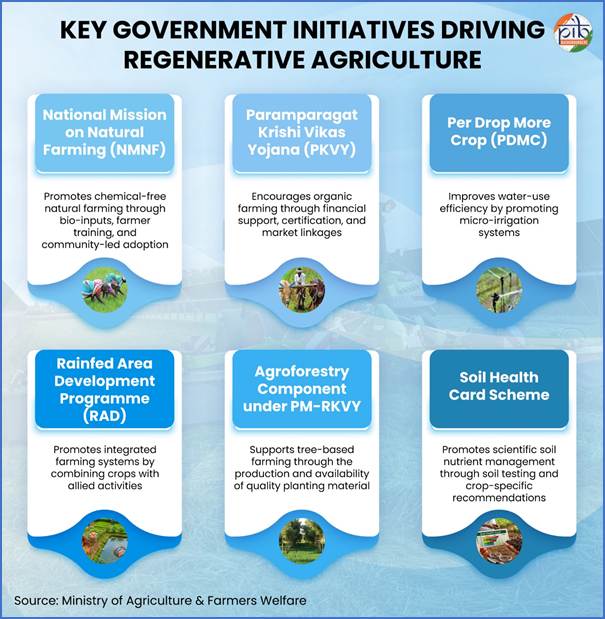
The Paramparagat Krishi Vikas Yojana, launched in 2015, supports organic farming and provides farmers with a structured framework for certification and market access. Since inception, it has covered 16.90 lakh hectares.
The National Mission on Natural Farming is expanding support for natural farming clusters and biological inputs. PDMC is improving water-use efficiency. RAD promotes integrated farming systems. The agroforestry component supports trees and quality planting material. The Soil Health Card Scheme provides scientific information for better nutrient management.
The challenge now is not necessarily to create another scheme.
It is to connect the existing schemes into a coherent agricultural transition.
A farmer should not have to navigate multiple disconnected programmes to adopt a regenerative model. Soil testing, water efficiency, crop diversification, livestock integration, agroforestry, natural inputs, market access and climate advisories should increasingly converge at the farm and village level.
The future lies in integrated planning.
A village, for instance, could map its soil conditions, groundwater availability, cropping patterns and climate risks. Farmers could then be supported in designing diversified systems appropriate to their local ecology. Demonstration farms could provide evidence. KVKs and agricultural universities could supply technical guidance. Farmer Producer Organisations could aggregate produce and negotiate better markets.
Such an approach would transform regeneration from a collection of practices into a community-level development strategy.
Farmers Must Be Partners, Not Recipients
Perhaps the most important principle in this transition is that farmers must remain at its centre.
Agricultural transformation has historically worked best when farmers are treated not merely as beneficiaries but as innovators and partners. Farmers possess deep knowledge of local soils, weather patterns, seed varieties, livestock and traditional practices.
Regenerative agriculture should build on that knowledge while bringing scientific evidence and modern technology into the system.
There should also be room for experimentation. Not every regenerative practice will work equally well in every location. Some interventions may require adaptation. Some may produce benefits only over several seasons.
That is why extension services, field demonstrations and farmer-to-farmer learning are essential.
The training of more than 70,000 Krishi Sakhis under soil-health initiatives and thousands of Community Resource Persons under natural farming demonstrates the importance of creating local knowledge networks.
The real agricultural extension worker of the future may need to be part agronomist, part climate adviser, part resource manager and part market facilitator.
The Road Ahead
India does not need to choose between productivity and ecology.
The real task is to make productivity increasingly dependent on ecological health rather than ecological depletion.
That requires a gradual shift in agricultural thinking. Soil must be treated as capital. Water must be treated as a finite economic resource. Biodiversity must be recognised as productive infrastructure. Crop diversity must be viewed as a form of risk management. Trees must be integrated into agricultural landscapes. Livestock should be considered part of nutrient cycles where locally appropriate. Technology should be deployed to improve precision rather than simply increase input intensity.
Regenerative agriculture offers a framework for bringing these ideas together.
Its greatest promise is not that every farm will immediately become carbon-negative or completely free of external inputs. Such expectations would be unrealistic. The more practical goal is to create a continuous process of improvement—better soil, better water use, greater biodiversity, lower avoidable costs, more diversified incomes and stronger resilience.
That process must be measurable, evidence-based and economically viable.
India’s impressive agricultural growth over the past decade provides a strong foundation. The next phase should focus on the quality and durability of that growth.
The country has already demonstrated that its farmers can respond to technological and policy transformation. The challenge now is to ensure that the soil beneath their feet remains capable of supporting that transformation for generations.
A field that produces a good harvest this year is productive.
A field that becomes healthier while producing good harvests year after year is regenerative.
That distinction may define the future of Indian agriculture.
The journey towards regenerative farming will not be completed in one season. It will require sustained public investment, farmer participation, scientific research, market reform, stronger extension systems and a willingness to learn from both traditional knowledge and modern innovation.
But the direction is clear.
India’s agricultural future cannot depend simply on extracting more from the land. It must increasingly depend on restoring what the land gives us.
The future of farming, ultimately, begins beneath the surface—in the health of the soil, the efficiency of the water, the diversity of the landscape and the resilience of the farmer.
If India can regenerate these foundations, it will not merely protect agriculture from the challenges ahead. It will give the sector a stronger, more sustainable and more prosperous foundation for the decades to come.
Comments are closed.