

Can PM Vidyalaxmi Democratise India’s Higher Education?

S Ahmad


The Pradhan Mantri Vidyalaxmi Scheme is a flagship initiative of the Education Ministry that seeks to make quality higher education accessible to deserving students facing financial constraints. The scheme provides collateral-free and guarantor-free education loans to such students for studying in top ranked higher education institutions in the country. It further supports beneficiaries through interest subvention based on family income, reducing financial constraints to educational attainment. In doing so, the scheme contributes to India’s progress towards SDG 4, which seeks to ensure inclusive and equitable quality education and promote lifelong learning opportunities for all by 2030.

Few investments yield returns as enduring as education. It expands individual opportunity, strengthens social mobility, fuels economic growth and builds the human capital on which nations compete. Yet, for millions of Indian students, the journey from merit to opportunity is interrupted not by a lack of talent but by a lack of money. Every year, countless students secure admission to prestigious institutions only to discover that the cost of higher education remains beyond their family’s reach.

This contradiction has become increasingly visible as India pursues the goals of becoming a developed nation by 2047. Universities have expanded, enrolment has risen, and aspirations have grown. The Gross Enrolment Ratio in higher education has climbed from 23.7 per cent in 2014-15 to 30 per cent in 2023-24, reflecting significant progress in widening access. Yet behind these encouraging numbers lies another reality: access is still unequal. The country’s finest institutions continue to remain financially inaccessible for many deserving students.

The Pradhan Mantri Vidyalaxmi Scheme attempts to bridge this gap. Approved in November 2024, the scheme represents one of India’s most ambitious efforts to remove financial barriers to higher education. Unlike conventional education loan programmes, it combines collateral-free lending, government-backed credit guarantees, targeted interest subvention and an entirely digital application process. More importantly, it shifts the conversation from financing education to protecting educational opportunity.


Merit Should Not Depend on Wealth

The central philosophy behind the scheme is simple yet transformative: admission secured through merit should not be denied because of financial limitations.

For decades, education loans have remained available in principle but inaccessible in practice. Banks often demanded collateral, guarantors or substantial financial documentation. Families from lower and middle-income backgrounds frequently hesitated to borrow because repayment risks appeared overwhelming. Students from rural areas or economically weaker sections were especially disadvantaged.


PM Vidyalaxmi attempts to remove these structural barriers.


Students admitted through merit to designated Quality Higher Educational Institutions (QHEIs) can now obtain collateral-free and guarantor-free loans. Government support through a 75 per cent credit guarantee on loans up to ₹7.5 lakh significantly reduces the lending risk for banks while expanding access for borrowers.

The policy sends an important message: educational opportunity should depend upon academic merit rather than inherited financial privilege.


Aligning with National Education Policy

The scheme is also a practical implementation of the National Education Policy (NEP) 2020, which emphasises equitable access to quality higher education.

NEP recognised that financial constraints remain one of the largest reasons students discontinue education or compromise on institutional choice. Expanding educational infrastructure alone cannot solve this challenge unless financing mechanisms are equally inclusive.

PM Vidyalaxmi therefore functions not merely as a banking initiative but as an educational reform. By integrating loan facilitation, digital governance and targeted subsidies, it strengthens India’s commitment towards Sustainable Development Goal 4, which seeks inclusive and equitable quality education for all by 2030.


Beyond IITs and IIMs

Public discussion often associates the scheme with elite institutions like IITs and IIMs. While these undoubtedly remain important beneficiaries, the programme’s coverage is considerably broader.

Currently, 1,425 Quality Higher Educational Institutions are included under the scheme, encompassing Central institutions, top-ranked State universities and highly ranked private institutions identified through the National Institutional Ranking Framework (NIRF).

The coverage includes engineering, medicine, law, management, science, humanities, commerce and numerous other disciplines. It extends to both undergraduate and postgraduate programmes, recognising that India’s future workforce requires excellence across sectors rather than within a handful of professions.

This wider institutional coverage broadens educational choice without restricting opportunity.


A Digital Architecture

One of the scheme’s most notable innovations lies in its digital architecture.

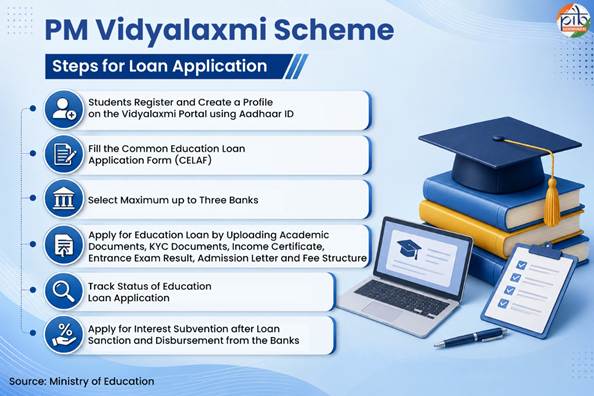
Instead of requiring students to navigate multiple bank branches and lengthy paperwork, PM Vidyalaxmi operates through a unified online portal where applicants can:

  • submit common loan applications;

  • choose participating banks;

  • monitor application status;

  • apply for interest subvention;

  • raise grievances digitally.


Such integration significantly reduces procedural complexity.

The use of Aadhaar authentication, digital processing and online tracking also enhances transparency while minimising opportunities for administrative delays.

Equally significant is the introduction of the Digital Rupee (CBDC) Wallet, through which interest subsidies are transferred directly before being credited to loan accounts. This reflects the government’s broader push towards digital public infrastructure in welfare delivery.


Interest Relief Matters

Education loans often become intimidating not because of principal amounts alone but because of accumulated interest during the study period.

PM Vidyalaxmi addresses this through targeted interest subvention.

Students from families earning up to ₹8 lakh annually receive a 3 per cent interest subsidy during the moratorium period on loans up to ₹10 lakh.

Those with family incomes below ₹4.5 lakh continue receiving full interest support under the existing Central Sector Interest Subsidy Scheme.

This layered structure reflects an important policy recognition: the financial challenges faced by India’s middle-income households are often underestimated.

Families earning between ₹4 lakh and ₹8 lakh annually frequently fall outside conventional welfare programmes while simultaneously lacking sufficient disposable income to finance expensive higher education.

By extending support to this segment, the scheme broadens educational inclusion beyond traditional poverty-based eligibility.


Lower Borrowing Costs

The scheme also introduces safeguards regarding lending costs.

Interest rates are capped at each bank’s Externally Benchmarked Lending Rate (EBLR) plus only 0.5 per cent, ensuring borrowers receive loans at rates below conventional education lending.

Repayment periods extend up to fifteen years after completion of the moratorium period, giving graduates greater financial flexibility during the early years of employment.

Combined with collateral-free lending and interest support, these provisions substantially reduce financial anxiety for students and families.

Early Indicators

The programme’s initial response suggests considerable demand.

During FY 2025-26:

  • over 6.45 lakh education loan applications were submitted through the portal across schemes;

  • 1,10,667 applications were received specifically under PM Vidyalaxmi;

  • 70,852 loans were sanctioned;

  • 67,728 loans had already been disbursed.

These figures indicate that a unified digital platform can substantially improve accessibility and processing efficiency.

Equally encouraging is the gender distribution.

Applications from women constitute a significant share of total beneficiaries, suggesting that financial assistance can contribute to narrowing gender disparities in higher education participation.

The participation of students from Scheduled Castes, Scheduled Tribes, Other Backward Classes, Economically Weaker Sections and Persons with Disabilities further reflects the scheme’s inclusive orientation.

The Promise and Limits of PM Vidyalaxmi

If Part I of the PM Vidyalaxmi story is about expanding access, Part II is about ensuring that access translates into opportunity. Education loans can open university gates, but they cannot by themselves guarantee employability, quality learning or equitable outcomes. The long-term success of the scheme will therefore depend not merely on the number of loans sanctioned, but on whether students who borrow emerge with the skills, confidence and employment needed to repay them with dignity.

This is where PM Vidyalaxmi must be viewed not as an isolated financial intervention but as part of India’s broader higher education ecosystem.

Financing Aspirations, Not Debt

For decades, discussions around education loans in India have often centred on debt. Families viewed borrowing for education with understandable hesitation, fearing uncertain employment prospects after graduation.

PM Vidyalaxmi attempts to change this perception by treating educational loans as investments in human capital rather than financial liabilities.

The scheme removes collateral and guarantor requirements, caps lending rates, provides targeted interest support and extends generous repayment periods. Collectively, these provisions reduce both financial risk and psychological barriers associated with borrowing.

More importantly, they send a larger policy signal—that the State shares responsibility in financing higher education alongside students and financial institutions.

Such shared responsibility reflects the understanding that education generates benefits extending well beyond individual earnings. An educated workforce strengthens productivity, innovation, research, entrepreneurship and national competitiveness.

The Importance of Interest Subvention

Among the scheme’s strongest features is its carefully designed interest subvention framework.

Students belonging to families with annual incomes up to ₹8 lakh receive a three per cent interest subsidy during the moratorium period, while economically weaker students continue to receive full interest support under the Central Sector Interest Subsidy Scheme.

This layered approach recognises an important economic reality.

India’s lower-middle and middle-income families frequently face significant financial stress despite being excluded from many welfare programmes. Rising tuition fees, hostel charges, living expenses and educational materials have substantially increased the cost of quality higher education.

For such households, even moderate interest relief can determine whether higher education remains affordable.

Instead of treating educational finance as an all-or-nothing proposition, PM Vidyalaxmi introduces graduated support based on financial capacity.

Strengthening the Credit Ecosystem

The scheme also addresses an issue that has historically discouraged banks from educational lending.

Education loans differ from conventional commercial loans because they finance future earning potential rather than existing assets. Students rarely possess collateral, stable income or substantial financial histories.

The Government’s decision to provide a 75 per cent credit guarantee on loans up to ₹7.5 lakh significantly reduces lender risk.

This has two important implications.

First, it encourages wider participation by banks.

Second, it improves confidence among lending institutions that education financing can remain commercially sustainable without compromising inclusion.

A stronger education credit market ultimately benefits students through wider institutional participation and faster loan approvals.

Digital Governance as Reform

Perhaps the most underappreciated aspect of PM Vidyalaxmi is its digital architecture.

India’s experience with Digital Public Infrastructure has demonstrated that technology can reduce transaction costs, improve transparency and enhance service delivery.

PM Vidyalaxmi applies similar principles to educational finance.

The unified portal allows students to submit a common application, compare lending options, monitor processing, seek interest subsidies and register grievances within a single digital ecosystem.

The integration of Digital Rupee (CBDC) wallets for subsidy transfers further reflects India’s expanding digital governance framework.

By reducing paperwork, increasing transparency and enabling real-time tracking, the system seeks to replace procedural uncertainty with predictable service delivery.

For students navigating admissions, deadlines and financial decisions simultaneously, this administrative simplicity itself becomes a significant reform.

Inclusion Beyond Economics

Although financial inclusion forms the scheme’s central objective, its broader social implications deserve equal attention.

The participation of women students, Scheduled Castes, Scheduled Tribes, Other Backward Classes, Economically Weaker Sections and Persons with Disabilities demonstrates that educational finance is also an instrument of social justice.

Higher education has historically reproduced existing inequalities whenever access depended primarily on family wealth.

By lowering financial barriers, PM Vidyalaxmi expands opportunities for first-generation learners and students from historically disadvantaged communities.

Education remains among the most powerful mechanisms for upward social mobility. Policies that democratise educational access therefore contribute simultaneously to economic growth and social inclusion.

The Missing Link: Employability

Yet education financing cannot be evaluated independently of employment outcomes.

Loans become meaningful only when graduates possess the skills required by changing labour markets.

India continues to face a paradox where university enrolment has expanded rapidly while graduate employability remains uneven across disciplines.

Students graduating with weak practical skills or limited employment opportunities may continue to struggle despite having accessed quality education.

The challenge therefore extends beyond financing education towards improving educational quality itself.

Curriculum modernisation, industry partnerships, internships, research opportunities, digital competencies and entrepreneurship support remain equally important components of educational success.

PM Vidyalaxmi addresses affordability.

The higher education system must simultaneously address employability.

Institutional Accountability

The scheme currently covers 1,425 Quality Higher Educational Institutions selected through NIRF rankings and government criteria.

This emphasis on institutional quality is important because educational loans should ideally support institutions capable of delivering meaningful academic outcomes.

However, inclusion within the scheme also creates expectations regarding institutional accountability.

Higher education institutions must ensure that students receiving financial assistance obtain quality teaching, adequate infrastructure, career guidance and placement support.

Educational finance should not merely increase enrolment numbers; it should improve educational outcomes.

Universities benefiting from increased student access must therefore strengthen academic quality, student services and employability support.

Managing Future Risks

Like every ambitious public programme, PM Vidyalaxmi will also confront implementation challenges.

Awareness remains uneven, particularly in rural and remote areas where many eligible students may still be unfamiliar with the scheme.

Financial literacy also deserves attention. Students borrowing for the first time require counselling regarding repayment obligations, budgeting and responsible financial planning.

Banks will need to maintain efficient processing timelines while ensuring prudent lending practices.

The digital platform must remain accessible, responsive and capable of handling increasing application volumes without creating technical bottlenecks.

Equally important is regular evaluation.

Monitoring loan sanction rates, repayment patterns, graduate employment outcomes and regional participation will help policymakers refine implementation over time.

Towards Educational Equity

The larger significance of PM Vidyalaxmi lies in its attempt to redefine educational opportunity.

For decades, educational inequality has often reflected financial inequality. Students from affluent families enjoyed wider choices while equally talented students from modest backgrounds frequently settled for less—not because of ability, but because of affordability.

The scheme seeks to narrow that gap.

Its success, however, should ultimately be measured not merely by loans disbursed or subsidies released, but by transformed lives—students who become scientists, engineers, teachers, doctors, researchers, entrepreneurs, artists and public servants because financial barriers no longer determined educational destiny.

Education remains India’s most important long-term investment. Roads, ports and factories create physical infrastructure, but universities create intellectual infrastructure.

PM Vidyalaxmi recognises this distinction.

By combining public support, financial innovation and digital governance, it attempts to ensure that merit, rather than money, determines who studies in India’s finest institutions.

That is both its greatest promise and its greatest responsibility.


The article is based on the inputs and background information provided by the Press Information Bureau (PIB). Author is Writer, Policy Commentator. He can be mailed at kcprmijk@gmail.com

Comments are closed.