
Kashmir’s Apple Growers Are Working Harder for Thinner Margins
A season-to-season gamble has replaced what was once the valley's most dependable livelihood


Mohammad Muslim Bhat
The most immediate pressure comes from imports, particularly from countries like Iran, Afghanistan, and increasingly other international sources, which enter the Indian market through various trade channels and compete directly with Kashmiri apples on price.
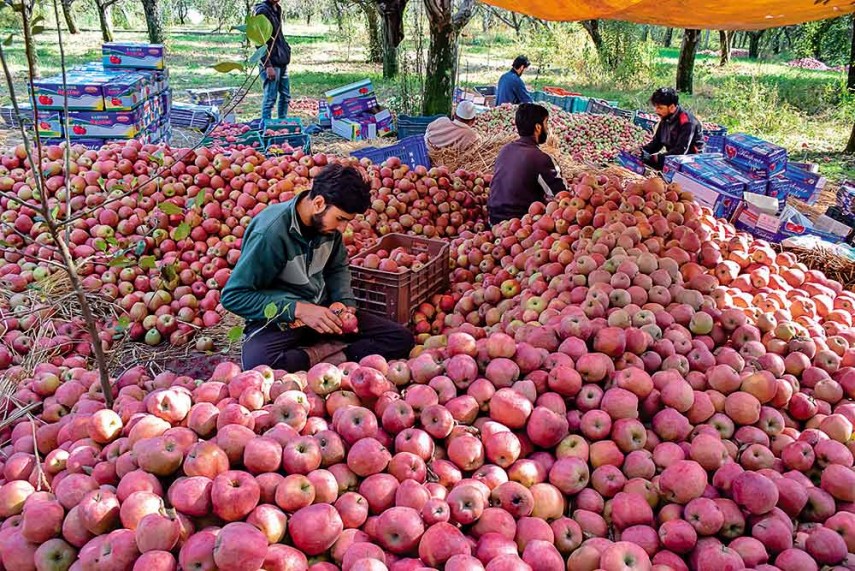
Apple cultivation has been the backbone of Kashmir’s horticultural economy for decades, employing a substantial share of the valley’s rural workforce either directly through orchard ownership and labor or indirectly through the extensive supply chain of transport, packaging, and trading that moves the crop from orchard to market each year. For a long time, apples represented something close to a reliable livelihood in a region where reliable livelihoods outside government service have never been especially abundant. That reliability has eroded meaningfully over the past several years, and growers across the valley describe a season-to-season uncertainty that didn’t define the trade the same way a generation ago.
The most immediate pressure comes from imports, particularly from countries like Iran, Afghanistan, and increasingly other international sources, which enter the Indian market through various trade channels and compete directly with Kashmiri apples on price. Kashmiri growers and their trade associations have periodically petitioned the central government for stronger protective measures, arguing that cheaper imported apples undercut domestic prices during precisely the harvest window when Kashmiri growers need strong prices to cover a year of accumulated input costs. Government response has included periodic tariff adjustments and import restrictions, but growers describe a persistent gap between the protection they’ve asked for and what’s actually been implemented, particularly given that import policy has to balance domestic grower interests against broader trade relationships and consumer price considerations that don’t always favor the orchard sector.
Input costs have climbed steadily in ways that squeeze margins even in years when apple prices hold reasonably steady. Fertilizer, pesticide, and labor costs have all risen, and the capital investment required to keep an orchard competitive, particularly the shift toward high-density plantation systems using dwarf rootstock, which produce earlier and more consistent yields than traditional tall trees but require significant upfront investment in saplings, trellising, and irrigation infrastructure, has put pressure on smaller growers who lack the capital to make that transition at the same pace as larger, better-resourced orchardists.
Storage and cold chain infrastructure remains a persistent structural weakness in Kashmir’s apple economy, one that’s been discussed for years without being fully resolved. Controlled atmosphere storage facilities, which allow apples to be held and released to market gradually over months rather than dumped onto the market immediately at harvest, exist in Kashmir but in quantities that fall short of what the full crop would need to be marketed optimally. Growers without access to adequate storage are forced to sell during the harvest glut, when prices are structurally weakest simply because supply is concentrated in a short window, missing out on the better prices that staggered release through the year could capture.
Market access and the trading structure connecting Kashmiri orchards to end consumers across India has its own inefficiencies that growers have long complained about. Multiple layers of intermediaries between orchard and retail market mean that the price difference between what a grower receives and what a consumer pays in Delhi or Mumbai can be substantial, with growers capturing a smaller share of final retail value than they’d like, even as they bear the direct production risk of weather, disease, and pest pressure that can devastate a season’s crop with little warning. Efforts to build more direct market linkages, including through government-supported mandis and some private sector initiatives connecting growers more directly to large retail buyers, have expanded gradually but haven’t yet fundamentally restructured the traditional trading chain.
Orchard debt has become an increasingly discussed problem, with growers who’ve taken loans to fund high-density plantation transitions, pesticide purchases, or basic operational costs during difficult seasons finding themselves carrying debt burdens that a single bad harvest, whether from hailstorm damage, pest outbreak, or a market price collapse, can make genuinely difficult to service. Agricultural loan structures and interest rates for horticultural credit in Jammu and Kashmir have been a subject of periodic policy discussion, with growers’ associations pushing for more favorable terms specifically calibrated to the multi-year investment cycle and weather-dependent risk that apple cultivation involves, distinct from shorter-cycle crop lending that doesn’t map well onto orchard economics.
Climate variability has added a further layer of unpredictability on top of these existing economic pressures. Unseasonal weather events, including untimely hailstorms, unexpected frost during bloom periods, and shifts in the timing of chilling hours that apple trees need during winter dormancy to fruit properly the following season, have become a more frequently cited concern among growers in recent years, adding weather-related risk to a crop that was already economically challenging before climate factors became a more prominent part of the conversation.
Younger family members in traditional apple-growing households increasingly describe ambivalence about continuing in the trade, weighing the capital requirements and unpredictable returns against other opportunities that don’t carry the same weather and market risk. This generational hesitation, if it continues at scale, has implications well beyond individual family decisions, given how central apple cultivation remains to Kashmir’s rural economy and to the broader horticultural identity the valley has built over decades. Whether the sector adapts through consolidation, infrastructure investment, and stronger market linkages, or continues its current trajectory of thinning margins and growing uncertainty, is a question growers themselves raise as often as the policymakers and trade bodies nominally responsible for addressing it.
Comments are closed.