
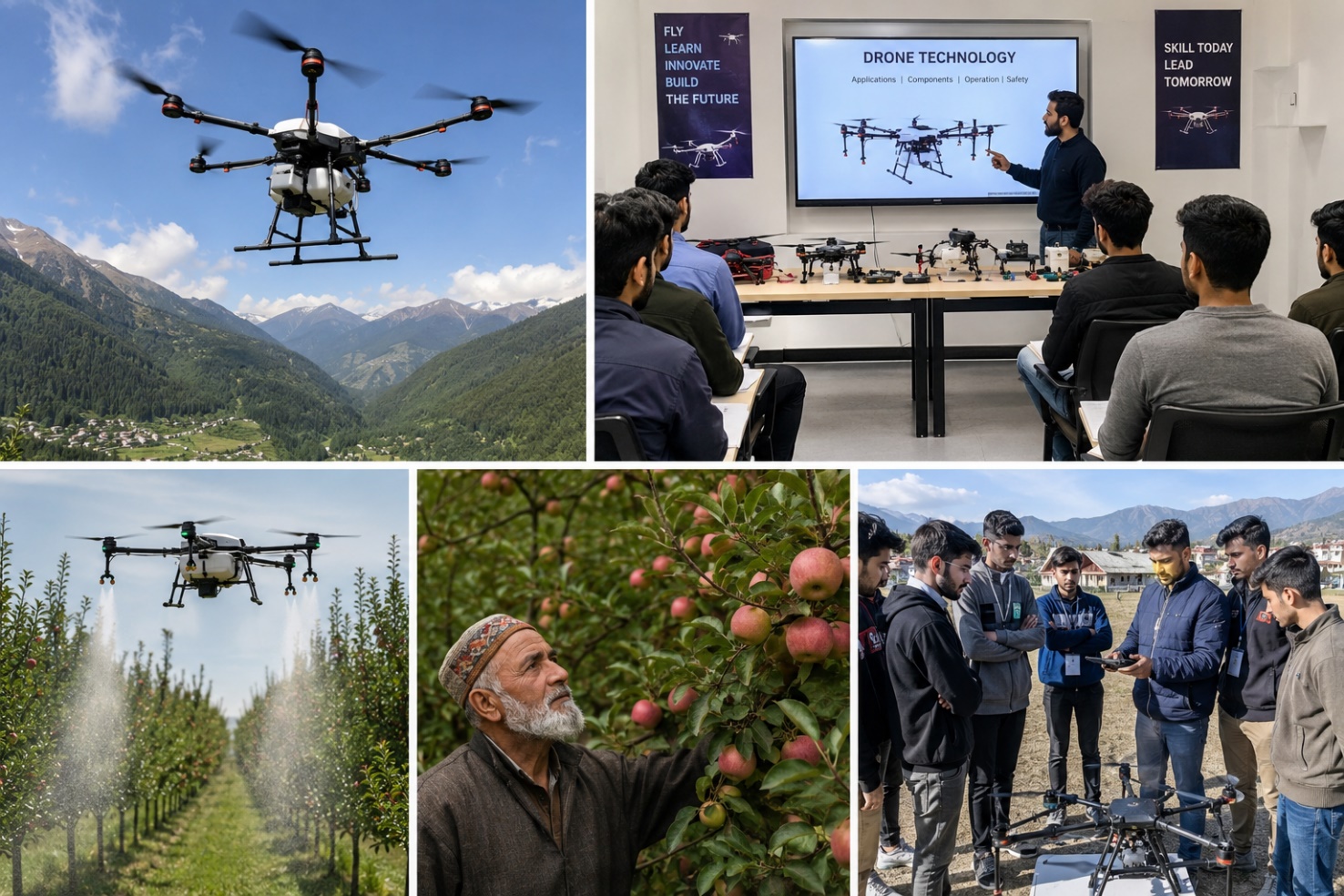


Er. Azhar Yousuf
بِسْمِ اللّٰهِ الرَّحْمٰنِ الرَّحِيم
“Drone education should empower young people with practical skills, not burden families with unrealistic expectations.”
The rapid rise of drone technology has transformed the global technological landscape. Recent geopolitical conflicts—including the Russia–Ukraine war, tensions involving Iran and the United States, and the recent Indo-Pak military operations (Operation Sindoor)—have demonstrated the strategic importance of unmanned aerial systems. Consequently, governments and industries across the world are investing heavily in drone technology for defence, agriculture, infrastructure, surveying, disaster management, logistics, and environmental monitoring.
India is no exception. The country has witnessed an unprecedented expansion of its drone ecosystem. Government initiatives such as the ₹10,000 crore Drone Shakti programme and the ₹1,261 crore Namo Drone Didi scheme reflect the nation’s commitment to promoting indigenous drone capabilities. Defence continues to be the largest driver of advanced drone systems, with India’s historic defence allocation of ₹7.85 lakh crore including plans for nearly ₹20,000 crore worth of indigenous drone procurement.
Today, India’s domestic drone market is estimated at nearly $1–1.5 billion and is growing at over 21% annually. More than 600 indigenous drone manufacturers and component developers have emerged, creating an ecosystem that is among the fastest-growing in the world. The country is currently training around 17,500–20,000 new DGCA-certified remote pilots every year, taking the cumulative number of certified pilots to nearly 40,000. To support this growth, 244 DGCA-approved Remote Pilot Training Organisations (RPTOs) are operational across the country.
These figures naturally inspire optimism among young people looking for new career opportunities. However, ground realities differ significantly from one region to another.
In Jammu & Kashmir, several institutions have established drone laboratories and introduced drone-related programmes. Yet, many of these facilities struggle to attract students.
On paper, everything appears promising.
Yet one question repeatedly arises during interactions with students and parents:
“What happens after completing the course?”
This question deserves an honest answer.
The issue is not with drone technology itself. Drone technology undoubtedly represents the future and offers tremendous potential. The concern lies in how these courses are being delivered and what outcomes they promise.
In many cases, training is reduced to a formality where institutions complete paperwork, conduct a few classroom sessions, issue certificates, and move on. Some centres appear more focused on utilising available funding than ensuring meaningful learning outcomes.
The consequences are visible.
Many participants complete short-duration training programmes without developing even the most fundamental operational understanding of drones. During my own interactions within the drone ecosystem, I have met individuals who have completed DGCA Remote Pilot Certificate programmes but still struggle with basic concepts such as identifying clockwise and anticlockwise propellers, understanding motor rotation, flight-controller configurations, or radio channel assignments. Even more concerning is that some instructors delivering drone courses themselves appear to have conceptual gaps in these areas.
When such situations exist, one must ask an uncomfortable but necessary question:
Are we producing skilled drone professionals—or merely distributing certificates?
The second concern is employment.
Students often invest substantial amounts of money, especially those coming from middle-class families, with the expectation that a drone certification will quickly lead to a stable career. While employment opportunities certainly exist in states with mature drone ecosystems, the situation in Jammu & Kashmir remains limited.
At present, local demand for certified drone pilots is still negligible in J&K. No Commercial applications, no private industries. Consequently, many trained individuals struggle to find meaningful employment within their home state.
This should not discourage young people from entering the field altogether. Rather, it highlights the importance of making informed decisions. Students must carefully evaluate the quality of a course before enrolling. They should ask:
-
Who are the instructors?
-
How much practical flying is included?
-
Is there training in drone assembly, maintenance, software, and data analysis?
-
Does the institution have industry collaborations?
-
What placement record does it have?
-
Will the skills remain valuable even if immediate employment is unavailable?
These questions are not signs of distrust.
They are signs of responsible decision-making.
Parents frequently assume that if a programme is organised by a recognised institution or receives government support, employment opportunities will naturally follow.
Unfortunately, this assumption is not always justified.
Drone technology undoubtedly has a bright future. Agriculture, precision farming, infrastructure inspection, mining, environmental monitoring, emergency response, logistics, defence, and smart-city applications will continue expanding. States such as Karnataka, Maharashtra, Gujarat, Telangana, and Tamil Nadu are already witnessing significant growth in these sectors. Jammu & Kashmir also possesses enormous potential. From horticulture and precision agriculture to disaster management, tourism mapping, forest monitoring, snow and avalanche assessment, and infrastructure inspection, drones can play a transformative role. However, realizing this potential requires sustained policy support, industrial investment, research collaboration, startup incubation, and quality training—not merely short certification programmes.
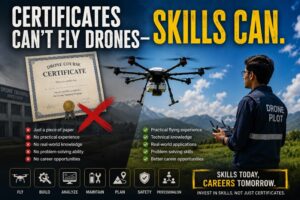
As someone who has worked in the drone ecosystem and interacted with students, instructors, training organisations, and industry professionals, my intention is not to discourage youth from pursuing drone education. Rather, it is to encourage them to make informed choices. A certificate without competence benefits neither the student nor the industry.
India’s drone revolution is real. But for Jammu & Kashmir to truly benefit, our focus must shift from counting certificates to building genuine capability. Only then will drone education become an investment that empowers our youth instead of becoming another financial burden for aspiring families.
Another Growing Debate: Should Apple Orchards in Jammu & Kashmir Be Sprayed Using Drones?
Another issue that has gained considerable attention in recent years is the use of agricultural drones for pesticide spraying in the apple orchards of Jammu & Kashmir. As someone who has worked extensively with drone technology, I believe this discussion deserves a balanced and scientific perspective rather than blind acceptance or outright rejection.
There is no doubt that agricultural drones represent the future of precision farming. They reduce human exposure to hazardous chemicals, optimise pesticide use, save labour, and improve operational efficiency. Across many crops and in modern orchards, drone spraying has already demonstrated significant advantages.
However, the conditions prevailing in most traditional apple orchards of Jammu & Kashmir present unique operational challenges.
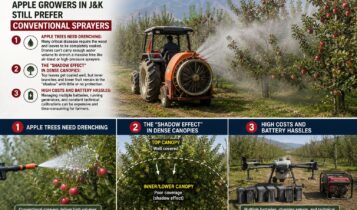
The first challenge is spray coverage. Diseases such as apple scab, powdery mildew, and other fungal infections require thorough wetting of leaves, branches, and woody surfaces. Conventional air-blast sprayers and high-pressure spray pumps deliver large volumes of water that penetrate deep into mature trees. Current agricultural drones are designed for ultra-low-volume or low-volume precision spraying and cannot always achieve the same level of drenching in large, decades-old orchards.
The second challenge is the dense canopy structure. Most traditional Kashmiri apple orchards consist of tall trees with thick, overlapping branches. Although drone propellers generate downward airflow, the upper canopy often acts as a barrier, preventing droplets from reaching the inner foliage, lower branches, and fruits. This “shadow effect” can reduce spray effectiveness, particularly during severe disease outbreaks where complete coverage is essential.
Battery endurance and operational logistics also remain practical concerns. Spraying extensive orchards requires multiple battery sets, rapid charging systems, careful mission planning, and trained operators. For many small and marginal orchard owners, these additional operational requirements may reduce the economic advantage of drone-based spraying.
These limitations should not be interpreted as a rejection of agricultural drones. Rather, they highlight the need for continued technological innovation. Improvements in battery technology, canopy-penetrating spray systems, intelligent flight algorithms, and the gradual adoption of scientific orchard management practices—such as high-density plantations and systematic pruning—will significantly enhance the effectiveness of drone spraying in the future.
For now, the most practical approach for Jammu & Kashmir is not to replace conventional spraying equipment entirely but to integrate drones wherever they offer a clear advantage. Drones can be invaluable for orchard monitoring, crop-health assessment, thermal imaging, precision mapping, nutrient analysis, and spraying in suitable plantation systems, while conventional equipment may continue to play an important role in mature traditional orchards.
Comments are closed.