
The Court of Beasts

(A symbolic short story that raises a profound question about the fading boundaries between humanity and brutality.)




Usuf  Mir


“The world calls us beasts, yet even our savagery has its limits. We hunt to satisfy hunger. We fight to survive. But we do not turn the helplessness of an innocent creature into a source of desire.”

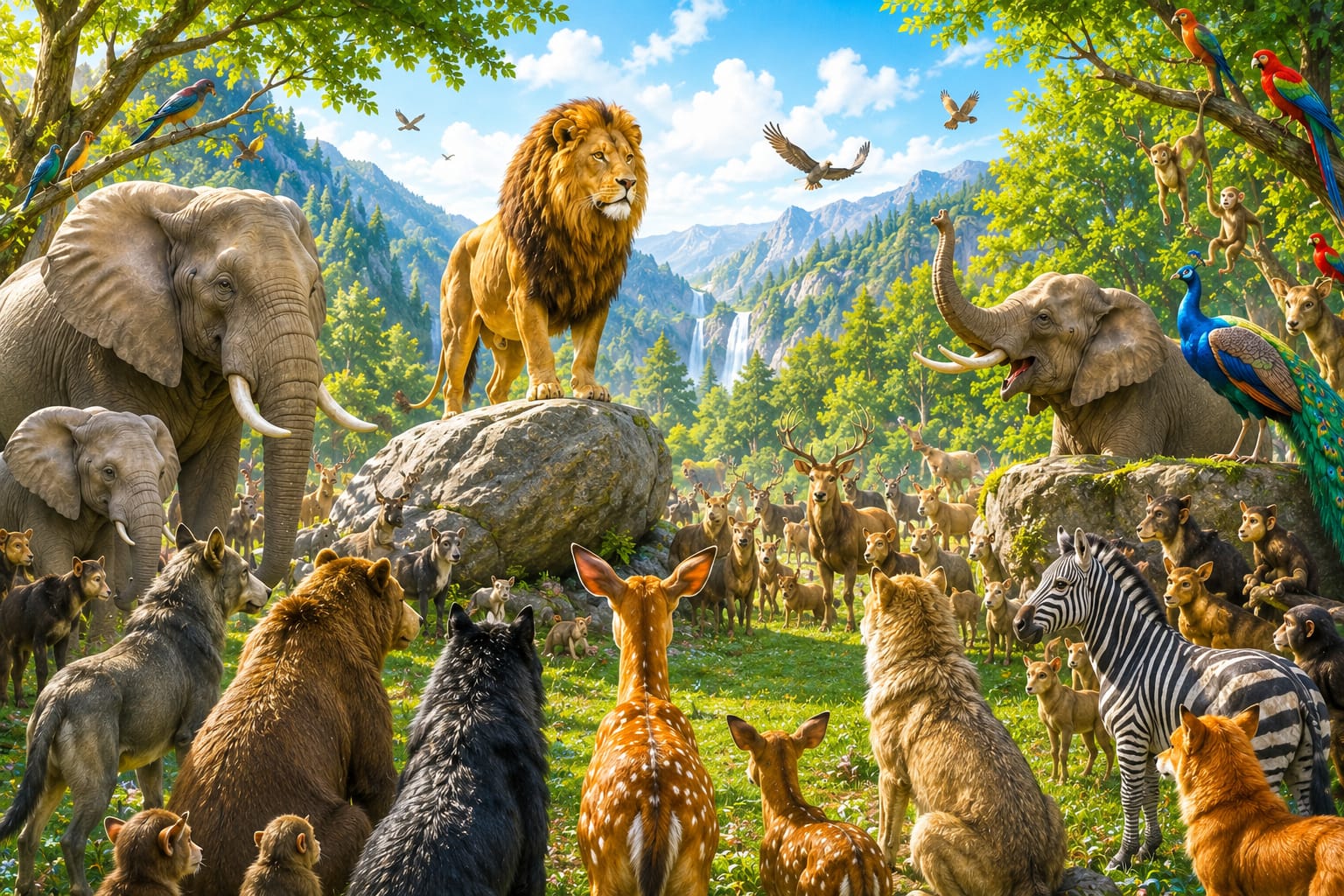
A vast stretch of dense, green forests lay nestled among towering mountains. Peace and the fragrance of nature filled the air. Every creature in the forest lived freely and fearlessly according to its own natural rhythm. Lions walked with dignity, elephants rested beneath the shade of trees, herds of deer raced across lush meadows, monkeys swung from branch to branch, squirrels gathered seeds, peacocks spread their feathers in dance, cuckoos awakened the woods with their melodious calls, nightingales scattered songs into the air, and countless birds filled the silence with their cheerful chirping. There was no fear, no distrust. Everywhere there was harmony, freedom, and coexistence.

One morning, before the sun had fully risen, an unfamiliar creature entered the forest. Its eyes were restless, wandering as though searching for prey. Yet there was no hunger in them. Something else lurked behind that gaze.

Not far away, a young fawn had wandered a little distance from its mother, chasing butterflies with innocent delight. It had no idea that the creature entering the forest was not a hunter in search of food, but something far more terrifying.

Suddenly, a heart-rending scream echoed through the trees. Even the wind seemed to tremble. Birds shivered upon their branches, and for a moment the entire forest stood frozen.

“Papa… save me!”

It was not merely a cry; it felt as though the whole valley had shaken.

The cuckoo fell silent. The nightingale ceased its song. The peacock folded its feathers. Monkeys climbed hurriedly to the highest branches. Elephants halted in their tracks, while herds of deer scattered in confusion.

At that very moment, the lion, king of the forest, let out a mighty roar that echoed from mountain to mountain. It was a warning, a call to gather.

Within moments, every creature assembled in a vast clearing. Elephants, bears, wolves, foxes, zebras, wild horses, deer, monkeys, peacocks, eagles, cuckoos, nightingales, and countless birds stood in solemn silence.

Perhaps for the first time in the history of the forest, all wildlife had gathered not because of a hunter, a famine, or a raging fire, but because of the anguished cry of an innocent being.

Standing atop a great rock, the lion surveyed the assembly. Anger burned in his eyes, but beneath it lay sorrow.

“Today,” he declared, “someone has shattered the peace of our forest. Tell me, which beast has committed this atrocity?”

For a few moments, it seemed as though even the wind had stopped moving.

Then an old elephant stepped forward slowly. Bowing his head respectfully, he spoke.

“Your Majesty, I do not believe this could be the deed of a beast.”

The lion looked at him in surprise.

“If not a beast,” he asked, “then whose act is it?”

The old elephant drew a deep breath.

“Your Majesty, the world calls us beasts, yet even our savagery has its limits. We hunt to satisfy hunger. We fight to survive. But we do not turn the helplessness of an innocent creature into a source of desire. What happened today was done by someone who bore the shape of a human, but had long abandoned humanity.”

Silence engulfed the gathering.

No one had a word to say.

The old elephant stepped forward again.

“In my long life, I have seen hunters. I have witnessed bloodshed and fire. But what happened today has forced me, for the first time, not to question our own wildness, but to mourn the loss of human humanity.”

The bear lowered his head.

Moisture gathered in the wolf’s eyes.

A doe stood clutching her little fawn close to her chest, while silent tears rolled down her face.

The old elephant continued in a low yet powerful voice.

“If hunger were savagery, then we would all be guilty. But lust is a fire that burns away the human within a human being.”

Once again, silence descended upon the field.

The lion slowly rose. The roar in his voice had faded; only grief remained.

“Today,” he said, “this court does not pass judgment upon a single criminal, but upon a mindset that crushes innocence beneath its feet.”

After a brief pause, he continued:

“When one of our kind strays into human settlements and attacks someone, the world immediately cries, ‘A beast has come!’ Yet the creature that entered our forest today has done what no beast would ever do.”

The lion looked across the assembly.

“From this day onward, let it be known throughout the forest that every being who appears in human form is not necessarily human in spirit. Protect your children not only from hunters, but also from those faces whose hearts have long been emptied of humanity.”

No one applauded.

No slogans were raised.

The court dispersed in silence.

The elephant’s steps seemed heavier than before.

For the first time, helplessness could be seen in the lion’s stride.

The peacock did not spread its feathers.

The cuckoo remained silent.

The nightingale’s songs had vanished.

The doe stood for a long time, holding her little one close against her chest.

Slowly, evening descended behind the mountains.

A gentle breeze passed through the trees.

Leaves rustled softly.

And somehow, every creature present felt as though a faint voice still lingered in the air—

“Papa… save me!”


Author is a retired District Information Officer. He can be mailed at  yousufmir555@gmail.com

Comments are closed.