

S Ahmad
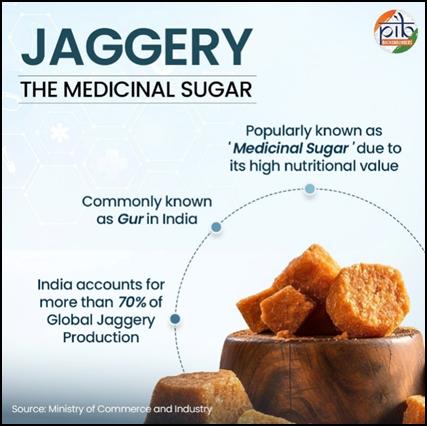
India accounts for over 70% of global jaggery production, firmly establishing itself as the world leader in natural sweeteners. Nearly 20–30% of the country’s sugarcane output is diverted towards jaggery production, supporting around 2.5 million rural livelihoods. The sector has also witnessed significant export growth. Jaggery exports have increased by 106.5% in value between 2015–16 and 2024–25, indicating rising international demand. Nutritionally rich in iron, minerals, and essential micronutrients, jaggery serves as a healthier alternative to refined sugar. Complementing this growth, government initiatives such as Pradhan Mantri Kisan SAMPADA Yojana, PM Formalization of Micro Food Processing Enterprises Scheme, and One District One Product, along with GI tagging, are playing a crucial role in promoting value addition, strengthening rural enterprises, and enhancing export potential.
For centuries, jaggery has occupied a cherished place in Indian kitchens, culture, and traditional medicine. From winter delicacies in north India to festive offerings in the south, this unrefined natural sweetener—popularly known as gur—has long symbolized nourishment, purity, and rural self-reliance. Yet today, jaggery is no longer viewed merely as a traditional household ingredient. It is emerging as an important economic commodity, a nutritional alternative to refined sugar, and a promising driver of rural entrepreneurship and export growth.
India’s jaggery sector today stands at the intersection of agriculture, health, culture, and rural development. Accounting for more than 70 percent of global jaggery production, India has firmly established itself as the world leader in natural sweeteners. Nearly one-fourth of the country’s sugarcane production is diverted towards jaggery manufacturing, supporting approximately 2.5 million livelihoods through decentralized agro-processing, small-scale enterprises, and cottage industries.
As global consumers increasingly shift towards natural, minimally processed, and chemical-free food products, jaggery is witnessing renewed relevance both domestically and internationally. Rising exports, expanding health consciousness, government support schemes, GI-tagged regional varieties, and growing demand for traditional foods are collectively transforming jaggery from a rural staple into a modern economic opportunity.
What appears at first glance to be a simple traditional sweetener is, in reality, becoming an important symbol of sustainable agriculture, nutrition security, and inclusive rural growth.
Few food products are as deeply connected to India’s cultural and agricultural history as jaggery. Historical references to sugarcane cultivation in India date back to the Vedic period between 1400 and 1000 BCE. Scholars widely acknowledge that some of the earliest varieties of sugarcane evolved in the moist and fertile regions of northeastern India before gradually spreading across tropical and subtropical regions of the world.
Even the word “sugar” itself traces its roots to the Sanskrit term sarkara, highlighting India’s ancient contribution to sweetener production and processing.
Historical accounts suggest that by the 7th century, Indian expertise in sugarcane processing had already achieved international recognition. In 647 AD, a Chinese mission reportedly travelled to Magadha specifically to learn sugar-processing techniques from Indian practitioners. This early transfer of agricultural and processing knowledge demonstrates India’s longstanding leadership in sweetener technology.
Jaggery, unlike refined sugar, retained its traditional production methods over centuries. Produced by boiling and concentrating sugarcane juice without chemical refining, it remained closely tied to rural economies and local consumption patterns. While industrial sugar mills modernized and centralized sugar production, jaggery continued to thrive through decentralized village-based processing systems.
This continuity has helped preserve not only traditional techniques but also livelihoods, local food cultures, and nutritional value.
India today dominates global jaggery production with over 70 percent share, making it by far the largest producer worldwide. This leadership is supported by the country’s vast sugarcane cultivation base.
In 2024–25, India’s sugarcane output was estimated at nearly 444.9 million tonnes. Uttar Pradesh alone accounted for almost half of total production, followed by Maharashtra and Karnataka. Other important producing states include Gujarat, Tamil Nadu, Bihar, Punjab, Haryana, Madhya Pradesh, and Uttarakhand.
A significant proportion—roughly 20 to 30 percent—of India’s sugarcane production is utilized for jaggery manufacturing rather than refined sugar production. This diversion reflects not only strong domestic demand but also the economic viability of jaggery-based value addition.
Unlike large industrial sugar mills, jaggery production is highly decentralized. Thousands of small processing units operate across rural India, creating localized economic ecosystems. The sector generates employment for farmers, seasonal labourers, transporters, traders, artisans, and small entrepreneurs.
In many rural areas, jaggery production functions as a cottage industry that supports household incomes during agricultural off-seasons. It minimizes transportation costs because sugarcane is processed close to cultivation areas, reducing spoilage and improving value retention within villages.
This decentralized structure makes jaggery one of the most inclusive agro-processing industries in India.
India’s jaggery industry is no longer driven solely by domestic consumption. International demand for natural sweeteners has created new opportunities in export markets.
Between 2015–16 and 2024–25, India’s jaggery and confectionery exports increased dramatically from USD 197 million to USD 406.8 million. Export volumes also rose substantially during the same period.
Major export destinations now include Indonesia, United States, United Arab Emirates, Nigeria, and Nepal.
This export surge reflects broader global trends in food consumption. Across international markets, consumers are increasingly seeking alternatives to heavily processed sugar products. Concerns regarding lifestyle diseases, obesity, artificial additives, and chemical processing have strengthened demand for natural sweeteners such as jaggery and honey.
India’s traditional expertise in jaggery production positions it advantageously within this growing market.
The sector has also shown strong year-on-year momentum. During April–January of 2025–26, jaggery exports recorded significant growth in both volume and value compared to the previous year, indicating sustained international demand.
The growing popularity of jaggery is not confined to exports alone. Within India itself, consumer preferences are rapidly evolving.
Urban health-conscious consumers are increasingly moving towards traditional foods perceived as natural, organic, and minimally processed. This shift has contributed to a compound annual growth rate of 15–20 percent in the natural sweetener segment between 2021 and 2024.
Jaggery sales in domestic markets have expanded steadily as consumers seek healthier substitutes for refined white sugar. The rise of wellness culture, organic food markets, Ayurveda-inspired diets, and traditional culinary practices has further strengthened demand.
Today, jaggery is not only consumed in traditional sweets and beverages but is also increasingly incorporated into bakery products, confectioneries, energy snacks, health drinks, and packaged food items.
Variants such as cane jaggery, raw jaggery, organic jaggery powder, and palm jaggery are finding growing acceptance among urban consumers.
This transformation reflects a larger rediscovery of indigenous food systems that combine nutrition with sustainability.
One of the most important reasons behind jaggery’s growing popularity lies in its nutritional value.
Unlike refined sugar, which undergoes intensive chemical processing that strips away minerals and micronutrients, jaggery retains many of the nutrients naturally present in sugarcane juice.
Jaggery contains essential minerals such as iron, calcium, potassium, magnesium, phosphorus, zinc, copper, and manganese. It also includes small quantities of vitamins and antioxidants that are absent in refined sugar.
Iron content in jaggery contributes to improved haemoglobin levels and makes it particularly useful in addressing anaemia, especially among women and children. Potassium and magnesium support muscle and cardiovascular function, while mineral salts help maintain electrolyte balance.
Because jaggery releases energy gradually due to its complex sucrose structure, it avoids the sudden spikes in blood glucose associated with refined sugar consumption. This makes it a preferred option for sustained energy release.
Traditional methods of preparation also contribute to its nutritional richness. In many rural areas, jaggery is prepared using iron vessels, which further enhance its iron content.
These characteristics have increasingly positioned jaggery as a “functional food” rather than merely a sweetener.
The nutritional importance of jaggery has also found recognition within public welfare programmes.
A notable example comes from Tamil Nadu, where jaggery has been integrated into nutrition interventions aimed at addressing child malnutrition and improving school participation.
Under the state’s nutritious meal programme and Integrated Child Development Services (ICDS), jaggery forms part of complementary food mixes distributed as take-home rations to beneficiaries. These products, commonly known as Sathumavu, use jaggery to improve both energy value and micronutrient content.
Importantly, the programme also supports women-led cooperative societies engaged in food production. Thousands of economically vulnerable women, including widows and deserted women, are associated with these cooperatives.
Thus, jaggery simultaneously contributes to nutrition security and livelihood generation.
Such models demonstrate how traditional foods can play a role in addressing modern developmental challenges.
Long before modern nutrition science acknowledged its benefits, jaggery occupied an important place in traditional healing systems such as Ayurveda.
Ayurvedic practitioners have historically recommended jaggery for digestive health, respiratory relief, detoxification, and energy restoration. It has traditionally been consumed during winters to generate warmth and improve immunity.
Its cleansing properties are believed to help remove toxins from the respiratory tract and digestive system, making it especially useful for individuals exposed to dust, smoke, or pollution.
Jaggery is also widely consumed after meals in many parts of India to aid digestion.
Its association with wellness and immunity has gained renewed relevance in recent years, particularly after increased public awareness regarding preventive healthcare and natural diets.
Perhaps the greatest significance of the jaggery sector lies in its contribution to rural development and agricultural value addition.
Selling raw sugarcane to mills often yields limited returns for farmers. In contrast, processing sugarcane into jaggery significantly enhances profitability.
Small-scale jaggery units allow farmers and rural entrepreneurs to capture greater value within local economies. Activities such as packaging, branding, organic certification, and product diversification further improve earnings.
The example of organic jaggery producer Anthonisamy from Tirunelveli district in Tamil Nadu illustrates this potential vividly. By producing organic jaggery powder using traditional methods and local sugarcane varieties, he transformed a conventional agricultural activity into a profitable value-added enterprise.
Organic jaggery products command significantly higher market prices than conventional varieties while production costs remain relatively similar. Such enterprises demonstrate how innovation within traditional sectors can improve rural incomes sustainably.
Additionally, the sector creates employment opportunities throughout the year and supports migrant labour engagement during processing seasons.
Recognizing the economic and nutritional significance of the sector, the Government of India has introduced several schemes supporting food processing and rural enterprise development.
Initiatives such as Pradhan Mantri Kisan SAMPADA Yojana, Pradhan Mantri Formalization of Micro Food Processing Enterprises Scheme, and the One District One Product (ODOP) programme are helping modernize jaggery processing infrastructure and strengthen market access.
Thousands of jaggery-based micro food processing units have already received financial assistance under these schemes.
The ODOP initiative has identified jaggery and allied products in multiple districts, enabling economies of scale, branding support, and value chain development.
Meanwhile, quality certification through the AGMARK system is helping improve standardization and export readiness.
These policy interventions are gradually integrating traditional rural industries into modern food supply chains.
Geographical Indication (GI) tagging is playing an increasingly important role in preserving regional identity and improving market recognition for traditional jaggery varieties.
India now has several GI-tagged jaggery products, each associated with unique regional characteristics and traditional production methods.
Kolhapur Jaggery is known for its golden colour and high sucrose content, while Muzaffarnagar Gur has gained recognition for export quality.
Similarly, traditional jaggery varieties from Kerala such as Marayoor jaggery are valued for purity and medicinal qualities.
GI recognition not only protects traditional knowledge but also enhances market value and export competitiveness.
India’s jaggery sector represents far more than a traditional food industry. It embodies the convergence of agriculture, nutrition, culture, sustainability, and rural entrepreneurship.
At a time when global food systems are increasingly criticized for excessive processing, chemical dependence, and nutritional decline, jaggery offers a compelling alternative rooted in traditional wisdom and natural production methods.
Its rising global demand, expanding domestic market, nutritional advantages, and strong rural employment potential make it one of the most promising agro-processing sectors in contemporary India.
Equally important, jaggery reminds us that development need not always abandon tradition. Sometimes, the path towards healthier economies and healthier societies lies in rediscovering the value of what communities have preserved for centuries.
India’s jaggery revolution is therefore not just about sweetness. It is about livelihoods, nutrition, sustainability, and the revival of indigenous food heritage in a rapidly changing world.
Jaggery production and processing form an important pillar of India’s agro-processing economy. It links agriculture, nutrition, rural livelihoods, and export potential. As the world’s largest producer, India benefits from a strong sugarcane base. Traditional processing knowledge and rising domestic and global demand for natural sweeteners further strengthen the case. The sector supports millions of livelihoods through decentralized cottage industries, offering opportunities for value addition, rural entrepreneurship, and enhanced farmer incomes.
In addition to its economic role, jaggery’s mineral content and therapeutic properties make it a healthier alternative to refined sugar. It is a useful dietary supplement for addressing micronutrient deficiencies. Government initiatives promoting food processing infrastructure, micro-enterprises, quality certification, GI tagging, and value chain development are strengthening market access and product credibility. With continued policy support, improved processing practices, and diversification into value-added products, the jaggery sector holds strong potential to drive inclusive and sustainable rural growth.
Comments are closed.