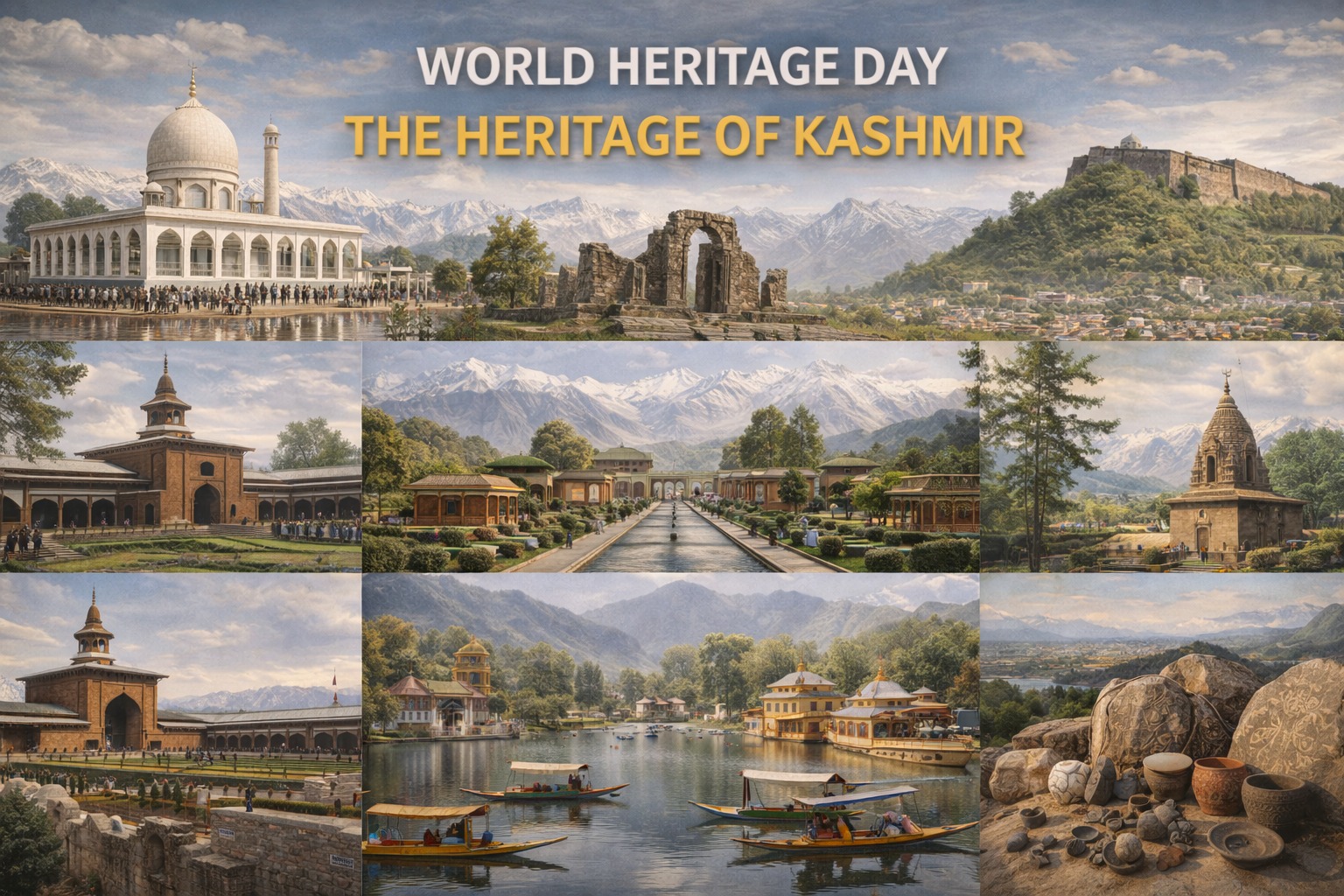
“Kashmir stands as a perfect example where cultural, natural, and living heritage coexist in harmony.”
On 18th April each year, World Heritage Day is celebrated worldwide to create awareness about the preservation of cultural and natural heritage. Heritage includes buildings and monuments, along with traditions, beliefs, landscapes, and the historical legacy of a region.
Worldwide, 1223 heritage sites have been recognized by UNESCO. In India, there are 43 World Heritage Sites that come under the categories of culture, natural, and mixed. While Kashmir is yet to receive world heritage status, it is widely known as the “paradise on earth” due to its breathtaking beauty and rich cultural and historical heritage.
Types of Heritage
Heritage is broadly classified into three types: cultural, natural, and mixed heritage. Cultural heritage includes monuments, temples, mosques, gardens, and forts created by humans over centuries. Natural heritage consists of rivers, mountains, valleys, forests, and natural landscapes shaped by nature.
Kashmir stands as a perfect example where all these forms of heritage coexist. Its scenic beauty, ancient architecture, and living traditions together create a unique and rich heritage landscape.
Cultural Heritage of Kashmir: Mughal Gardens of Kashmir
Shalimar Bagh (Srinagar)
Shalimar Bagh is one of the most famous Mughal gardens located on the banks of Dal Lake in Srinagar. It was built in 1619 by Mughal Emperor Jahangir for his beloved wife Nur Jahan. The garden reflects the grandeur and elegance of Mughal architecture and their love for nature.
It is designed in a series of terraces with flowing water channels, fountains, and chinar trees. The layout follows the Persian Charbagh style, symbolizing paradise. Shalimar Bagh was used for royal gatherings and relaxation, making it not just a garden but a symbol of Mughal luxury and artistic excellence.
Nishat Bagh (Srinagar)
Situated about 11 km from Srinagar along the eastern side of Dal Lake. It was built in 1633 by Asif Khan, the brother of Empress Nur Jahan.
The garden is famous for its twelve terraces, each representing different levels of beauty and possibly the twelve zodiac signs. It offers a breathtaking view of Dal Lake and the Zabarwan mountain range. Nishat Bagh represents harmony between human design and natural surroundings.
Chashme Shahi (Srinagar)
Located around 9 km from Srinagar, it was built in 1632 by Ali Mardan Khan under the orders of Emperor Shah Jahan.
It is the smallest of the Mughal gardens but is highly valued for its natural spring, whose water is believed to have medicinal properties. The garden is arranged in terraces with water flowing through them, creating a peaceful and refreshing environment.
Pari Mahal (Srinagar)
Meaning “Palace of Fairies,” it is situated on the Zabarwan mountain range overlooking Srinagar and Dal Lake. It was built in the 17th century by Dara Shikoh, the eldest son of Shah Jahan.
It served as a center for learning, particularly astronomy and Sufi philosophy. The structure, with its arched terraces and panoramic views, reflects both educational and architectural significance.
Achabal Garden (Anantnag)
Achabal Garden is located in the Anantnag district and was built around 1620 by Empress Nur Jahan. It was originally known as Bagh-e-Begumabad.
The garden follows the Persian Charbagh style but is uniquely adapted to the natural slope of the land. It includes terraces, water channels, fountains, and natural springs. Achabal was used as a royal retreat and reflects the engineering and artistic skills of the Mughal period.
Religious & Spiritual Heritage
Hazratbal Shrine (Srinagar)
The Hazratbal Shrine is situated at the northern end of Dal Lake. It is the most sacred and significant shrine in Kashmir as it contains the relics of Prophet Muhammad (PBUH).
Its marble construction and serene environment contribute towards the importance of the shrine and attract several believers, especially on religious festivals.
Jamia Masjid (Srinagar)
Situated within the old walled city of Srinagar and is believed to have been constructed in the year 1394 under the reign of Sultan Sikandar.
The architectural style of Jamia Masjid consists of 370 wooden pillars and a massive courtyard. It has served as an important place of religious congregation since the early times.
Khanqah-e-Moula (Srinagar)
Khanqah-e-Moula or Shah-e-Hamdan Shrine is situated close to the Jhelum River. Khanqah-e-Moula is the most ancient shrine of Kashmir, built by Mir Sayyid Ali Hamadani, who preached Islam in this region. It is famous for its unique wooden architecture and beautiful carvings.
Kheer Bhawani Temple (Tulmulla)
The Kheer Bhawani Temple is located in Tulmulla, about 27 km from Srinagar. It is dedicated to Goddess Ragnya Devi and is built around a sacred spring. The colour of the spring water is believed to change, which holds religious significance. The temple is an important pilgrimage site for Kashmiri Pandits.
Chatti Patshahi Gurudwara (Baramulla)
This Gurudwara is located in the Baramulla district of Kashmir, and it is established in honour of Guru Hargobind, the Sixth Guru of Sikhs. This Gurudwara indicates the visit of Guru Hargobind to Kashmir. It has immense religious significance for the Sikh community.
Shrine of Muqam Shah Wali (Kupwara)
Muqam Shah Wali shrine, which is highly revered by the local population and serves as a reflection of the Sufi tradition of Kashmir.
Archaeology of Ancient Temples and Monuments
Martand Sun Temple (Anantnag)
The Martand Sun Temple is situated near Anantnag and was constructed in the 8th century by King Lalitaditya Muktapida of the Karkot dynasty.
This temple is devoted to the sun god and is considered one of the best instances of Kashmiri architecture of that time. It has magnificent pillars with carved stones, even after being destroyed over centuries.
Awantipora Ruins (Pulwama)
The Awantipora ruins are situated about 30 km away from Srinagar and were constructed in the 9th century by King Avantivarman. It is comprised of the ruins of two temples, one for Lord Shiva and the other for Lord Vishnu.
Shankaracharya Temple (Srinagar)
This temple is located on Shankaracharya Hill overlooking Srinagar. It is dedicated to Lord Shiva and is believed to date back to ancient times, later renovated by different rulers. The temple provides a panoramic view of the entire city and holds both religious and historical importance.
Sugandesha Temple (Pattan)
The Sugandesha Temple, located near Srinagar, is an example of early medieval Kashmiri temple architecture and reflects the region’s religious history.
Burzahom Archaeological Site (Srinagar)
Burzahom, which means “place of birch”, lies at a distance of 16 kilometres from Srinagar and belongs to the period 3000 BCE – 1000 BCE. This site holds great archaeological importance in Kashmir as it represents a place where people used to live in pit dwellings. Burials of animal skeletons with human beings, tools and pottery have been found here, along with traces of ancient medicine such as trepanning.
Gufkral Archaeological Site (Tral)
Gufkral is an important prehistoric archaeological site situated in Tral, which marks the transition from the age of caves to that of civilization.
Bumzuva Cave Temple (Mattan)
The Bumzuva Cave Temple is situated near Mattan in the Anantnag district. It is a rock-cut cave temple that acts as a transitional period between the rock-cut architecture of the earlier days and structural temples. This monument represents both the natural formation and the workmanship of man.
Satbaran Rock Carvings (Lolab Valley)
Satbaran rock carvings can be found in the Lolab Valley, Kupwara district. The carved art is etched in a big rock, dating back to 3300 BCE to 1000 BCE.
These artefacts act as an artistic representation and indicate the existence of a civilization during those times. They hold cultural and archaeological importance.
Forts and Cultural Monuments
Hari Parbat Fort (Srinagar)
Hari Parbat Fort is located in Srinagar and sits atop a hill. The Fort has seen many rulers, such as the Mughals, Afghans, and Sikhs. The fort showcases the history and politics of Kashmir, along with providing a beautiful view of the city.
Meeras Mahal (Sopore)
There is a heritage museum named Meeras Mahal in Sopore, established by the ‘Iron Lady of Sopore’, Atiqa Bano, in 2001. This is a significant cultural heritage site in Kashmir because it contains cultural and historical elements in the form of artefacts and tools.
Ancient Learning Center
Sharda Peeth
Sharda Peeth was one of the most important ancient temple universities between the 6th and 12th centuries CE. It was dedicated to Goddess Sharada, a form of Saraswati. It was a major centre of learning and attracted scholars from different regions, playing a key role in shaping the intellectual history of Kashmir.
Natural and Mixed Heritage
Verinag (Anantnag)
Verinag is located at the foothills of the Pir Panjal range and is the main source of the Jhelum River. It was developed in 1620 by Mughal Emperor Jahangir, who constructed stone arcades around the octagonal spring. Later, Shah Jahan extended it into a garden. It is a perfect example of the combined natural and architectural heritage.
Kalaroos Caves (Kupwara)
The Kalaroos caves are located in the Lolab Valley and are surrounded by dense forests.
They are associated with myths of a tunnel leading to Russia. Although unproven, these stories add mystery and attract visitors.
Intangible Cultural Heritage
The rich heritage of Kashmir is also embodied in some of its traditions, which continue to thrive to date. Some of these traditions include Pashmina shawls, carpet weaving, Sufi music, the traditional food known as Wazwan and other celebrations. These traditions have been inherited by successive generations and constitute an integral part of Kashmiri identity.
The rich heritage of Kashmir is a distinct combination of its natural, historical and cultural significance. Whether it be the presence of old temples, archaeological sites, Mughal gardens, or traditions, each of these signifies some other aspect of Kashmir’s identity. It is thus pertinent on World Heritage Day to honour this rich heritage.
The author is a writer and Social Educator from District Baramulla. He can be mailed at shoaibhat2018@gmail.com



Comments are closed.