
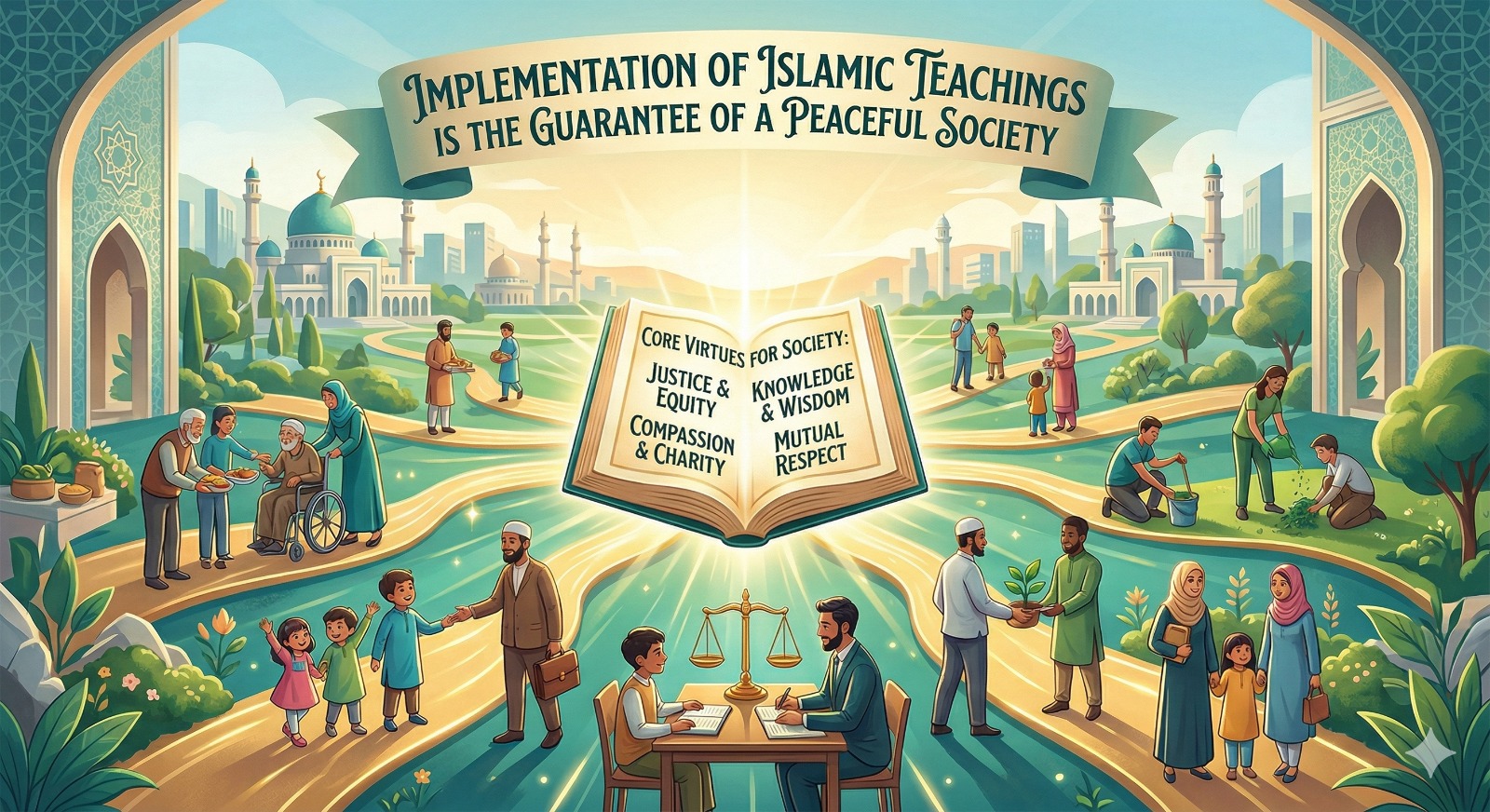
How Islamic Teachings Can Build a Peaceful Society: Between Moral Ideals and Human Realities


Dr. Reyaz Ahmad
“If moral values were lived as sincerely as they are preached, the world would not be free of problems — but it would be far more humane.”
It is often said that if the teachings of Islam were truly followed, society would witness justice, harmony, and peace—and much of the unrest that troubles the modern world would gradually disappear. At first glance, this assertion carries deep moral weight. Islam does not present itself merely as a collection of rituals or spiritual exercises; rather, it offers a comprehensive ethical framework that governs both personal conduct and social order. It speaks of justice, compassion, honesty, restraint, accountability, and respect for human dignity. It calls upon human beings to rise above divisions of tribe, race, and status, and to recognize one another through the lens of shared humanity.
The moral vision embedded in the Qur’an is striking in its clarity. It commands justice and forbids aggression. It elevates the sanctity of human life to the highest level, declaring that saving one life is akin to saving all of humanity. It urges individuals to act with fairness even when it is difficult, to uphold truth even when it goes against personal interest, and to exercise mercy in all dealings. In principle, a society that genuinely internalizes and practices such values would almost certainly be more peaceful than one driven by greed, arrogance, and unchecked self-interest.
Yet, the reality of the present world compels us to look beyond principle and into practice. If the ethical framework is so powerful, why do many societies that identify strongly with religion continue to struggle with corruption, injustice, violence, mistrust, and division? Why does a world rich in religious language remain poor in social harmony?
The answer lies in a critical but often overlooked distinction—the difference between believing in a moral system and living by it. There is a vast gap between admiration and application, between ritual observance and ethical transformation. The problem, therefore, is not the inadequacy of Islamic teachings; it is the inconsistency of human practice.
Islam, when properly understood, does not reduce religion to isolated acts of worship. Prayer, fasting, and charity are not ends in themselves; they are means to cultivate moral discipline. A person cannot meaningfully claim devotion to God while engaging in injustice, dishonesty, or cruelty. Worship in Islam is inseparable from conduct. If prayer does not instill humility and restraint, if fasting does not awaken empathy for the less fortunate, if charity does not reduce greed, and if religious knowledge does not soften the ego, then religion has been performed outwardly but not internalized inwardly.
This gap between outward expression and inward transformation is where much of the present unrest finds its roots.
The world today is not simply dealing with isolated pockets of conflict; it is facing a broader moral crisis. Global reports point to rising levels of violence, increasing displacement, and deepening social fragmentation. Millions of people are forced to leave their homes due to war, persecution, and instability. Inequality continues to widen, trust in institutions is eroding, and communities are becoming increasingly polarized. These realities are not confined to any one region or culture—they reflect a shared human condition.
Importantly, these conditions do not disprove the moral vision of Islam. On the contrary, they reinforce it. Much of the unrest we witness today stems from precisely the moral failures that Islamic teachings warn against—unchecked injustice, economic exploitation, dishonesty, arrogance, and the misuse of power. When leaders govern without accountability, when wealth is accumulated without compassion, and when identity is weaponized to demean others, social instability becomes inevitable. Islam did not create these problems; it identified them long before they became global crises.
Consider the issue of corruption. A society may outwardly display religiosity—building places of worship, observing religious rituals, and celebrating sacred occasions. Yet, if bribery becomes normalized, merit is sidelined, and public office is treated as personal property, the moral foundation of that society begins to erode. Trust diminishes, frustration grows, and social cohesion weakens. Such a society may appear religious on the surface, but its underlying system operates in contradiction to the very values it claims to uphold.
The same contradiction can be observed within family structures. Islam places immense emphasis on the family as the foundation of a stable society. It honors parents, protects the rights of children, and establishes a framework of mutual respect and compassion between spouses. However, when homes are marked by neglect, domination, or emotional distance, the seeds of unrest are sown at the most fundamental level. A society cannot expect peace in the public sphere if its private spaces are filled with unresolved tensions.
Equally significant is the issue of human dignity. Islamic teaching rejects all forms of superiority based on race, tribe, or lineage. It emphasizes that all human beings are equal in their essence and worth. Yet, in many parts of the world, divisions based on ethnicity, sect, class, and nationality continue to shape social interactions. These divisions foster mistrust and hostility, undermining the possibility of unity. When the principle of human dignity is compromised, social harmony becomes fragile.
At the same time, intellectual honesty requires us to acknowledge that not all unrest can be attributed solely to individual moral failure. The modern world is shaped by complex structural forces—geopolitical rivalries, economic inequalities, historical injustices, and institutional weaknesses. War economies, authoritarian governance, disinformation, and the proliferation of weapons all contribute to instability. Even a morally conscious population can struggle in the absence of just and effective institutions.
Here again, Islamic teachings remain relevant. They do not limit themselves to personal morality; they extend to the organization of society. Islam advocates fairness in trade, justice in governance, protection of life and property, and care for the vulnerable. It emphasizes the fulfillment of trusts and the importance of accountability in positions of authority. In essence, it calls for a moral alignment between individual behavior and institutional practice.
This brings us to a crucial point—the meaning of “properly followed.” Proper adherence to Islamic teachings is not selective. It does not mean strictness in ritual and leniency in ethics. It does not mean public displays of piety coupled with private injustice. Nor does it mean defending one’s own group while denying fairness to others. True adherence requires consistency—an awareness of accountability before God in all circumstances, whether in public or private, in moments of power or vulnerability.
If such a standard were applied consistently across society, its impact would be transformative.
A businessperson would conduct transactions with honesty and transparency.
A judge would uphold justice without fear or favor.
A teacher would fulfill their responsibility with sincerity and dedication.
A spouse would act with kindness and respect.
Children would care for their aging parents with compassion.
Leaders would serve with integrity rather than exploit divisions for personal gain.
Scholars would prioritize truth over popularity.
Citizens would not remain silent in the face of injustice.
Such a society would not be perfect—human imperfection is an enduring reality—but it would be far more just, stable, and humane than what we witness today.
Therefore, the claim that Islamic teachings can build a peaceful society should neither be dismissed as unrealistic nor accepted without nuance. It is true in its moral essence but often unfulfilled in its social application. The principles are sound; the challenge lies in their consistent implementation.
The unrest that defines much of the contemporary world is not evidence of the failure of moral guidance. Rather, it is evidence of how rarely such guidance is fully embraced. Values such as justice, mercy, and accountability are widely acknowledged, yet insufficiently practiced. This gap between knowing and doing is where the real crisis lies.
The lesson, then, is both simple and profound. Peace does not emerge from identity alone; it emerges from integrity. It is not enough to claim affiliation with a moral system—one must embody its values in everyday life. Until justice is practiced, compassion is extended, dignity is protected, and accountability is upheld, unrest will persist, regardless of the labels societies adopt.
In the end, the world is not suffering because moral teachings are absent. It is suffering because those teachings are admired more than they are lived.
And perhaps that is the most honest reflection of all.
Comments are closed.