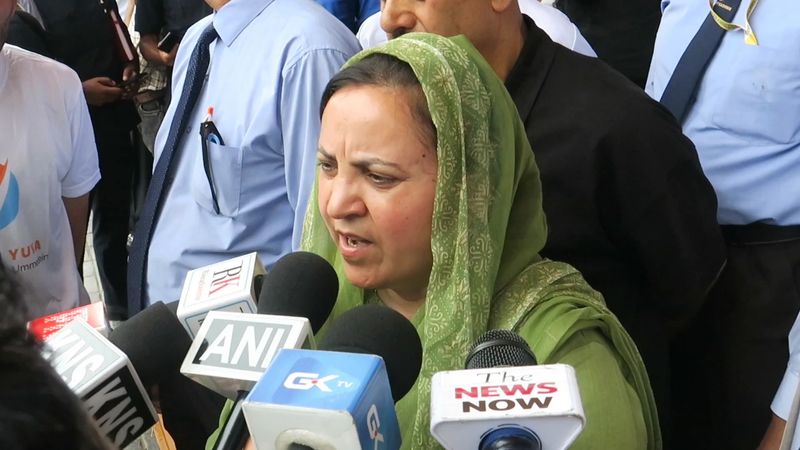
Jammu, Mar 28: Cabinet Minister Sakina Itoo on Saturday said the government has finalized a comprehensive bill to tackle the menace, with the Law and Finance departments already granting their concurrence, while asserting that substance abuse has turned into a “grave epidemic” in Jammu and Kashmir.
Speaking to Kashmir Convener outside the Assembly, Minister Itoo said the legislation is a “need of the hour” and will be brought to the House during the current session.
“The bill is almost ready. The law department and the finance department have already given concurrence to it. God willing, we are trying to bring that bill to the House during this assembly session and pass it,” she said.
The minister’s remarks come amid growing concern over rising addiction among the youth in the Union Territory.
Citing data from the past five to six years, she pointed to a sharp increase in cases of depression and unemployment, which she said were pushing young people toward drugs.
“Earlier, young people in Jammu and Kashmir did not use drugs so much. But today, if you look at the figures, in the last five to six years, young people are suffering from depression. They do not have any jobs. But if they turn towards drugs, then this is destruction and devastation,” Minister Itoo said.
She emphasized that the issue has become a collective concern for the entire House, with legislators from all sides calling for urgent action. While the Home Department is responsible for curbing the supply and infiltration of narcotics, the minister said her role as Health Minister is to strengthen the healthcare infrastructure for those already trapped in addiction.
“My job as Health Minister is to treat them, to counsel them,” she said, adding that the proposed bill is being prepared on the foundations of rehabilitation, counselling, treatment, and stricter enforcement.
The minister also addressed the role of chemist shops in the drug supply chain, stating that authorities have already clamped down on the sale of scheduled drugs without prescription. “Every medical shop has been called for CCTV. They have already been banned from giving these medicines without a prescription. If a doctor prescribes a medicine, it should be given only with a prescription,” she said.
On de-addiction centres, Minister Itoo cautioned against mere tokenism. “It is not just that you open the ribbon and put up the board. But the equipment that you have near the de-addiction centre—doctors, consultants, psychiatrists—should be there. Only when they are there, then you can have a de-addiction centre and you can treat there,” she said.
When asked about repeated instances of drug seizures failing to translate into long-term deterrence, the minister maintained that the problem is not impossible to control. “It is not impossible to stop something. When you put a stop to it continuously, then it is not difficult to control it,” she said.
The proposed bill, once passed, is expected to provide a unified legal framework to address what Ms Itoo described as an “epidemic” spreading through society. “So that according to it, whatever laws are there, whatever things are there, those things can be implemented properly, so that we can get rid of this epidemic,” she added.

Comments are closed.