

S. Ahmad
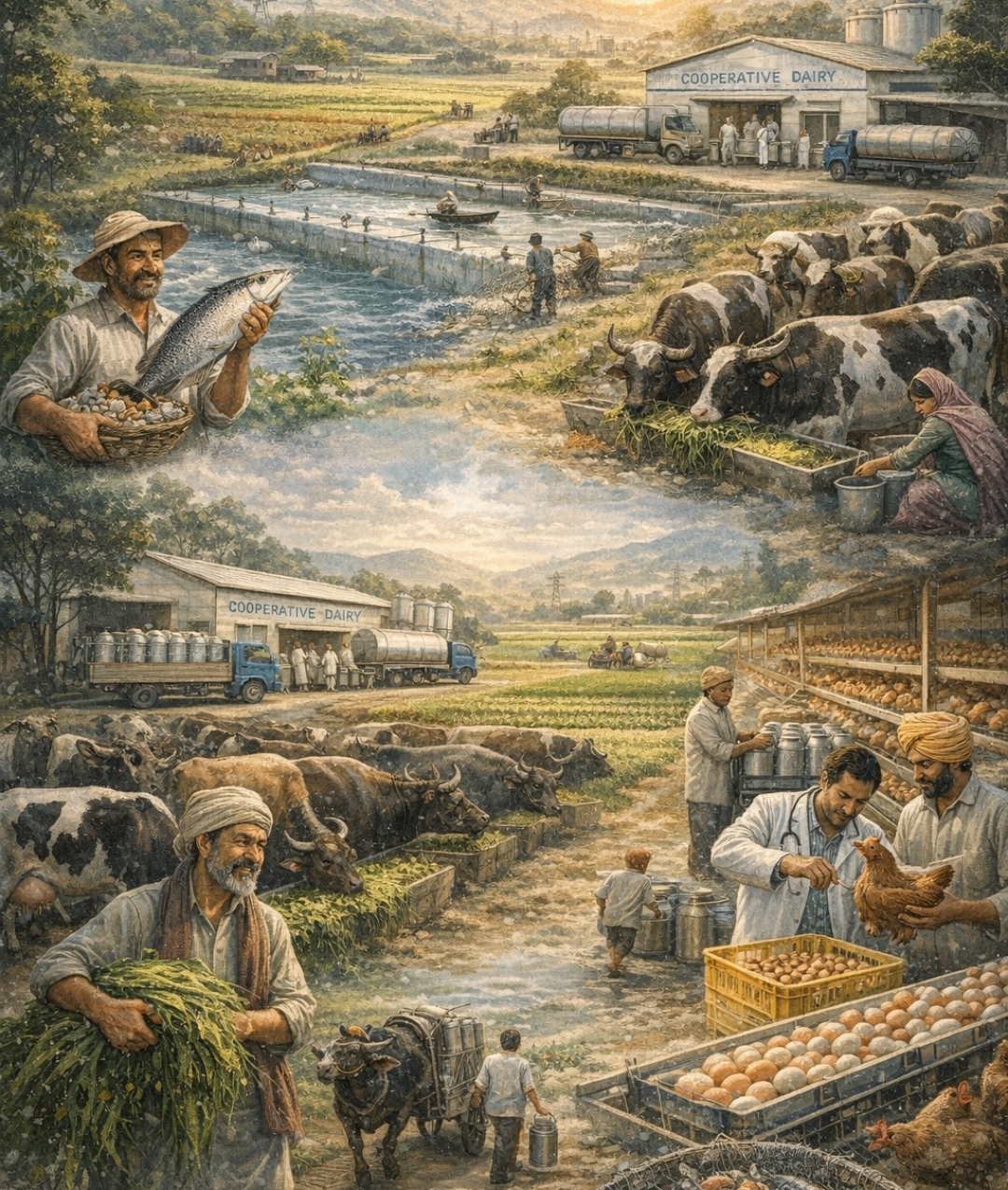
India’s agricultural transformation is no longer confined to crop cultivation alone. Over the past decade, allied sectors such as livestock, dairy, poultry, and fisheries have emerged as dynamic engines of rural growth, income stability, and employment generation. As land fragmentation, climate variability, and price volatility reshape traditional farming systems, rural households increasingly rely on diversified income sources to ensure economic resilience. In this evolving landscape, livestock and fisheries have become central pillars of agricultural Gross Value Added (GVA) and non-farm rural livelihoods.
Agriculture and allied sectors have maintained a steady compound annual growth rate of 3 to 5 percent in recent years, driven by targeted policy interventions, rising domestic demand, and private sector innovation. Projections suggest that by 2047, the sector could potentially triple in size, significantly strengthening India’s economic trajectory. Rather than signalling a departure from agriculture, diversification reflects the emergence of an integrated rural economy in which farming is complemented by dairy, fisheries, and other income streams. Institutions such as cooperatives, Farmer Producer Organisations (FPOs), and Self-Help Groups (SHGs) have improved credit access, technology adoption, and market linkages, enabling small and marginal farmers to participate more effectively in organised value chains.
Within this broader transformation, livestock and fisheries have demonstrated particularly robust and stable growth, averaging 5 to 6 percent annually. Their importance lies not only in output expansion but in income regularity. Dairy provides frequent cash inflows through daily milk sales, while fisheries offer multiple production cycles across the year, creating sustained employment. Many rural households integrate crop production with livestock rearing, recycling crop residues as fodder and organic manure, thereby reducing input costs and enhancing sustainability. Between FY15 and FY24, the allied sector’s GVA rose by nearly 195 percent at current prices, reflecting a CAGR of 12.77 percent. Recognising this strategic role, the Union Budget 2026–27 allocated ₹6,153.46 crore to the Department of Animal Husbandry and Dairying, marking a 16 percent increase over the previous year.
India’s global standing in livestock and fisheries underscores the scale of this transformation. The country is the world’s largest milk producer, accounting for nearly one quarter of global output. Milk production rose from 146.31 million tonnes in 2014–15 to 247.87 million tonnes in 2024–25, representing a growth of over 69 percent. Per capita milk availability has reached 485 grams per day, significantly exceeding the global average. India also ranks second globally in egg production, with output rising from 78.48 billion eggs to 149.11 billion eggs over the same period. In fisheries, India is the world’s second-largest producer, with total output increasing from 9.58 million tonnes in 2013–14 to 19.77 million tonnes in 2024–25. The sector supports over 30 million livelihoods and contributes nearly 8 percent of global fish production. Meat production has similarly expanded, rising from 6.69 million tonnes in 2014–15 to 10.50 million tonnes in 2024–25, consolidating India’s position as the fourth-largest producer globally.
This expansion has been underpinned by sustained policy interventions. Flagship programmes such as the National Livestock Mission, the Rashtriya Gokul Mission, and the National Animal Disease Control Programme have strengthened breed improvement, disease control, and livestock entrepreneurship. Under genetic improvement initiatives, over 14.56 crore artificial inseminations have been conducted, benefiting more than 5.62 crore farmers. The training of nearly 39,810 MAITRI technicians has reinforced last-mile service delivery, accelerating productivity gains. Indigenous cattle productivity has increased significantly, while buffalo productivity has also registered sustained improvement, reflecting one of the fastest productivity growth trajectories globally.
Disease control has been equally transformative. Large-scale vaccination under the National Animal Disease Control Programme led to a dramatic reduction in Foot and Mouth Disease outbreaks, declining from 132 reported cases in 2019 to just 6 cases in 2025. Brucellosis outbreaks have been eliminated. Over 125.75 crore FMD vaccinations were administered, directly benefiting approximately 26.27 crore farmers. These measures have reduced production losses and strengthened income stability.
Market integration has been deepened through the expansion of dairy cooperatives and procurement networks. The dairy ecosystem now includes 22 milk federations, 241 district unions, and nearly 32,000 dairy cooperative societies integrating millions of producers into formal value chains. Daily milk procurement has increased substantially, and processing capacity is being expanded to 100 million litres per day by 2028–29. Institutional credit support under the Kisan Credit Card (KCC) scheme has further enabled farmers to transition from subsistence operations to market-oriented enterprises, with high acceptance and sanction rates in animal husbandry and fisheries applications.
In fisheries, growth has been accelerated by focused policy initiatives such as the Pradhan Mantri Matsya Sampada Yojana and the Pradhan Mantri Matsya Kisan Samridhi Sah-Yojana. Fish production has grown at an average annual rate of 8.74 percent over the decade, with inland fisheries driving much of the expansion. Seafood exports have more than doubled, increasing from ₹30,213 crore in 2013–14 to ₹62,408 crore in 2024–25, reaching over 130 countries. Infrastructure development has supported this expansion, with thousands of fish transportation units, retail markets, and value-added enterprises established. The Fisheries and Aquaculture Infrastructure Development Fund, launched with a corpus exceeding ₹7,500 crore, has strengthened harbours, landing centres, cold chains, and aquaculture facilities.
Marine governance reforms further reflect sustainability commitments. With a coastline exceeding 11,000 kilometres and an Exclusive Economic Zone of approximately 24 lakh square kilometres, India has implemented new Rules and Guidelines for Sustainable Harnessing of Fisheries in the EEZ and High Seas (2025), aligning resource management with international compliance standards. Institutions such as the Marine Products Export Development Authority continue to anchor export competitiveness through quality assurance and ecological stewardship.
Digital transformation has emerged as a defining feature of sectoral reform. The 12-digit livestock identification system known as Pashu Aadhaar has created a digital backbone for animal health and breeding data. Over 36 crore livestock have been registered on the Bharat Pashudhan Portal. Automated Milk Collection Systems ensure transparent procurement and timely payments, while the Internet-based Dairy Information System integrates data across cooperatives. In fisheries, the National Fisheries Digital Platform has registered over 28 lakh stakeholders, linking fishers to credit, insurance, and traceability systems, thereby reducing transaction costs and strengthening financial inclusion.
Beyond economic metrics, the dairy and fisheries sectors contribute directly to the Sustainable Development Goals. Sustainable marine resource management aligns with SDG 14 on life below water, while inclusive dairy development supports poverty reduction, productive employment, and reduced inequalities. Nearly 150 million farmers are engaged in dairying, many of them women and smallholders, making the sector a critical vehicle for social empowerment.
In conclusion, India’s emphasis on livestock and fisheries represents a structural shift toward diversified, resilient rural growth. Productivity enhancement, institutional support, market integration, digital public infrastructure, and sustainability reforms have collectively transformed these allied sectors into powerful drivers of income stability and nutritional security. By strengthening cooperatives, expanding credit access, and integrating producers into organised markets, India has built a rural economic framework capable of withstanding climatic and market shocks. The convergence of policy innovation, technological advancement, and grassroots participation ensures that livestock and fisheries will remain central to India’s agricultural and developmental future.
Comments are closed.