

S.Ahmad
The Union Budget 2026–27 presents tourism not merely as a service sector, but as a structural pillar of India’s long-term economic architecture. By combining infrastructure expansion, heritage conservation, skill development, ecological sustainability, and digital integration, the Budget places tourism at the intersection of economic growth, cultural preservation, and regional transformation. Rather than isolated announcements, the measures collectively indicate a comprehensive strategy aimed at employment generation, international positioning, and balanced development.
Tourism occupies a critical place within India’s economic framework. According to the India Tourism Data Compendium 2025 issued by the Ministry of Tourism, the sector contributes 5.22 percent to the country’s total GDP impact, with a direct contribution of 2.72 percent. Its employment impact is even more substantial, supporting 13.34 percent of total jobs, including a direct share of 5.82 percent. These figures underscore tourism’s strong multiplier effect, as it sustains livelihoods across hospitality, transport, handicrafts, local entrepreneurship, and a wide range of allied services. In recognising this capacity, the Budget frames tourism as both an economic catalyst and a vehicle for inclusive development.
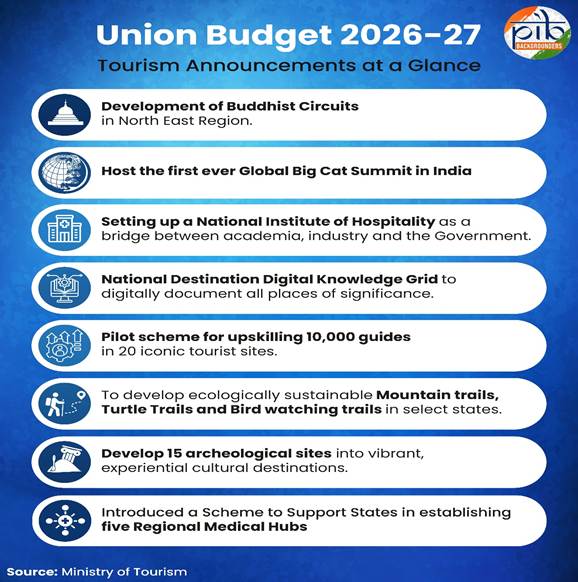
A significant thematic emphasis of the Budget is destination-led development, particularly in regions with untapped spiritual and cultural potential. The announcement of a new scheme for the development of Buddhist Circuits in the North-Eastern Region reflects a deliberate attempt to position Arunachal Pradesh, Assam, Sikkim, Manipur, Mizoram, and Tripura as key nodes on the global Buddhist tourism map. The initiative proposes conservation and development of temples and monasteries, the establishment of pilgrimage interpretation centres, improved connectivity to major sites, and enhanced pilgrim amenities. By building upon the earlier Swadesh Darshan Scheme and its revamped version Swadesh Darshan 2.0, the Government seeks to integrate spiritual heritage with sustainable infrastructure and community participation. With seventy-six projects sanctioned under the original scheme and seventy-five already completed at a cost exceeding ₹5,290 crore, the track record provides institutional credibility to the new initiative.
Sustainability forms another central axis of the tourism strategy. The Budget proposes the development of ecologically sensitive mountain and nature trails in Himachal Pradesh, Uttarakhand, and Jammu & Kashmir, alongside biodiversity-based circuits such as turtle nesting trails in Odisha, Karnataka, and Kerala, and bird-watching trails around Pulicat Lake in Andhra Pradesh. By promoting eco-tourism grounded in conservation, the Government aims to leverage India’s diverse ecosystems while ensuring environmental responsibility. Expanded rail connectivity, regional transport integration, and improved access to remote destinations are intended to complement these efforts, enabling seamless mobility without compromising ecological balance.
India’s global positioning in eco-tourism diplomacy receives renewed emphasis through the announcement that the country will host the first-ever Global Big Cat Summit in 2026. The summit will invite heads of governments and ministers from ninety-five big cat range countries to deliberate on conservation strategies, habitat protection, and sustainable wildlife tourism. This initiative aligns with India’s leadership role in the International Big Cat Alliance, a treaty-based body headquartered in India. Home to five of the world’s seven big cat species—tiger, lion, leopard, snow leopard, and cheetah—India seeks to reinforce its standing as a global conservation leader while simultaneously strengthening eco-tourism partnerships and knowledge exchange frameworks.
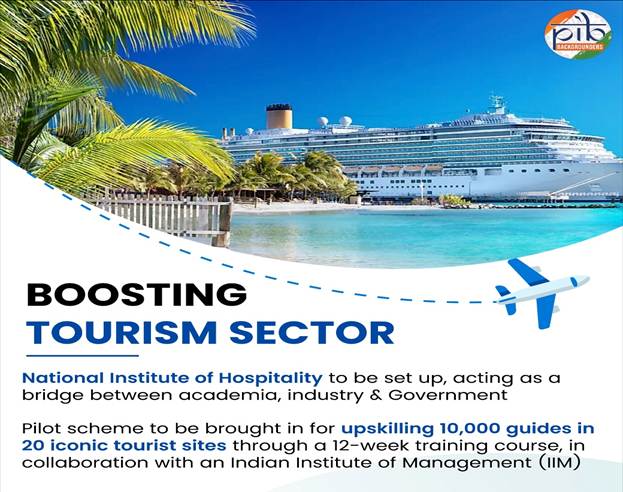
Institutional reform and human capital development represent another critical component of the Budget’s tourism blueprint. The proposed upgrade of the National Council for Hotel Management and Catering Technology into a National Institute of Hospitality is designed to enhance academic standards, align curricula with industry demands, and foster research and international collaboration. Simultaneously, a pilot initiative to upskill ten thousand tourist guides across twenty iconic destinations aims to professionalise guiding services through a structured twelve-week hybrid training model in collaboration with a premier management institute. These interventions complement existing programmes such as Capacity Building for Service Providers and the Incredible India Tourist Facilitator initiative, reinforcing the objective of creating a skilled and globally competitive tourism workforce.
Comments are closed.