
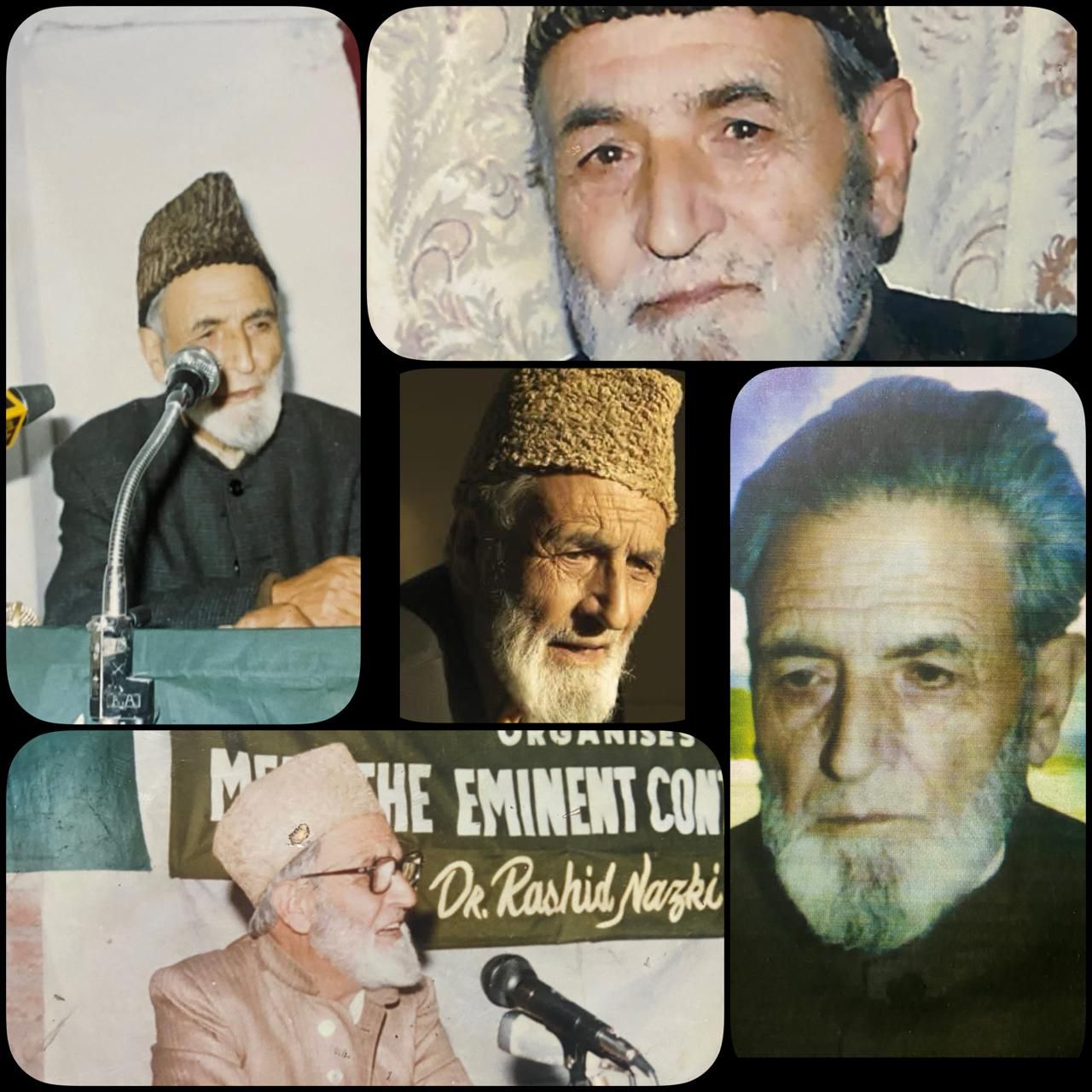

Shabeer Ahmad Lone
Kashir Shairee te Tasawuff: This upcoming book is a scholarly exploration of Tasawuff and Kashmiri poetry.It engages with its historical and cultural roots, mystical philosophy, symbolic language with critical attention and contemporary relevance etc.
Rashid Nazki in Letters:
بہر رنگے کہ خواہی جامہ مے پوش
من اندازِ قدت را مے شناسم
In historical perspective, literary and intellectual correspondence among notable figures(mashaheer) signals an individual’s recognized standing, active engagement, and lasting participation in the broader currents of intellectual and cultural history. From distinguished luminaries such as Amin Kamil, M. Yousuf Taing, Rehman Rahi, Shafi Shauq, and others P.Nos 550- 557, Sheeraze Rashid Nazki 2019,bear witness to a rare convergence of reverence, intimacy and intellectual exchanges. They illuminate Nazki’s erudition while revealing a spirit of humility and gentleness that rendered him not merely a scholar but a guide, a mentor, and a source of inspiration. Through these exchanges, one glimpses how true intellectual greatness harmonizes with modesty, transforming scholarship into a living, enlightening dialogue of hearts and minds in the spirit of;
از کریمان این هم دشوار نیست
Through a series of letters addressed to Rashid Nazki, dated 9 June 2005, 10 November 2005, and 23 March 2006 from an accomplished poet Rehman Rahi shared his poems and natiyah kalam, seeking attentive engagement ,critical impressions, and refinement /corrective guidance. These exchanges testify not only to Nazki’s stature as a trusted literary mentor and critic, but also to a vibrant tradition of scholarly dialogue rooted in humility, rigor, and mutual reverence.
Letters addressed to luminaries such as Shamim Ahmad Shamim, Shamsur Rahman Faruqi, Hammidi Kashmiri, Tanha Ansari, M. Yousuf Taing, Mishal Sultanpuri, and others reveal a style unmistakably his own. One is drawn into the text, captivated by its nuanced diction, measured cadence, and expansive vision, while simultaneously encountering a lexicon enriched by the subtle resonances of Arabic, Persian, and Urdu, which lends his expression both depth and enduring elegance.
Kashir Kitab-Kashur Qalm (Presented copy, 2008 inscription),upon presenting Kashir Kitab to Prof. Rashid Nazki, Mohammad Yusuf Teng inscribed: “To the Murshid (Spiritual Guide) of life and literature, the great Mahapadam Sir (vast expanse of ʿilm-o-ʿirfān), Professor Rashid Nazki Sahib, a cherished cloud of my affection, for the delight of study and the grace of your benevolent gaze.”[19] -Mohammad Yusuf Teng, 19 May 2008.
Rashid Nazki left us on January 7th, 2016, leaving an indelible void in Kashmiri literature. Yet his monumental scholarly and literary achievements will keep his legacy alive, ensuring that his name endures as long as the Kashmiri literary tradition itself continues to thrive.
Noozkus gul marqads d zeyuv kafan gul shaand gull
Poshe moot chul baag teravith az chu matam daar gul
Reading, translating and publishing Rashid Nazki’s works-both his celebrated texts and his unpublished manuscripts-is essential to unlock the full breadth of his intellectual, literary, and mystical vision. Such efforts will allow a global readership to engage with the literary, philosophical and spiritual insights his corpus contains, while enabling scholars, poets, and seekers to experience and preserve the enduring depth and transformative power of his legacy.
Among his sons, former administrator Mubashir Saleem Nazki (a son who embodies, honours and understands the enduring legacy of his ancestors and his father Prof.Abdul Rashid Nazki) has taken the initiative to collect Professor Rashid Nazki’s manuscripts for publication. Yet at the institutional level-whether the Sahitya Akademi, New Delhi, the Jammu & Kashmir Academy of Art, Culture and Languages, the Kashmiri Department at the University of Kashmir, or other state cultural organizations-there remains a pressing need for collective effort. Scholars, contemporaries, students, and translators must step forward to support this cause, gather and publish his unpublished works, and thereby ensure that the full breadth and enduring significance of his literary and intellectual legacy is recognized. shabirahmed.lone003@gmail.com
Shabeer Ahmad Lone
Educationist, researcher, writer, colunmist, Ex.L.member ICPR, MAAS.
Critical Appreciations of Prof. Abdul Rashid Nazki
Z-e-shair-e-dilkash-e-Hafez kisi bawad aagah
Ke lutf-e-taba‘ o sukhan guftan-e-Dari danad
(Hafez Shirazi)
تھا ضبط بہت مشکل اس سیل معانی کا
کہہ ڈالے قلندر نے اسرار کتاب آخر
Acher Awazi Garan Kaech Shabeeh
Preth shabihas zabaan bayan tanha
Tath shaharas Az te Narus gul folan
Khabri cha vead nazri hind yaven golab
Vanin kum kyah vanun , cho Nuzkus narok sanear baqi-(Nazki)
Prof.Rashid Nazki’s poetic and prose corpus extends a compelling invitation to scholars and critics, urging a sustained engagement that uncovers its enduring relevance, illuminates the depth of its aesthetic, philosophical, and mystical vision, and reveals its transformative resonance for both contemporary and timeless literary discourse.
The many facets of Rashid Nazki’s poetic counciousness has been encompassed as: A poet of aesthetic vision-Hamidi Kashmiri in Vahraath and Mishal Sultanpuri in Shiraazi Rashid Nazki Number, Poet of gami douraan and gami janaan (worldly sorrow and the soul’s yearning)- Syed Rasul Pompre (Soun Koshur Adab/Kashir Zabaan te Adab), poet of sublime grace-G.N Gowhar, A Modern Poet of Subtle Mystical Temperament /A poet of Eastern Aesthetics-Prof. Shaad Ramzan, Maji-zav /Wahbi Shair-S.Razi, Ashiq Mijaz-Nazir Kulgamiin Shiraazi Rashid Nazki No, and Aziz Hajini (Dari Patch Hund Shair), Tradition-councious poet, Witness of His Time etc. Rashid Nazki’s poetry embodies a continuum of Kashmiri literary aesthetics . Nazki himself affirms that his work is a living extension of Mahjoor (Shiraaze 688).In Noozkan toel ghazal nav laye az/Kamlaneh lehjkoy mudr yaqrar,invoking Kamil’s lehja, Rashid Nazki signals not mere formal novelty but a renewal of voice, sensibility, and consciousness within the Kashmiri ghazal tradition. The form remains, yet diction, tone, and vision are transformed, showing that true innovation lies in the evolution of poetic awareness itself.By carrying forward the profound lyrical, philosophical, and spiritual sensibilities of the Kashmiri poetic tradition. His verse bridges past and present, weaving personal expression, cultural memory, and metaphysical insight into a luminous tapestry of enduring literary significance.
Asr sharuk dilech masti chona aasaan kudadadie
Vanin kum kyah vanun, cho Nuzkus narok sanear baqi
Lit.Trans.[The soul’s intoxication by poetry is a divine endowment;
Let the world speak as it will-the delicate heart still burns with a deep, enduring fire.]
Ye Gardish Aaftabuk tarkan hund yun Ghachun piehum
Me Basaan doori chayen choori kustaamath sahr baaqi
Lit.Trans.[Though sun and stars traverse the heavens ceaselessly,
I sense a hidden enchantment lingering within the distant veil of shade.]
Nazki fuses mystical insight with ethical and social awareness. Fire and intoxication signify resilient consciousness; cosmic flux evokes impermanence, while hidden magic hints at enduring hope and moral potential. Poetry bridges inner reflection and collective responsibility, transforming suffering and change into a call for conscience, empathy, and action.
Hamidi Kashmiri has remarked that “Rashid Nazki’s poetic universe is beauty and love. In poetry, beauty and love are traditional subjects, but in Rashid Nazk’s poetry it becomes a part of his aesthetic consciousness, a new and unique experience, and a different color”[1].Vahrath P.N 12. Har dil-e-bey-ishq agar padshah ast/Juz kofan-e-atlas o juz gor nist-Jami (A heart without love, however mighty, is but a silk shroud and a grave.
“Ami lolah neyak Aawlin yer wa jins gehti la jins
Shani mani hani hani gajins pad maan waisi madi wa jins.”
Loeluch katha kariv waliv dil mushkbov kariv
Beyeh nooshlab parov te mecheol guftagu kariv
Kostaam mechyul saath , rounyal cheouh chhe gachaan chumbh
Kostaam Nazli sourme chashmun chayiah chche Vahraat
Roy chous fulwani Azluk noor
Moyi chous Rangeen Ghazluk Shaam
Within the insilaakey state of rapture(intellectual and spiritual realisation/enlightenment), the creative impulse manifests as a miraculous surge of imagination, wherein abstraction is embodied, the transcendent becomes experientially accessible, paradox is held in dynamic tension, expression assumes dramatic intensity, and aesthetic states are realized with profound depth and immediacy as in:
Malran Pyeth Khour Theharawvith
krekha layim toofaanus
Bal Gie Shohrat Dil Guv ram
Em voech kem kem dil guv raam dila ram
Chani aaftaabe os roshan te mukhtalas geh chhu paair peyumuth
Shaheed thaz kaari boonth koon poak su saafraazi agar chi vouchhak
Rashid Nazki remained immersed in his intellectual pursuit until his last breath. He continually strengthened this pursuit with his studies and experiences, ensuring it stayed relevant with the times. Through this dedication, Nazki Sahib fully expressed his poetic self, adding a unique voice to Kashmiri poetry.
His approach created a blend of the ancient and the modern. Nazki considered Hazrat Jami and Allama Iqbal as his guides, crafting his unique poetic voice with the most fitting language. Despite the strong influence of his teachers, Nazki Sahib’s classical work incorporates a romantic flair, replacing a stern and rigid style with a natural emotional depth.
“In essence, Rashid Nazki’s poetry serves as a luminous antidote to the spiritual stagnation and cold rationalism of the modern age. Saturated with loel and ishq, it unveils a mode of knowing that the intellect may perceive but can never fully comprehend.” [2] -Shafi Shauq in Sheeraza -Rashid Nazki Number
Beyond the metaphysical, Nazki’s poetry consistently explores the human condition in its full spectrum-love and loss, faith and doubt, mortality and transcendence. His Vatsun, for instance, probes the internal struggles of existence and the soul’s confrontation with finitude, employing a sophisticated palette of symbols, paradoxes, and metaphors. He engages themes of Karbala, divine justice, and existential suffering not merely as poetic tropes but as experiential and ethical paradigms, inviting the reader into a dialogue between personal introspection and collective memory. Nazki’s poetry embodies a rare duality: it is simultaneously intensely personal and universally resonant, weaving ethical contemplation into the fabric of aesthetic experience.
According to Prof.Shad Ramzan: “Rashid Nazki is a poet of Eastern aesthetics and believes in Islamic values, while also not being detached from modern intellectual movements. In the modern era, in terms of subject matter, he has brought new trends to the language. Due to his insight into Arabic and Persian literature, his vocabulary seems personal, flourishing, and eternal”[3] Rashid Nazki has an eternal romantic view and thought, despite the pain and suffering of contemporary life.
“Che Raazi dil zan
Dareech Band chhes
Te Kochi voraan
Laban che khum heyou
Te haanklun Leal
Gharun andr biheth
Ootrek heave
Kirai der zan”-(Ye Shehr Soonie) -Shaad Ramzan: “Ath Zulmatus Lael Kya Chee Ty, Kashmiri Department University of Kashmir ,2005, P.N 227.
Professor Rashid Naz holds a distinctive place among contemporary Kashmiri poets who amid 20th centuries scientific advancements and intellectual reorientations of the twentieth century, thoughtfully engages with the changing contours of modern thought and cultural awareness in his poetry, while remaining grounded in enduring spiritual values and the reflective wisdom of ancient mystical traditions. -Ghazluk fun ,Inhaar 2004,P:185
The poet reflects on his own experienial journey, the social and political concerns of his time as the witness of his times giving them expression through his own distinctive voice. These lines attain greater depth and resonance when read alongside Iqbal’s Zabur-i-Ajam, and S.Saad’s couplets offering a more elevating and contemplative experience.
با چنیں زور جنوں پاس گریبان داشتم
در جنون از خود نه رفتن کار هر دیوانه نیست
زبور عجم
آنچہ جانِ عاشقاں از دستِ ہجرت می کشد
کس نہ دیدہ ایں جہاں جز کشتگانِ کربلا (سعدی)
Rathie vaneo tem meh zi gulraiz chos paraan
Az vochh meh lalchowk so chakrith kitaab heov
Akh ne sa saeri detin dus ma deton
Loease pymanie magr mas ma deton
Hoti kin yete kin narie naar
Kath Kath shahras kare Matum
Saree che hacherlud hev khoonas che yehie reh his
Ha vave tala vantum rate daed pazur sapdya
Az chu Nuzuk dapaan tengul chapaan
Waq chchu toot nar Aetibar Kariv
Lachh qayamtch te saas karobala
Nozkan pardeh thov izharun
Neabre curfew te andre sher damfoit
Kas ghachow khabri kas karo matum
Tange teing baer vaeth mandorian
Yeth shahras sultan chchu maa
Preth izharus bakhshiv zeave
Rateh daad preth Anhaar kariv
Sath gaz asman biye vasi bon
Bozo Kya rozan hallat
Bangi chekquomut chou vijdaan
Khaistun thed thed masjid prung
Rashid Naz’s ghazal is an authentic and powerful expression marked by romantic imagination and contemporary sensibility. With a conscious, sensitive poetic vision, he forges a distinct rhythm and individual voice, avoiding both rigid traditionalism and forced complexity. His poetry achieves a refined balance between emotion and expression, resulting in a clear, resonant, and unmistakably personal tone.[4].-Prof.Shaad Ramzan in Panchhan Varehan hund Kashur Adab/Fifty Years of Kashmiri Literature”Editor Aziz Hajini,Sahitya Academy 2003
Nazki’s contributions as a translator and cultural mediator further demonstrate his role as a conduit between linguistic and intellectual worlds. By translating foundational texts-such as Qasidah Burdah, Compiler of Kuliyat‑i‑Nadim, and scores of scholarly articles on Allama Iqbal, Ibni Arabi, Reshiyat, Trika Philosophy with insightful comparative accounts etc. He did not merely render Qasideh Burdeh text accessible; he recontextualized it within Kashmiri linguistic, cultural, and intellectual sensibilities, thereby enriching local literary discourse while maintaining fidelity to the original philosophical and aesthetic visions. His translations are careful acts of interpretation, balancing literal fidelity with an imaginative sensitivity to poetic resonance.
Prof. Majrooh Rashid emphasized that Nazki’s poetic corpus encompasses both nazms and ghazals, many of which have earned wide recognition, including Zooni hie Zooni, Me Basaan, Khat Choon Votum, Ghazalas Kun, Ye Shahr Soonie, Sadaa, Catch/Shadow, Ehsaas, alongside his major poetic work’ Isra’ on the Prophet’s Ascension (Miʿrāj). In Zooni hai Zooni, he voices the anguish of a devastated homeland, absorbing its pain as his own, yet without surrendering to despair. The poem affirms life through a romantic sensibility and enduring hope, reflecting Nazki’s larger poetic vision in which spiritual resilience and traditional values offer strength amid modern crises.[5]
Tu te choam temsund tasawar atar bakhshaan hausan
Ye zi Yeth tareek taah khaanas chhu prath darwaaz baend
Bas faqat temeh maarchi mast zoon chhum saheeh kathah (Zooni hay zooni.)[6]
Rashid Nazki is deeply attuned to the realities of his age; he carries an acute, living awareness of them. Yet this awareness does not descend upon him as a sudden burden-it is an organic consciousness, inwardly earned and profoundly felt.-Asri Kashir Shairi/Contemporary Kashmiri Poetry”)by Prof .Majrooh Rashid, 2nd edn.Meezan Pub.& Distributors ,2020 P.No 154-55
According to Professor Majrooh Rashid,”To study Rehman Rahi’s poetry correctly, just as it is necessary to be knowledgeable in Persian, Urdu, and English poetry, in the same way, while appreciating Nazki’s art, it is necessary to be aware of philosophy, Islamic theology, prophetic hadiths, and the word of Allah. In the poetry of Rashid Nazki, Iranian characters, hadiths, and Quranic verses are appropriately used throughout, which gives the poem’s expression and style a unique color and tone.”-Asri Kashir Shairi/Contemporary Kashmiri Poetry”) by Prof .Majrooh Rashid Book Media Sgr 1995, P.No 155
Equally significant is his scholarly engagement with Islamic philosophy, Sufism, and comparative mysticism, positioning Kashmiri intellectual traditions within a global dialogue of ideas. His critical articles on Iqbal and Ibn Arabi reflect a nuanced understanding of universalist and metaphysical currents, demonstrating that Kashmiri literature can be both a repository of local memory and a participant in broader philosophical discourses. His treatment of mystical theology and ontology is meticulous, showing sensitivity to epistemological and metaphysical nuances while grounding these ideas in poetic and linguistic expression.
In lengthy insightful critical analysis of Nazki’s “Zam Zam” translation of “Qasida Burda Sharif” Prof.Gh.R Malik praises Nazki’s translation, stating that ,it introduced new perspectives and nuances to the work in Kashmiri that were felt to be present in the original Arabic poem but not as apparent in earlier Persian translations.
“I had previously read this holy poem in Arabic and also seen its Persian translation. But when I heard the Kashmiri translation, it felt as if I was hearing the poem for the first time. The meaning of some verses that I had not fully understood before became clear in this Kashmiri translation. Nazki Sahib has introduced new points and aspects in this translation which are very beautifully present in the original holy poem.”[7]
“Nazki represents the rare scholar whose erudition is matched by his capacity to translate complex metaphysical concepts into poetic and critical articulation without losing depth or nuance.”
Nazki’s role as an educator and cultural steward complements his literary and mystical endeavors. At the University of Kashmir, he mentored generations of students in the Kashmiri Department, fostering rigorous scholarship alongside a deep appreciation for cultural heritage. As editor and chief editor at the Jammu & Kashmir Academy of Art, Culture and Languages, he curated publications that documented, analyzed, and preserved Kashmiri literary traditions, ensuring the transmission of intellectual and cultural memory. His founding of Adbi Markaz Kamraz and the Literary Forum Bandipora provided institutional frameworks for nurturing writers, poets, and critics, establishing platforms where ideas could flourish and the Kashmiri language could assert its contemporary relevance.
What distinguishes Nazki is the integration of intellect, spirituality, and social conscience. Unlike many scholars whose work remains esoteric, Nazki’s writings consistently address societal, ethical, and existential concerns. He lived in a region marked by conflict and trauma, yet his response was not mere lamentation but an artistic and intellectual insistence on resilience, reflection, and the pursuit of ethical and aesthetic ideals. His personal tragedies, including the loss of family members to political violence, deepened the spiritual and emotional resonance of his poetry without diminishing its universal appeal.
In assessing the totality of Abdul Rashid Nazki’s contribution, one observes a holistic vision: a mind at once poet, philosopher, mystic, translator, critic, editor, educator, and cultural visionary. His life and works illuminate the dynamic interplay between tradition and modernity, local specificity and universal human inquiry, art and ethics, intellect and devotion. His writings do not merely preserve Kashmiri culture; they transform it, offering readers a renewed lens through which to explore literature, philosophy, and spirituality in a world characterized by both historical continuity and existential uncertainty.
Nazki’s legacy, therefore, is multidimensional: it encompasses the literary and mystical, the pedagogical and institutional, the local and the universal. His life’s work constitutes an encyclopedic repository of knowledge, imagination, and spiritual insight, ensuring that future generations of scholars, poets, seekers and thinkers will continue to engage with his writings as a source of illumination, reflection, and ethical inspiration. In the contemporary moment, when questions of cultural identity, faith, and intellectual creativity are often contested, Nazki’s oeuvre serves as a luminous guide-an exemplar of how intellectual courage, artistic depth, and ethical consciousness can converge to enrich both a local tradition and the global intellectual landscape.
References, Citations, and Literary Works, (translated excerpts from kashmiri and urdu to retain depth and nuaned resonance).
-
Vahrat ,1995 Tabish Publications Sgr.P.N 12.
-
Sbeeraza, Rashid Nazki Number 2019,JKAACLP. 46.
-
Shaadi Ramzan: “Ath Zulmatus Lael Kya Chee Ty, Kashmiri Department University of Kashmir ,2005, P.N 227.
4 Prof.Shaad Ramzan in Panchhan Varehan hund Kashur Adab/Fifty Years of Kashmiri Literature”Editor Aziz Hajini,Sahitya Academy 2003
5.Asri Kashir Shairi/Contemporary Kashmiri Poetry”)by Prof .Majrooh Rashid, 2nd edn.Meezan Pub.& Distributors ,2020 P.No 154-55
6.Ibid.
7.Zum Zum ,Kashmiri Translation of Qasidie burdesharif,Tabish Publication Sgr 1992.
8.Kulyati Nadim (Second Edition, JKAACL 1985)
9.Religious Leaders, published in 1987 by the Kashmiri Department of Kashmir University
10.Reshiyaat , first published by JK Offset Printers, Delhi / in 1978, and 2nd edition by JKAACL in 1992
11.Vahraath (Poetic collection/Kashmiri)186 pages Tabish Publications Sgr/Shalimar Art Press Sgr 1995,P.N 41-53
12.Ibid
13.Zikr-e-Habīb/Kashmiri (Vol. I: 2007 | Vol. II: 2011)J.K offset Printers Jamia Masjid Dehli
14.Sirriyet (2016)/Kashmiri
15.Reshiyet ta Saen Resh (182 page)/Kashmiri, Kashmiri Department University of Kashmir Sgr, 1979
16.Kashmiri Translation of Qasidie Burdesharif (Zum Zum) (pocket size , 1st Ed.1992 and 2nd Ed.2018)
17.Prav,Rashid Nazki No, 118-121, AMK 2015.
-
Sbeeraza, Rashid Nazki Number 2019,JKAACLP. 550-557
Comments are closed.