Srinagar, Feb 21: When Suraya Majeed sat in a Delhi classroom surrounded by educators from across the country, she wasn’t thinking about the training module. She was thinking about Kupwara.
I kept asking myself how do I take this back to my girls? the government school teacher from north Kashmir’s frontier district told Kashmir Convener. Not just the lessons, but the belief that they belong in these conversations too.
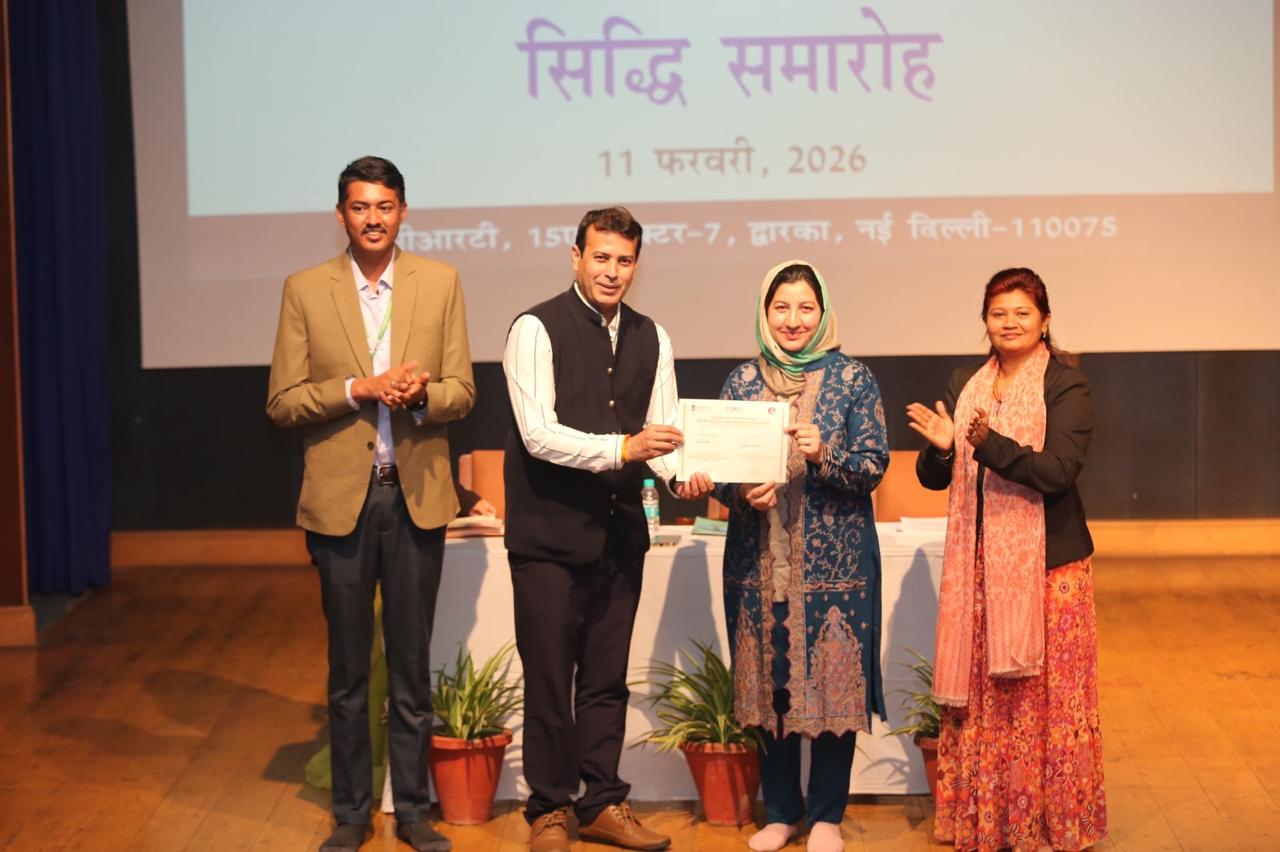
Suraya was the sole woman participant from her district at the 10-day national training programme organised by the Centre for Cultural Resources and Training (CCRT) in New Delhi. The programme focused on culture-based pedagogy and experiential learning — methodologies designed to make classroom instruction more immersive and relevant.
“It is about bridging the experiential deficit,” she said. “Our students are not lacking in capability, but they are often deprived of exposure. This training is a tool to show them that their geographical location does not define their intellectual potential.”
For Suraya, the journey to Delhi was not merely about professional development. It was, she says, about representation.
When they announced the participants and I realised I was the only woman from my district, it felt heavy, she recalled. Not in a bad way. But I thought, if I don’t speak up in those sessions, if I don’t participate, if I don’t learn everything I can — who will? There is no one else from Kupwara in that room. The responsibility is mine.
Organisers at the CCRT noted her active engagement in collaborative discussions and practical demonstrations. Back home in Kupwara, where harsh winters frequently disrupt the academic calendar, connectivity remains tenuous, and resources are often scarce, such opportunities are rare.
In Delhi, they spoke about labs and museums and digital tools, she said. “I thought of my classroom. We don’t have those things. But we have children who are just as curious, just as capable. So I must find other ways. That is what this training has given me — not answers, but questions I hadn’t thought to ask.”
Her colleagues describe her dedication as exceptional. “She functions as more than just an instructor; she is a mentor, particularly for the girls,” said Sabreena, a fellow teacher at her school. “In an area where female dropout rates remain a persistent concern, her classroom has become a space where aspiration is nurtured, not curtailed.”
Suraya says the female dropout rate is precisely why her participation in such programmes matters.
The girls in my class look at me and think, ‘She teaches us, she went to Delhi, she came back.’ That matters, she said. I want them to see that distance is not a barrier. That Kupwara is not the end of the road. That they can go places — literally and figuratively.
Local educationalists point to her journey as a microcosm of a larger issue: the chasm between educational opportunities in the country’s heartland and its peripheries. If the exposure gained by a single educator from a national platform can create a ripple effect, Peerzada Zubair told Kashmir Convener, one can only imagine the transformative potential of a more structured, systemic push to include teachers from border districts in such programmes.
Back in her hometown, Suraya is now engaged in the meticulous task of adaptation — sifting through the notes and methodologies she gathered in Delhi and rooting them in the stark reality of her students’ lives.
The ideas are expansive, but their execution must be grounded in the students’ own context, she said. Translating a national perspective into a local reality is the real challenge. But it is also the most rewarding part of this profession.
At the heart of it all, she says, is a simple message she wants every child in her classroom to internalise.
“I want my students to know they aren’t behind,” she said. “The world may think of Kupwara as a distant border. But distance is just geography. It is not destiny. That is what I tell them. That is what I will keep telling them.”


Comments are closed.