

Dr. Shivesh Pratap
“Biopharma SHAKTI represents India’s decisive pivot from a generics-driven model to innovation-led biologics leadership. It signals a future where India does not merely supply medicines to the world, but shapes the science that defines global healthcare.”
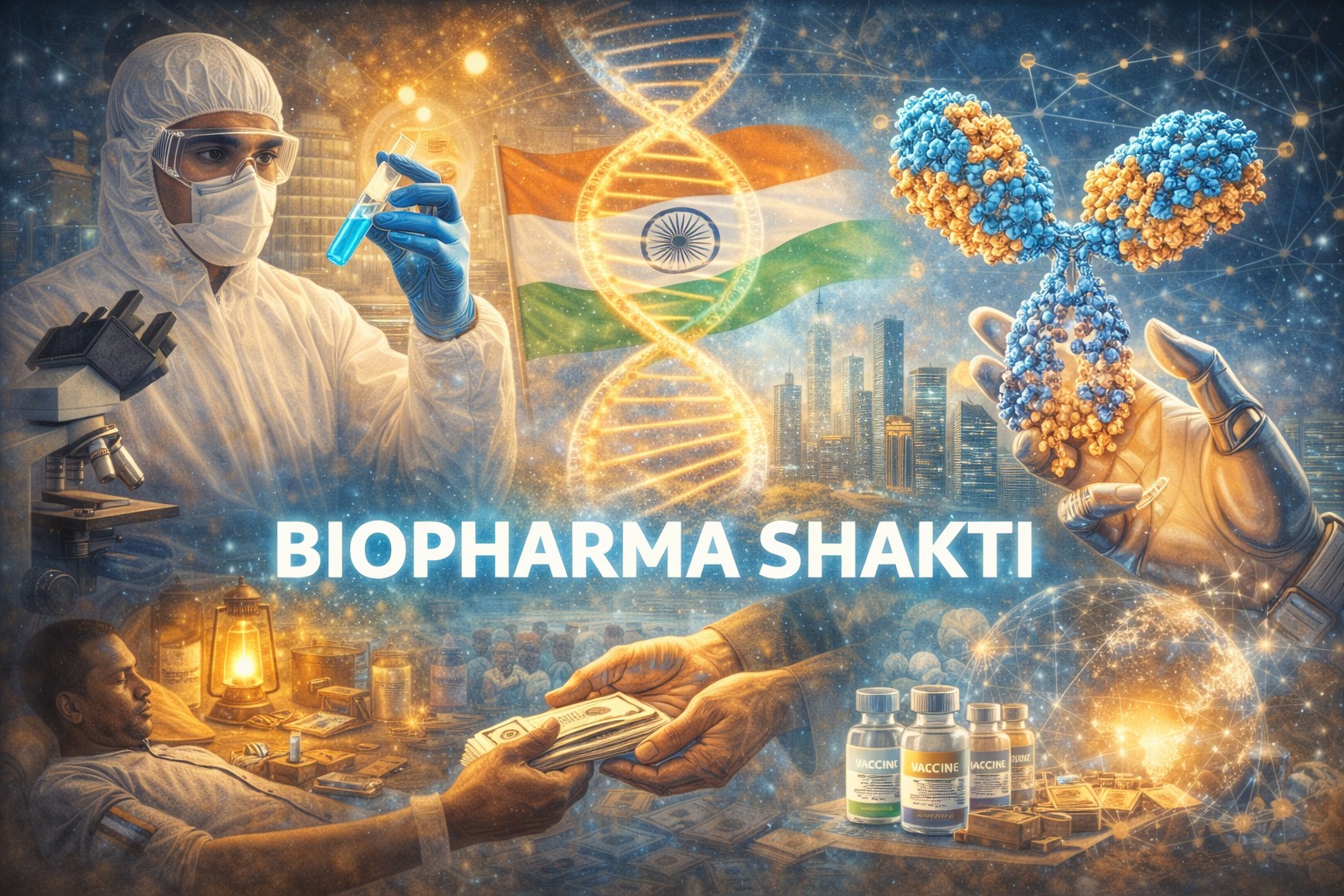
In India’s Union Budget 2026–27, the Government of India announced Biopharma SHAKTI (Strategy for Healthcare Advancement through Knowledge, Technology and Innovation), a ₹10,000 crore national mission designed to transform India into a global manufacturing and innovation hub for high-value biologics and biosimilars.
At a time when healthcare technologies are becoming increasingly complex and biologics are dominating the global pharmaceutical landscape, Biopharma SHAKTI represents a decisive shift from India’s traditional strength in volume-driven generics to an innovation-led, technology-intensive biopharmaceutical ecosystem.
This initiative is not merely a sectoral reform; it is a strategic intervention aligned with India’s long-term developmental vision of Viksit Bharat @ 2047. By strengthening domestic manufacturing capabilities, enhancing research and regulatory infrastructure and integrating India more deeply into global value chains, Biopharma SHAKTI aims to elevate India’s pharmaceutical sector to the next level of global competitiveness.
The Global Pharmaceutical Industry: Scale, Structure and Strategic Transformation
The global pharmaceutical industry today stands as one of the largest and most research-intensive sectors of the world economy. With an estimated market size exceeding 1.5 trillion US dollars annually, pharmaceuticals form a critical pillar of global healthcare systems. Over the past two decades, the industry has undergone structural transformation, from traditional small-molecule drugs toward complex biologics and precision therapies. Nearly half of the global pharmaceutical revenue now comes from biologics and this share is steadily increasing.
The industry is geographically concentrated. The United States alone contributes approximately 40–45 percent of global pharmaceutical revenues and dominates in innovation, intellectual property generation and advanced biologics research. Europe follows with strong biotech clusters in Germany, Switzerland and the United Kingdom. China has rapidly emerged as a manufacturing and innovation competitor, investing aggressively in biotechnology infrastructure and state-backed R&D ecosystems.
In contrast, India contributes around 3–4 percent of global pharmaceutical market value, despite commanding nearly 20 percent of global generic exports by volume. This gap between value share and volume share highlights India’s structural challenge: while it excels in cost-efficient manufacturing of generics, it has limited penetration in high-value biologics and innovative therapies.
India’s Pharmaceutical Sector: A Strong Foundation
India’s pharmaceutical industry has firmly established itself as a global leader in generic medicines and is widely known as the “Pharmacy of the World.” The country supplies affordable medicines to more than 200 nations and accounts for nearly 20 percent of global generic medicine exports by volume. Indian pharmaceutical companies meet around 40 percent of the generic drug demand in the United States and contribute approximately 60 percent of global vaccine production by volume.
Over the past decade, India’s pharmaceutical exports have shown consistent growth, exceeding 25 billion US dollars annually in recent years. Beyond exports, the industry generates millions of direct and indirect jobs, makes a significant contribution to India’s trade balance and plays an indispensable role in strengthening global public health systems.
However, despite this impressive performance, the sector remains heavily skewed toward small-molecule generics. High-value biologics, such as monoclonal antibodies, recombinant proteins, advanced vaccines and gene therapies, are increasingly dominating global pharmaceutical revenues. Biologics account for nearly half of the global pharmaceutical market value and this share is projected to rise further as chronic and complex diseases increase worldwide.
India’s limited share in the global biopharmaceutical market, particularly in original biologics and advanced therapies, represents both a vulnerability and a massive opportunity. Biopharma SHAKTI is designed to address precisely this gap.
The Strategic Imperative for Biopharma SHAKTI
Biopharma SHAKTI (Strategy for Healthcare Advancement through Knowledge, Technology and Innovation), with an allocation of ₹10,000 crore over five years beginning in 2026–27, is designed precisely to address this strategic transition. The initiative seeks to transform India into a global manufacturing hub for high-value biologics and biosimilars.
One of its core objectives is to enable India to capture 5 percent of the global biopharmaceutical market. Considering the size of the global biologics market, even a modest percentage share would significantly increase export revenues and strengthen India’s global pharmaceutical standing.
The initiative recognizes that future pharmaceutical dominance will depend on innovation capacity, regulatory credibility, skilled manpower and advanced manufacturing ecosystems. Biopharma SHAKTI attempts to address all these pillars simultaneously.
Why India Needs Biopharma SHAKTI
-
Rising Burden of Non-Communicable Diseases (NCDs)
India is witnessing a sharp epidemiological transition marked by a rapid rise in non-communicable diseases such as cancer, diabetes, cardiovascular ailments and autoimmune disorders, fundamentally altering the country’s healthcare needs. Cancer incidence is steadily increasing, with millions of patients requiring targeted biologic therapies such as monoclonal antibodies and advanced immunotherapies rather than conventional small-molecule drugs. India is also home to one of the world’s largest diabetic populations, driving sustained demand for insulin analogues and other biologic treatments.
At the same time, autoimmune diseases and rare genetic disorders are being diagnosed more frequently due to improved awareness, screening and diagnostic capabilities. However, a significant proportion of biologics used for these conditions are imported and priced at levels unaffordable for large sections of the population, creating access gaps and financial strain on households.
Expanding domestic production of biosimilars and advanced biologics can substantially lower treatment costs, reduce import dependence and promote health equity by making life-saving therapies accessible to a much broader segment of Indian society.
-
Reducing Import Dependence
India continues to depend heavily on imports for critical drug components, active pharmaceutical ingredients (APIs) and advanced biologic technologies, often sourced from a limited number of global suppliers. The COVID-19 pandemic starkly exposed the risks associated with such concentrated supply chains, as disruptions led to shortages, price volatility and strategic vulnerabilities in essential medicines.
Biopharma SHAKTI seeks to address this challenge by systematically encouraging domestic manufacturing of biologics and biosimilars, while simultaneously building indigenous capabilities in cell-line development, fermentation technologies and advanced bioprocessing.
By fostering self-reliance in high-end biologic manufacturing and reducing dependence on external sources for critical inputs, the initiative strengthens India’s healthcare security and industrial resilience. This strategic shift is closely aligned with the broader vision of Atmanirbhar Bharat, ensuring long-term healthcare sovereignty, supply chain stability and national preparedness against future global disruptions.
-
Capturing 5% Global Market Share
One of the central objectives of Biopharma SHAKTI is to enable India to secure at least 5 percent of the global biopharmaceutical market. Considering that the global biologics segment is valued in the hundreds of billions of dollars annually and continues to expand at a strong growth rate, even a modest 5 percent share would generate significant additional export revenues for India. Such a shift represents more than incremental growth; it marks a structural transformation in the country’s pharmaceutical profile.
Moving up the value chain from low-margin generics to high-margin biologics would substantially increase export revenue per unit, improve profitability and reduce vulnerability to intense price competition. It would also elevate India’s brand positioning from a cost-efficient generics’ supplier to a trusted global player in advanced therapeutics, while strengthening its negotiating power in international pharmaceutical markets through technological capability and innovation-driven competitiveness.
Strategic Pillars of Biopharma SHAKTI
-
Innovation Leadership
Biopharma SHAKTI places strong emphasis on innovation-driven growth, recognizing that long-term global leadership in pharmaceuticals depends on the ability to create, not just replicate, advanced therapies. The initiative actively supports the development of next-generation treatments such as monoclonal antibodies, recombinant proteins, advanced vaccines and emerging gene and cell therapies, which represent the fastest-growing and highest-value segments of the global pharmaceutical market.
By fostering robust public–private partnerships and providing targeted financial support for research and development, the scheme incentivizes Indian companies to invest in original biologics and novel therapeutic platforms rather than relying primarily on reverse engineering of existing molecules.
This strategic shift from replication to innovation is critical for enhancing India’s scientific depth, strengthening intellectual property creation and ensuring sustained global competitiveness in the evolving biopharmaceutical landscape.
-
Infrastructure Expansion: NIPER Network
A critical constraint in advancing biopharmaceutical development in India has been the limited availability of highly specialized human capital. Biopharma SHAKTI directly addresses this gap by proposing the launch of three new National Institutes of Pharmaceutical Education and Research (NIPER) and the upgradation of seven existing NIPERs, together forming a dedicated, biopharma-focused academic and research network.
These institutions are envisioned as national centers of excellence in biotechnology, biologics manufacturing, regulatory sciences and translational research, closely aligned with industry and global best practices.
By systematically training scientists, regulatory professionals, bioprocess engineers and innovation managers, the initiative aims to create a sustainable and future-ready talent pipeline capable of supporting large-scale biologics manufacturing, advanced research and global regulatory compliance, thereby strengthening India’s long-term competitiveness in the biopharmaceutical sector.
-
Clinical Trial Network
Biopharma SHAKTI proposes the establishment of more than 1,000 accredited clinical trial sites across India, a move that has the potential to fundamentally transform the country’s clinical research landscape. Such a large, standardized network will enable faster and more reliable clinical validation of new biologics, significantly reducing development timelines and costs. It will also lessen India’s dependence on foreign trial sites, allowing domestic companies to retain greater control over research pipelines and intellectual property.
India’s vast and diverse population offers a unique advantage for generating robust, representative clinical data across age groups, genetic profiles and disease patterns. By improving the quality, scale and credibility of clinical trials, this nationwide network will enhance global acceptance of Indian data, accelerate regulatory approvals and substantially increase investor confidence in India as a preferred destination for biopharmaceutical research and development.
-
Regulatory Strengthening
Global approval standards for biologics are highly stringent, requiring rigorous evaluation of safety, efficacy, manufacturing consistency and pharmacovigilance data. Strengthening the Central Drugs Standard Control Organisation (CDSCO) with a dedicated scientific review cadre is therefore a critical reform under Biopharma SHAKTI.
A more specialized and technically equipped regulatory framework will enable faster and more evidence-based decision-making, reduce approval delays and improve predictability for industry stakeholders. It will also ensure closer alignment with international regulatory benchmarks followed by agencies in the United States and Europe, thereby enhancing the credibility of Indian approvals.
Greater regulatory efficiency and harmonization will lead to wider acceptance of Indian biologics in advanced markets, directly supporting export expansion, attracting global partnerships and reinforcing India’s position as a reliable biopharmaceutical producer.
-
Governance and Oversight
A high-level oversight committee under NITI Aayog ensures effective implementation, stakeholder coordination and real-time feedback. Strong governance mechanisms are essential for a ₹10,000 crore initiative spanning five years.
Impact on Export Power
Biopharma SHAKTI has the potential to substantially strengthen India’s export profile by shifting the sector toward higher-value and innovation-driven products. Biologics command significantly higher prices than conventional generic tablets, meaning that even moderate growth in biologics production can generate disproportionately large increases in export revenue without a corresponding rise in production volume.
The development of advanced biologics and biosimilars will also enable India to diversify its export markets, particularly in highly regulated regions such as North America, Europe and East Asia, where quality standards and regulatory alignment are critical for entry.
As global economies increasingly seek to diversify pharmaceutical supply chains to reduce overdependence on limited geographies, India can strategically position itself as a trusted, democratic and stable supplier of high-value biologics.
Furthermore, moving beyond a generics-centric identity will enhance India’s global brand image, transforming it from a cost-efficient manufacturer into an innovation-driven biotechnology hub with strong research, regulatory and manufacturing capabilities.
Comments are closed.