
India’s Strengthened Sports Ecosystem: From Budgetary Support to a National Sporting Renaissance

S. Ahmad

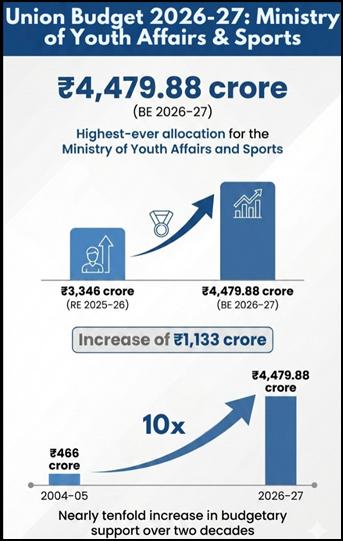
The Union Budget 2026–27 marks a defining moment for Indian sport. What was once viewed largely as a cultural or recreational activity has now been placed firmly within the architecture of nation-building. With the announcement of the Khelo India Mission and the highest-ever allocation of ₹4,479.88 crore to the Ministry of Youth Affairs and Sports, the Government has signalled that sports is no longer peripheral to policy—it is central to India’s developmental vision.

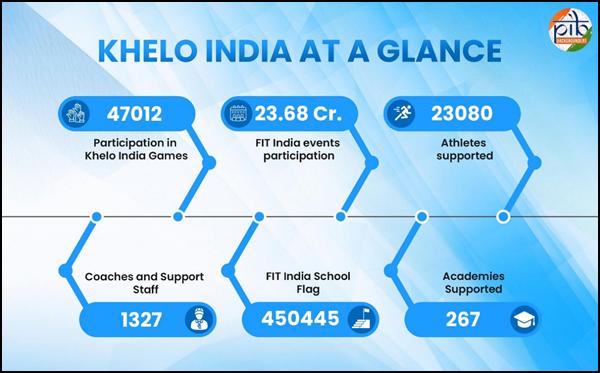
For decades, India’s sporting ambitions often struggled against limited infrastructure, fragmented talent identification, and inconsistent funding. That cycle now appears to be shifting. The transformation began with the Khelo India Scheme, launched in 2016–17, which sought to build a structured pathway from grassroots participation to elite competition. Over time, financial allocations expanded steadily, reflecting growing confidence in sport as a vehicle of social change and national pride. The 2026–27 Budget takes this trajectory forward by converting the scheme into a long-term, mission-mode initiative—the Khelo India Mission.
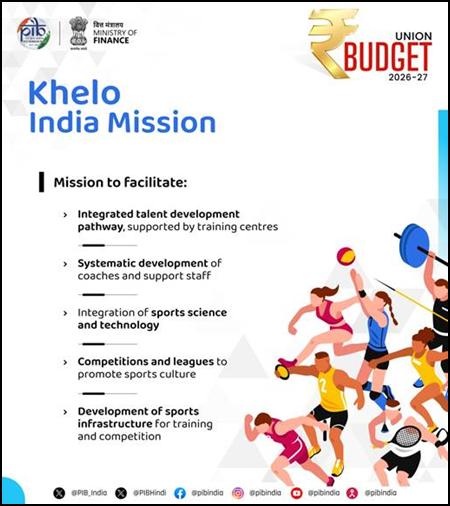
In her Budget speech, Finance Minister Nirmala Sitharaman underscored that the sports sector offers “multiple means of employment, skilling and job opportunities.” Her words reflect a broader understanding that sports is not merely about medals. It is about building industries, generating livelihoods, encouraging entrepreneurship, and creating structured opportunities for young people. The new Mission is designed to nurture talent systematically over the next decade, ensuring that young athletes are not lost due to lack of institutional support.

The Budget rests on three core duties: accelerating economic growth, fulfilling people’s aspirations, and ensuring inclusive access to opportunities. Sport intersects with all three. It promotes health and discipline, strengthens social cohesion, and inspires aspiration across regions and classes. By embedding sports policy within these broader national goals, the Government has elevated athletics from a sectoral concern to a strategic priority.

Financial commitment is the backbone of any long-term reform. The allocation of ₹924.35 crore for Khelo India in 2026–27 continues a pattern of rising investment. Earlier phases of the programme saw substantial increases in funding, expanding infrastructure development, athlete scholarships, and competitive platforms. This steady growth reflects policy continuity rather than episodic enthusiasm. It also demonstrates that sports development is being treated as a sustained national project rather than a short-term campaign.
Equally significant is the ₹500 crore initiative for sports goods manufacturing. India has long been known for producing quality sports equipment, yet the sector often operated below its full potential. By investing in domestic manufacturing capacity, research in material sciences, and design innovation, the Government aims to position India as a global hub for affordable, high-quality sports goods. This initiative connects sport to economic growth. It links athletics to industrial policy. It creates employment in manufacturing, logistics, and allied services. In doing so, it strengthens India’s presence in global supply chains.

The Budget also carries a distinctive youth-driven character. It draws inspiration from young voices and ideas emerging from national consultations. Union Minister for Youth Affairs and Sports Mansukh Mandaviya has reinforced this participatory approach through initiatives such as the MY Bharat Budget Quest 2026. This nationwide programme seeks to make budgetary provisions accessible and meaningful for young citizens. Through quizzes and essay competitions, it invites youth to critically engage with public policy and envision India’s developmental future.

The culmination of this participatory framework is particularly symbolic. Winners of the Budget Quest will have the opportunity to interact with Prime Minister Narendra Modi, discussing the vision of a Viksit Bharat. Such engagement reflects a shift in governance culture. Young people are not merely beneficiaries of policy; they are contributors to it.

Beyond infrastructure and funding, the Khelo India Mission aims to create a seamless pipeline from grassroots participation to elite performance. This involves talent identification at the school level, structured training ecosystems, high-performance centres, sports science integration, and international exposure. It also demands inclusivity—ensuring that rural regions, small towns, and underrepresented communities are part of India’s sporting ascent.

The ambition is bold. India aims to rank among the top ten sporting nations by 2036 and the top five by 2047. These goals are not rhetorical flourish. They represent measurable benchmarks aligned with the broader national aspiration of becoming a developed country by its centenary of independence. Achieving them will require disciplined implementation, transparent governance, and sustained public support.

Yet the deeper significance of the 2026–27 Budget lies in its recognition of sport as a transformative force. A robust sports ecosystem cultivates resilience, teamwork, leadership, and confidence. It channels youthful energy into constructive pathways. It reduces social alienation and fosters national unity. In a country with one of the world’s largest youth populations, such investment is both strategic and necessary.

The journey from aspiration to achievement is rarely linear. It demands persistence, institutional reform, and cultural change. The Union Budget 2026–27 suggests that India is prepared to undertake this journey with seriousness and scale. By combining mission-mode policy, financial commitment, industrial strategy, and youth engagement, it lays the foundation for a sporting renaissance.

If implemented with rigour and inclusivity, the strengthened sports ecosystem will not only produce champions on global podiums. It will produce healthier citizens, skilled workers, innovative entrepreneurs, and confident young leaders. In that sense, the true victory will extend far beyond medals—it will be measured in national capacity, opportunity, and pride.

The article is based on the inputs and background information provided by the Press Information Bureau (PIB) Author is Writer, Policy Commentator. He can be mailed at kcprmijk@gmail.com

Comments are closed.