
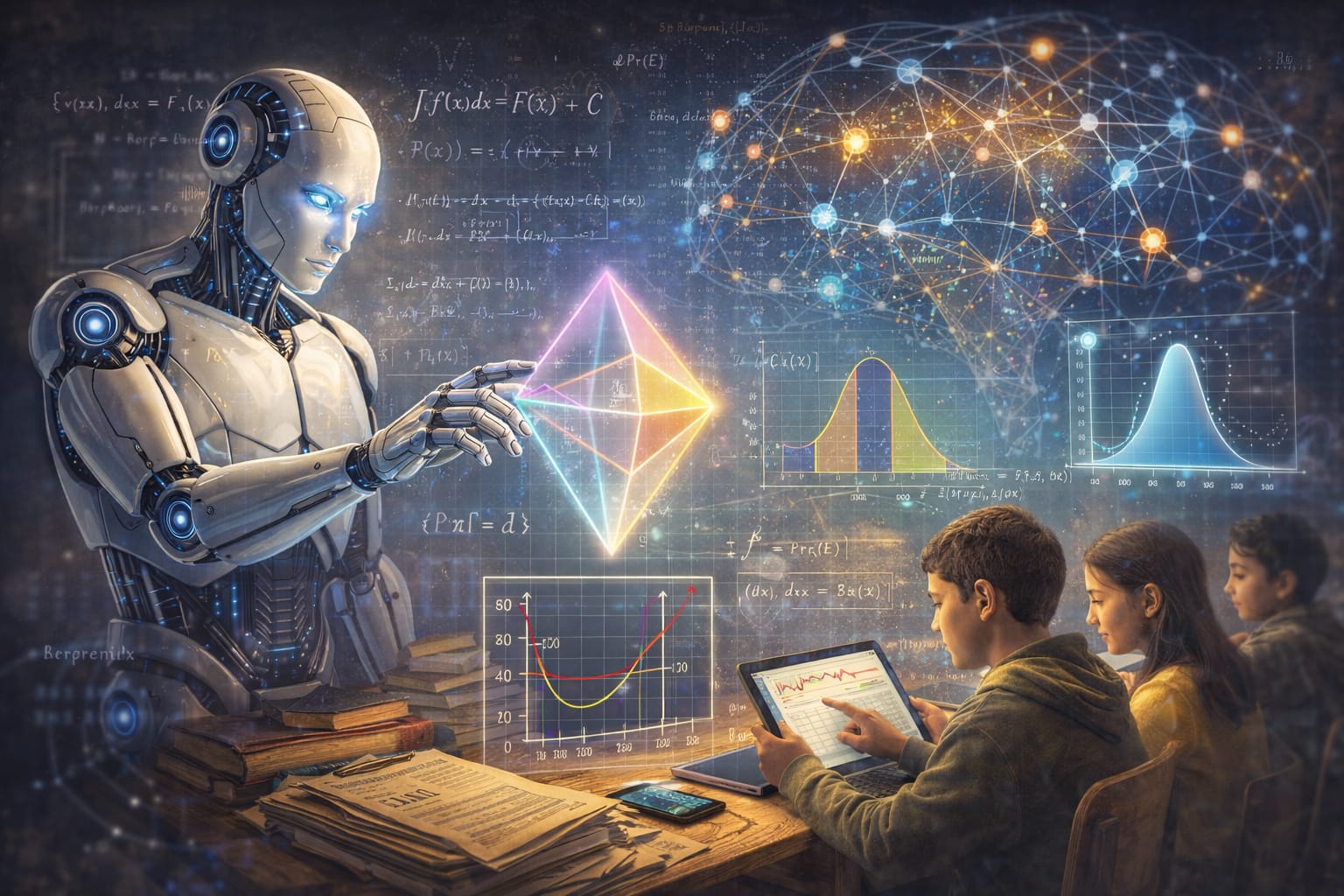
Machine Learning, Artificial Intelligence and the Future of Mathematical Conceptual Learning

Malik Mushtaq


“Artificial Intelligence is not separate from mathematics. It is mathematics in motion. Linear algebra, calculus, probability, and discrete logic form the invisible engine behind intelligent systems. To understand AI is to understand mathematics — not as abstract symbols on a blackboard, but as the living language of modern intelligence.”

In the rapidly transforming landscape of the 21st century, few developments have altered human life as profoundly as Machine Learning and Artificial Intelligence. From medical diagnostics to financial forecasting, from governance systems to digital communication, AI is quietly reshaping how societies think, decide and function. Yet beneath this technological revolution lies a deeper truth that is often overlooked. Artificial Intelligence is not separate from mathematics. It is built upon mathematics. And in a fascinating turn of history, it is now reshaping how mathematics itself is taught and understood.

For decades, mathematics education has largely remained examination-driven. Classrooms have focused on procedures. Students memorized formulas. They practiced repetitive steps. They prepared to reproduce answers within strict time limits. Conceptual clarity was often secondary. Understanding “why” something works was less important than knowing “how” to arrive at the answer.

This model produced results. It created engineers, accountants and scientists. But it also created anxiety. It reduced mathematics to a mechanical exercise. Many students feared it. Many believed they were “not good at maths” simply because they struggled with memorization.

Today, Artificial Intelligence offers an opportunity not just to digitize textbooks, but to fundamentally reimagine mathematical conceptual learning.

Mathematics: The Invisible Engine of AI

Artificial Intelligence may appear futuristic. It may seem driven by machines and code. But its foundations are deeply classical and mathematical.

Linear algebra powers neural networks through matrices and vectors. Calculus drives optimization using derivatives and gradient descent. Probability and statistics enable prediction and uncertainty modeling. Discrete mathematics forms the backbone of logic, algorithms and computational structures.

Platforms such as TensorFlow and PyTorch operate entirely through mathematical computation. Even conversational AI systems like ChatGPT function through large-scale matrix operations and probabilistic modeling.

AI does not stand apart from mathematics. It is mathematics in motion.

This realization changes everything. It shows students that mathematics is not abstract for its own sake. It is the language that powers modern intelligence systems. It runs recommendation engines. It predicts diseases. It optimizes traffic. It detects fraud. Mathematics is no longer confined to blackboards. It is embedded in the digital world around us.

Moving Beyond Rote Learning

Traditional classrooms often emphasize procedural fluency. Students learn to apply formulas. They replicate worked examples. They follow steps. But when the formula is forgotten, understanding collapses.

Artificial Intelligence tools can shift this pattern.

Interactive simulations can visually explain why a formula works. Dynamic graphs can show how changing one variable affects another. Real-time feedback can identify misconceptions instantly rather than after an exam.

Educational platforms such as Khan Academy have demonstrated how adaptive algorithms can personalize instruction. When learning becomes responsive rather than rigid, students engage more deeply. They experiment. They explore. They ask questions.

Conceptual mastery grows when students see mathematics as a system of relationships rather than a collection of rules.

Personalized Mathematics: A Paradigm Shift

No two learners think in identical ways. Yet conventional systems treat classrooms as uniform groups moving at the same speed.

Machine Learning changes this assumption. By analyzing patterns in student performance, AI systems can detect recurring errors. They can identify conceptual gaps. They can adjust the level of difficulty. They can recommend targeted practice exercises.

This personalization reduces the fear associated with mathematics. It allows students to progress at their own pace. It strengthens confidence. When confidence improves, curiosity follows.

Instead of labeling students as “weak” or “strong,” AI-supported systems recognize that learning is dynamic. Progress becomes individualized. Struggle becomes part of growth rather than a mark of failure.

Visualization: Making the Abstract Tangible

One reason many students fear mathematics is its abstract nature. Concepts such as limits, probability distributions or vector spaces can seem distant from everyday experience.

AI-powered tools can transform abstraction into interaction.

Students can rotate three-dimensional geometric shapes. They can observe calculus graphs changing in real time. They can simulate statistical experiments repeatedly to see probability unfold visually.

When symbols move. When graphs respond. When models simulate reality. Understanding deepens.

Abstraction becomes exploration.

Higher-Order Thinking in an AI Age

The future demands more than computational speed. Machines already calculate faster than humans. What society needs now is reasoning, creativity and problem-solving.

AI-supported education shifts the focus away from repetitive arithmetic toward applied reasoning. Instead of only calculating derivatives, students can explore optimization problems linked to real-world data. Instead of memorizing probability formulas, they can analyze patterns and trends.

Organizations such as DeepMind have shown how intelligent systems can assist in solving complex mathematical and scientific problems. This signals a new partnership between human cognition and machine computation.

In this emerging world, students must understand the logic behind algorithms. They must question outputs. They must think critically about data. Mathematics becomes a tool for interpretation rather than mere calculation.

Implications for Youth and Educational Reform

For societies aspiring toward economic growth and intellectual advancement, integrating AI into mathematics education is not optional. It is essential.

A strong mathematical foundation combined with digital literacy equips young people to participate in fields such as data science, robotics, cybersecurity and AI research. These are not distant careers. They are expanding realities.

However, meaningful integration requires systemic reform. Curriculum must emphasize conceptual depth rather than mechanical repetition. Teachers must receive training in digital pedagogy. Schools must invest in infrastructure. Ethical frameworks must guide technology use.

AI should not replace teachers. It should empower them. The teacher’s role evolves. From information provider to mentor. From examiner to facilitator of inquiry.

Human judgment remains irreplaceable.

Ethical and Practical Considerations

The integration of AI into education brings challenges. The digital divide remains real. Not every student has equal access to devices or connectivity. Data privacy must be protected. Over-reliance on automated systems must be avoided.

Technology should enhance human capacity. It should not diminish critical thinking or replace reflection.

Balance is essential.

Mathematics as Civic Literacy

In a world shaped by algorithms, mathematics becomes more than an academic subject. It becomes civic literacy.

Citizens who understand probability are less likely to be misled by misinformation. Individuals who grasp data interpretation can better analyze economic reports or health statistics. Understanding statistics empowers democratic participation.

Mathematics is the language of the digital age. To ignore it is to disconnect from contemporary reality.

A Defining Educational Moment

Machine Learning and Artificial Intelligence are not disruptions external to education. They are extensions of mathematical reasoning.

Mathematics powers AI: AI transforms mathematical learning. If integrated thoughtfully, AI can turn classrooms into laboratories of curiosity. It can help students move from fear of formulas to fascination with patterns. It can nurture thinkers who reason logically and innovate responsibly.

The question before educators and policymakers is not whether AI will influence education. It already does.

The real question is whether we will use it to build a generation that understands mathematics deeply. A generation that sees equations not as obstacles, but as expressions of logic and beauty.

The future of mathematics education does not lie in replacing teachers or textbooks. It lies in enriching them with intelligent tools that deepen conceptual understanding and awaken intellectual curiosity.

Comments are closed.