
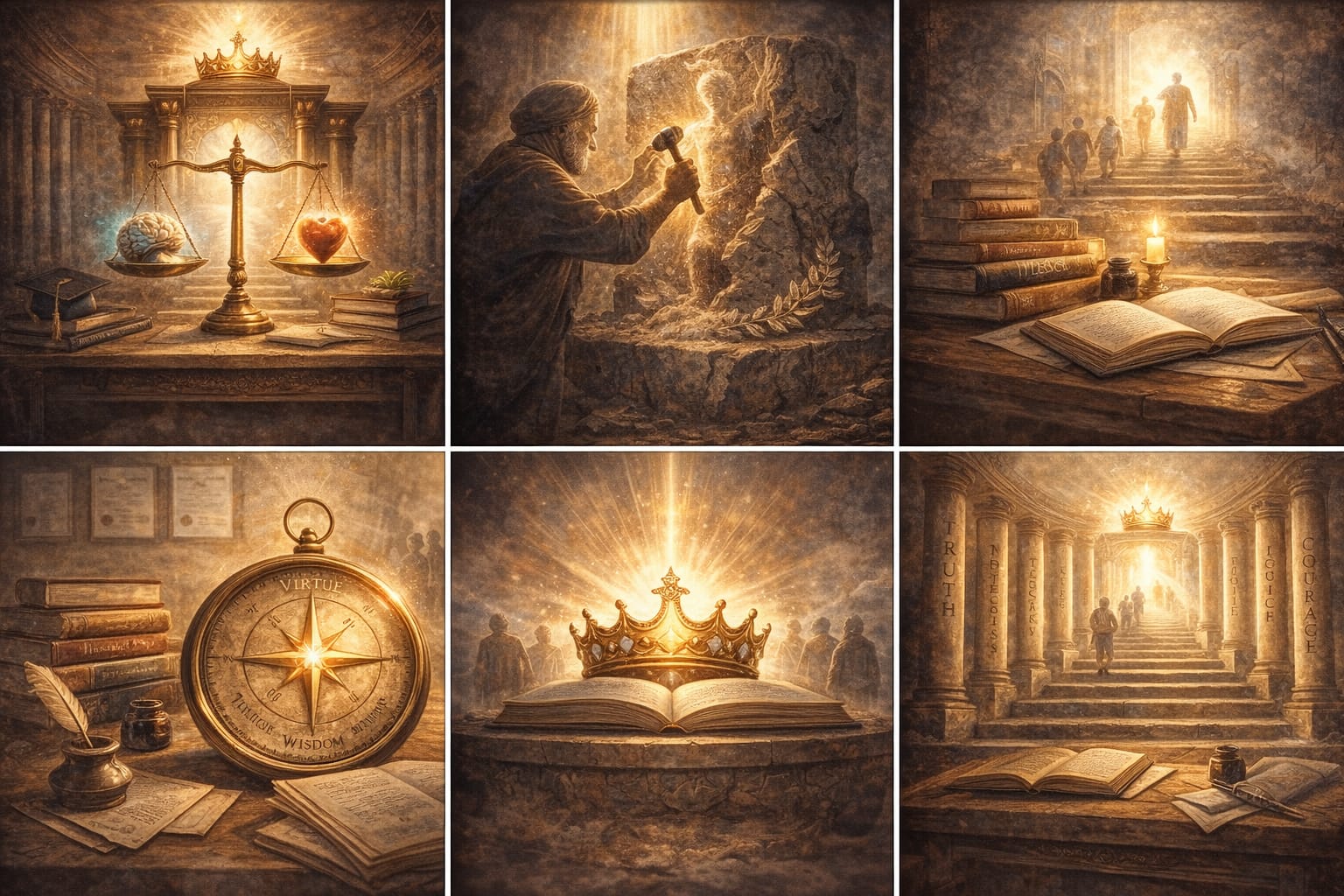

Moral Architecture of Education: How Character Becomes the True Crown of Humanity

Muhsin Ahmad Malik

“A society that exalts wealth but neglects virtue may appear prosperous, yet beneath its glitter lies moral fragility. When character collapses, no degree, no technology, no economic system can prevent the slow erosion of civilization.”

In an age overwhelmed by moral erosion and frenzied material pursuits, humanity stands precariously at a crossroads where intellect has expanded exponentially, yet inner virtue steadily withers. The contemporary individual, dazzled by technological sophistication and seduced by transient pleasures, often drifts away from the deeper imperatives of conscience, integrity, and purposeful existence.

Within this turbulent climate, the call for authentic character formation and principled education becomes not merely relevant but indispensable for civilizational survival. True enlightenment is not measured by academic credentials or accumulated information, but by the refinement of one’s moral compass—the invisible architecture that governs conduct, fortifies resilience, and elevates the human spirit above mediocrity. Only when education transcends rote learning and evolves into a transformative moral force can society hope to reclaim its lost ethical moorings and cultivate individuals capable of confronting adversity with dignity, discipline, and unwavering resolve.

In the contemporary world—overshadowed by moral erosion, escalating violence, hyper-materialism, and an ever-deepening crisis of human values—the relationship between education and character has assumed unprecedented significance. The incessant use of these two words in debates, classrooms, policy documents, and intellectual circles reflects a collective anxiety: Is modern education truly creating human beings, or merely manufacturing efficient machines?

Humanity today stands dangerously close to an ethical precipice. Scientific advancements have reached dazzling heights, yet human behaviour often descends into alarming depths. At such a historical juncture, the inseparable bond between education and character demands renewed attention. These two pillars, when harmoniously united, uplift societies; when severed, they push civilizations into moral decay.

Education Without Character: A Threat to Civilization

In the hyper-competitive, consumerist age we inhabit, knowledge has been commodified and learning has been reduced to a mechanical accumulation of qualifications. The masses are enchanted by the glittering façade of material success, while the inner illumination of character remains neglected. A society that prioritises profit over principles inevitably breeds chaos, corruption, and cruelty. Character, therefore, emerges not merely as a personal virtue but as a civilizational necessity. Without it, education becomes hollow, dangerous, even destructive. A knowledgeable person devoid of moral strength is like a sharp blade in the hands of a child—capable of immense harm.

Swami Vivekananda’s celebrated assertion reverberates with timeless truth:

“If you have assimilated fine ideas and made them the base of your life and character, you have more education than any man who has merely filled his mind by reading libraries.”

This profound statement underscores that education is not measured by certificates, but by conduct, integrity, and moral wisdom.The evolution of character requires the cultivation of noble emotions, refined sensibilities, and virtuous ideals. Values such as love, courage, truth, humility, empathy, and moral courage do not emerge spontaneously; they must be nurtured through:

meaningful education,

responsible parenting,

ethical social environments, and

conscious self-discipline.

Morality, when nurtured properly, becomes the victor over primal impulses—anger, hatred, greed, irrational aggression, and prejudice. It elevates a person above the brute instincts and shapes a dignified, humane personality.Thus, character is not a decorative ornament—it is the moral backbone of an individual.

Character in Modern Times: A Scarce Yet Precious Commodity

Unfortunately, the modern era is plagued with moral bankruptcy. Terrorism, exploitation, fraud, substance abuse, and intellectual dishonesty have taken root across societies. Money has become the new deity and human beings are increasingly evaluated not by virtue but by wealth.In this climate, character has become the rarest of treasures.A truly charactered person stands out like a luminous star in a dark sky. Such individuals become the anchors of peace, the custodians of justice, and the promoters of compassion. They love humanity, oppose cruelty, uphold fairness, and inspire others.History honours saints, prophets, scholars, sages, and reformers not because of their academic degrees, but because of their unshakeable moral fabric. Character is the golden aura that made them immortal.

Education and Character: A Sacred Interdependence

Education and character share an unbreakable spiritual bond—one is the seed, the other is the harvest. Education, when pure and purposeful, ignites the human intellect, awakens curiosity, refines emotions, and cultivates sensitivity. It transforms an ordinary individual into a human being in the truest sense—noble, compassionate, enlightened.Character, on the other hand, is the fruit of such education. It represents the mature expression of ethical learning. A genuine education must necessarily lead to the development of virtuous character; otherwise, it is merely information without transformation.

Education as Enlightenment: The Role of Spiritual Intelligence

True education is a form of inner illumination. It empowers a person to distinguish between:

truth and falsehood

virtue and vice

justice and injustice

nobility and wickedness

In other words, it awakens conscience—the divine spark within. Education becomes the polishing instrument that removes the accumulated rust of ignorance, ego, arrogance, and base temptations.

Such education prepares a person not only for worldly responsibilities but for the greater, eternal journey of the soul. It gives life meaning beyond consumption, entertainment, and greed.A person may speak eloquently, but if his character is corrupt, his words lose power. Conversely, a person of moral integrity exudes greatness even in silence. Character behaves like a magnetic force; it attracts respect without demanding it.

Character is the unseen architecture of an individual’s identity. It shapes decisions, governs relationships, influences behaviour, and ultimately determines destiny. When education purifies the heart and strengthens the intellect, character blossoms naturally. It becomes the soul of the person—the intrinsic essence that accompanies a human being everywhere.

Why Character Matters in the Age of Technology

We live in an era dominated by artificial intelligence, automation, social media, and the relentless pressure for productivity. While our external tools have evolved, our internal compass is faltering. The dangers of misinformation, moral confusion, cyberbullying, radicalization, and emotional numbness threaten societal harmony.

Hence, character education becomes even more crucial. Without ethical grounding, technological empowerment becomes hazardous. Scientific brilliance without empathy can create destruction; intellectual genius without humility breeds arrogance. Therefore, character is not a luxury—it is an urgent necessity.

The Teacher’s Role in Character Formation

A teacher is not merely an instructor of subjects; he is a sculptor of personalities. His gestures, tone, discipline, compassion, and fairness silently educate students far more deeply than textbooks. A morally upright teacher becomes a living textbook of virtue.

Teachers must inspire:

honesty

self-discipline

critical thinking

respect for diversity

empathy

responsibility towards society

Through their example, students learn that education is not confined to marks or ranks, but is a lifelong pursuit of goodness.

The First School of Character

Long before a child enters a classroom, the foundations of character are laid at home. Parents become the child’s first role models. Their behaviour, emotional environment, discipline, and communication all contribute to shaping moral identity. A home that cultivates truthfulness, kindness, gratitude, and respect produces children who carry these values into the world. Society benefits immensely from such morally equipped individuals. Character does not belong solely to individuals; it has collective implications. A society where people are guided by principles naturally flourishes. Crime reduces, trust increases, cooperation strengthens, and harmony expands.

On the other hand, societies where character collapses face:

corruption

injustice

exploitation

violence

discrimination

social fragmentation

Thus, character is not merely a personal achievement—it is a national asset.

Education for Character in the 21st Century

Educational institutions must redefine their purpose. Beyond academic excellence, they must consciously integrate:

moral education

ethics and civics

community service

emotional intelligence training

cultural and spiritual literacy

value-based curriculum

Only then can education create not just skilled workers but responsible citizens and ethical leaders. The true purpose of education is no the accumulation of data but the transformation of the human being. It must produce individuals who possess:

clarity of thought

purity of heart

strength of character

nobility of intention

compassion for humanity

Such individuals become the torchbearers of civilization. Their presence enriches communities and elevates human dignity.

Conclusion: Character—The Eternal Wealth of Humanity

In the ultimate reckoning, education may illuminate the mind, but only character illuminates life. Academic brilliance may secure positions, but moral brilliance secures reverence. Knowledge can command influence, yet only character commands genuine admiration. Skills may generate livelihood, but character generates trust, affection, and an enduring legacy that outlives the individual. Character is the lone treasure impervious to corrosion—untouched by time, unmoved by fortune, and undefeated by adversity. It is the subtle fragrance of an ennobled spirit, the quiet anthem of a life anchored in virtue. Therefore, the highest calling of education is not merely to sharpen intellect or expand competence, but to sculpt the moral architecture of the human soul. Character is not an accessory to education; it is its heartbeat, its essence, its ultimate destination. For when education culminates in noble character, humanity discovers its truest greatness and society discovers its most enduring hope.

Author is Teacher at GMS Pinjura. He can be reached at malikmuhsin92@gmail.com

Comments are closed.