

Majid Marouphay
“Every new colony carved out of a rice field is celebrated as progress, but the soil beneath it dies forever.”
Our Kashmir is not merely a postcard of mountains and lakes. It is a living, breathing agricultural civilization. Our vast paddy fields, once shimmering like sheets of gold under the summer sun have fed generations. Agriculture has never been just an occupation here, it has been our economic spine, our cultural memory and our food security shield. The Valley’s fertile plains sustained us with rice, vegetables and allied produce, while surplus harvests travelled beyond our borders, strengthening our economy.
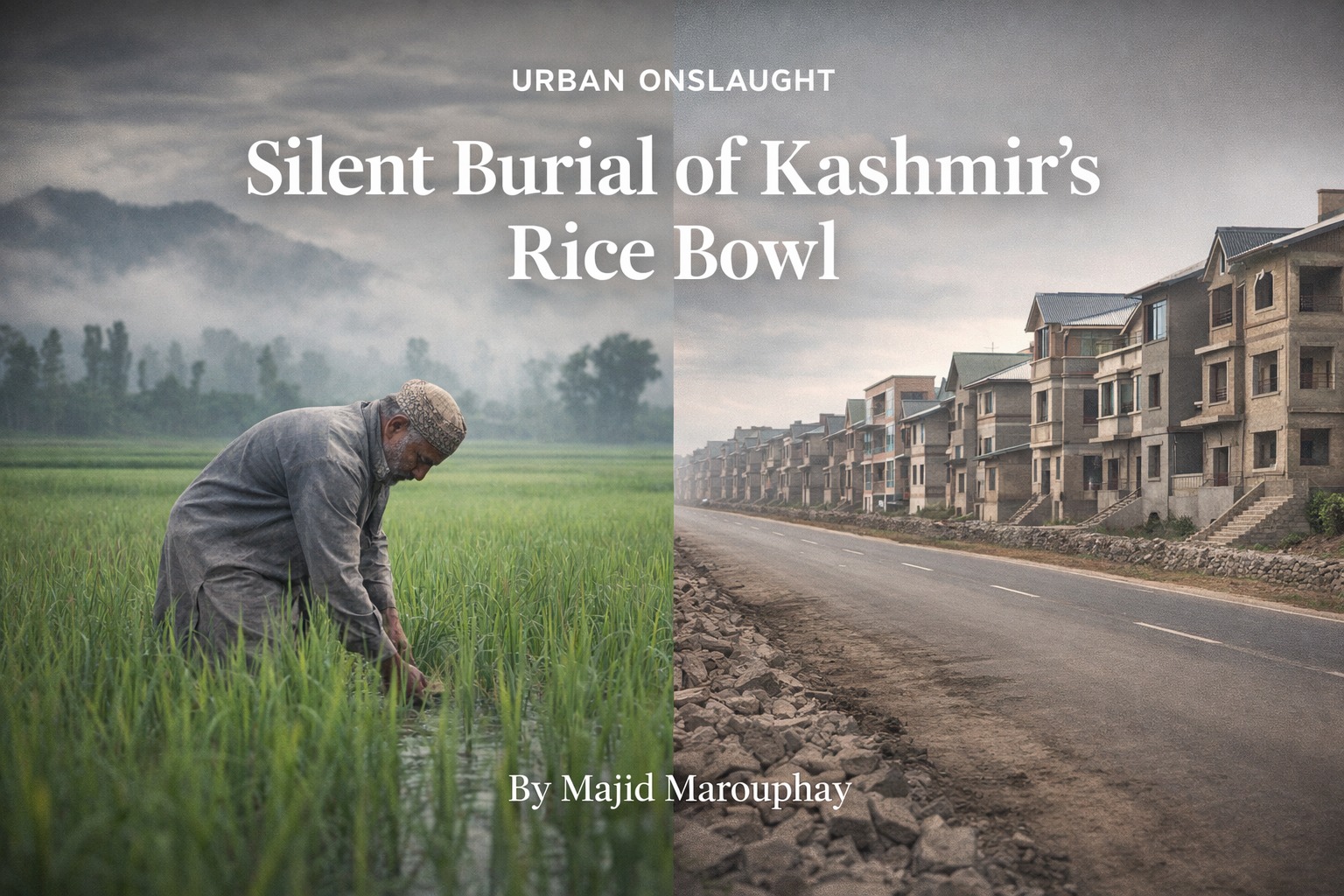
Today, that lifeline is being strangled, quietly, steadily and almost shamelessly. What we are witnessing is nothing short of a silent loot of Kashmir’s agricultural wealth. Fertile paddy lands are being devoured by mushrooming residential colonies, shopping complexes, industrial units and widening highways. Every new colony carved out of a rice field is celebrated as ‘development’. Every widened road that slices through orchards and farms is hailed as ‘progress’. But at what cost? Development that destroys food-producing land is not development, it is ecological suicide.
The so-called urban expansion has become reckless and unplanned. Entire belts of cultivable land surrounding towns and villages have been swallowed by concrete. In village after village, one can see a disturbing pattern. As sons marry, separate houses are constructed – each one built on what was once productive agricultural land. As many sons, so many houses. The result? Paddy fields that once stretched across horizons have vanished within a decade, replaced by brick, cement, and steel. The mushrooming of residential colonies over paddy lands has assumed epidemic proportions. There is little accountability, little regulation and almost no serious enforcement of land protection laws.
Even more alarming is the aggressive conversion of Kashmir’s historic ‘rice bowl’ areas into high-density fruit orchards. Under the promise of quick profits, vast stretches of paddy fields are being uprooted and replaced with new varieties of high-density fruit trees. But this shift is not rooted in careful ecological wisdom. It is driven by market temptation and short-term gains. Many agricultural scientists themselves have expressed skepticism about the long-term sustainability of these high-density plantations in Kashmir’s uniquely fragile climatic conditions. Our Valley is known for its sudden weather fluctuations, erratic snowfall, hailstorms and unseasonal rains. What happens if these experimental varieties fail? What happens if pests, disease, or climate shocks wipe them out? Unlike rice cultivation, which has been perfected over centuries in harmony with our soil and water systems, these new varieties remain uncertain guests on our land. Are we willing to gamble our staple food security on uncertain horticultural experiments?
Rice is not just another crop in Kashmir. It is our staple food, grown and consumed here for generations for its distinctive taste and nutritional richness. Yet, our rice bowl areas are shrinking at an alarming pace. The Valley that once proudly fed itself is now increasingly dependent on rice and vegetables transported from outside. And what do we receive in return? Questionable quality, adulterated products and mounting public health concerns. Cases of food contamination and lifestyle diseases are rising. Is this the future we want, imported food and exported fertility?
The horticulture industry itself is far from immune to instability. Repeated highway closures, unpredictable climate patterns and volatile markets have caused losses worth hundreds of crores. In moments of despair, orchardists in parts of South Kashmir have uprooted fruit trees in frustration. When even fruit cultivation is vulnerable, why are we dismantling our traditional agricultural backbone?
Meanwhile, road widening projects continue to consume chunks of farmland. Small hills are flattened, wetlands disturbed, and fertile topsoil permanently buried under asphalt. Each project is justified in the name of connectivity. The proposed expansion under the Greater Srinagar Master Plan is set to consume even more fertile land. New ring roads and alternate bypass corridors around Srinagar, along with additional bypasses for district headquarters and major towns across North, South, and Central Kashmir, are slicing through productive paddy fields and orchards. These roads are not passing over barren land, they are swallowing the Valley’s food-producing soil. While connectivity matters, sacrificing prime agricultural land at this scale raises serious concerns about Kashmir’s long-term food security and ecological balance. But no one calculates the ecological and agricultural cost of this relentless expansion. This is not merely a land-use issue. It is a question of survival. Once a paddy field is covered with concrete, it can never be reclaimed. The soil dies. The irrigation channels disappear. The centuries-old relationship between farmer and land is severed.
Where is the structured land-use policy that Kashmir desperately needs? Why are we not enforcing strict zoning laws to protect prime agricultural land? Why is vertical urban growth not being encouraged instead of horizontal sprawl? If metropolitan cities can build multi-storey apartments and organized housing societies, why can’t we? Well-planned, earthquake-resistant multi-storey residential complexes with three-room flats can accommodate families without devouring fertile land. Such societies can provide better civic amenities, sanitation and infrastructure while preserving our fields for cultivation. But this requires political will. It requires administrative courage.
The people of Kashmir must recognize that selling agricultural land for short-term profit is a long-term disaster. Governments must immediately regulate land conversion, penalize illegal constructions on paddy fields, and incentivize farmers to continue rice cultivation. Agricultural scientists, planners and environmental experts must be brought together to create a sustainable roadmap before it is too late.
If we remain silent today, tomorrow we will stand in supermarket queues buying imported rice grown on someone else’s soil, while our own soil lies buried beneath concrete. Kashmir’s golden fields are not empty spaces waiting for real estate projects. They are our inheritance, our security and our responsibility. The question is simple: Will we protect our lifeline or will we watch it disappear, one field at a time?
“Kashmir is not just a postcard of mountains and lakes; it is a living agricultural civilization.”
Comments are closed.