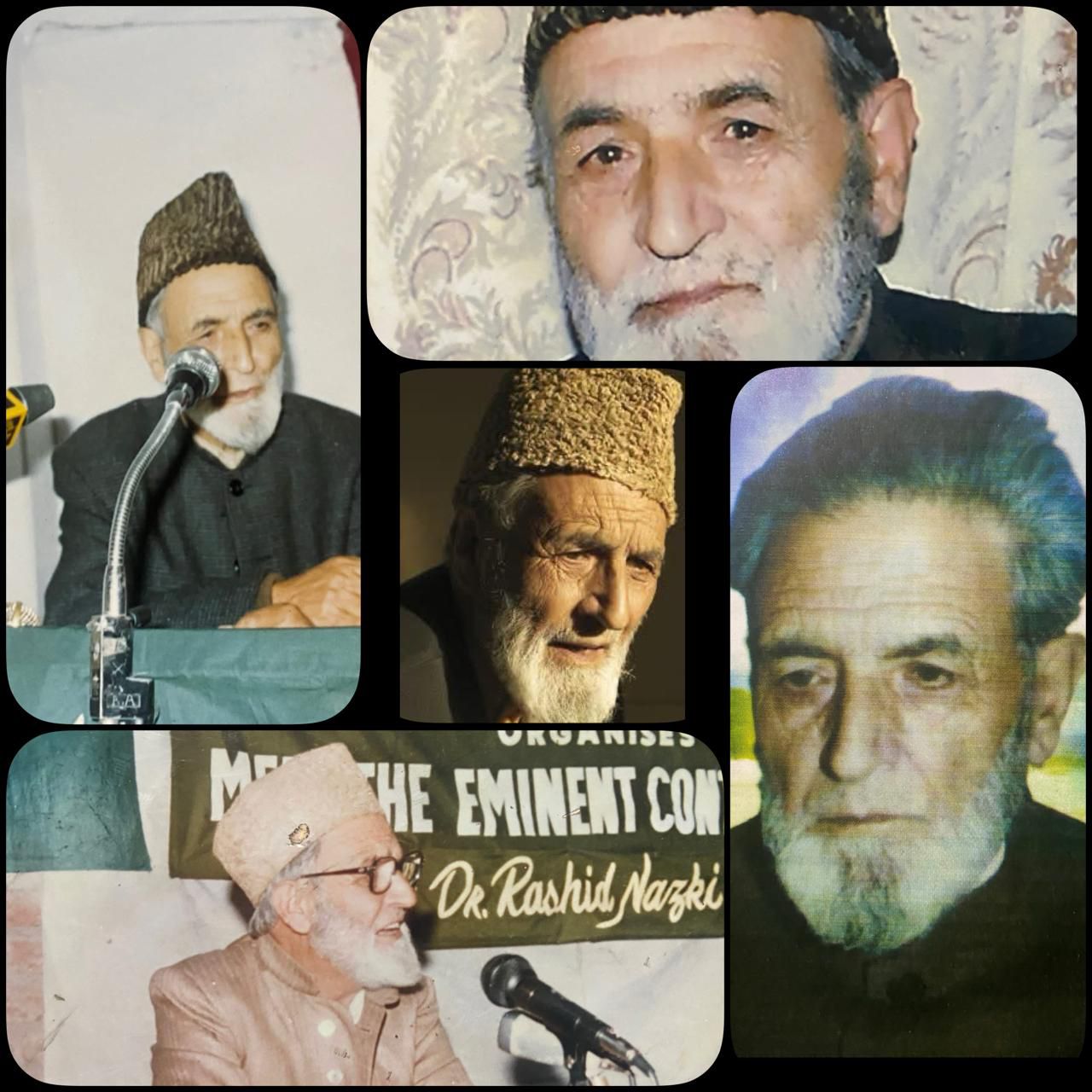

Prof Rashid Nazk’s scholarly, literary, critical , translational and compiled corpus

Part-II


This write-up serves as a modest monographic tribute to Professor Abdul Rashid Nazki, outlining key aspects of his literary and intellectual legacy while indicating areas that invite further scholarly exploration and critical study.



By: Shabeer Ahmad Lone

1.Kulyati Nadim (Second Edition, JKAACL 1985)

This copy of the book is the second edition published by the [Academy of Art, Culture, and Languages]in January 10, 1985. The esteemed compiler presents the book titled Kulyati Nadim, with a 72-page brief insightful introduction to Kashmiri Naʿat poets along with an analysis of excerpts from their poetry. Thus, this book is a concise mention of Kashmiri Naʿat poets. The Naʿat poets mentioned within this work include: Alamdar Kashmir (RA), Khawaja Habibullah Naushehri, Fakhir Kashmiri, Mahmood Gami, Waliullah Matoo, Qutbuddin Waiz, Mir Sanaullah Krairi, Maqbool Shah Kralwari, Maulvi Siddiqullah, Sail, Mir Shahabadi, Rasul Mir, Abdul Ahad Nazim, Rizullah Haqani, Wahab Paray, Siddiqullah Hajini, Ghulam Ahmad Jaid, Miskin, Yusuf Khushi Geh, Aashiq Trali, Ismail Nami, Aasi Kashmiri, Ghulam Rasul Shewa, and Sita Ram Butt, Adam, Darvesh Abdul Qadir Aasi, Ghulam Ahmad Mahjoor, Meer Ghulam Rasool Nazki, Tanha Ansari, Dina Nath Nadim, Abdul Ahad Nadim and Abdul Jabbar Khamoosh (Kulyati Nadim, p. 85).Compilation is structured as: 1.Munajaat, 2.Kashir zi Mehjoori, 3.Shumail Nabwi te seerat ,4.Naet(Wanewun), 5.Shehr-i-Aashoob, 6. Muutfrqaat.

In this, Rashid Nazki provides full information about Abdul Ahad Nadim’s life, presenting Nadim as a high-ranking Naʿat-reciting poet. He presents the conditions and description of Nadim Sahib’s life in his unique style.

Chi eksie nadimus manz jamah gameath

Iraqi, Anwari, Jami, Nizami-(Nazki) [8]

Abdul Ahad Nadim (1258-1329 H) of Bandipore wrote na’ats, poems on the Pophets’s personality (Pbuh) and a social satire entitled Shaharaashob, exposes the weaknesses of society.He is pre-eminent in his naats which apart from being rich in passionate devotion, reverance, striking allusions from the Quran and in remarkably simple language, are in the rhythm of the vanavun-songs for wedding and other festive occasions.Putting the naat in this form was breaking new ground , and he has been unparalled in this art. Nadim Sahib’s widely cherished naat poetry continues to echo in our hearts and collective memory, testifying to its enduring spiritual and aesthetic appeal:

Yarub Madni Jani Jahanus

Sooz preth Aanus teeth salwaat

Yeet che chie imkaan qudrech paanus

Sooz preth Aanus teeth Salwaat Or

Arabee shaaha madanee maahaa

Asi gotsh gati manz gaashaa chon

Maahaa tareef chonuy taa haa

Asi gotsh gati manz gaashaa chon

                                                  ~(Marhoom Abdul Ahad Nadim)

2.Religious Leaders (1987)

Religious Leaders, published in 1987 by the Kashmiri Department of Kashmir University, is a seminal work by Prof. Abdul Rashid Nazki examining eight towering religious figures-Shri Krishna Ji Maharaj, Mahatma Buddha, Mahavir Jain, Zoroaster, Confucius, Prophet Moses (peace be upon him), Prophet Jesus (peace be upon him), and Prophet Muhammad (peace be upon him). As noted by Professor Marghoob Banihali, the sequence does not follow historical chronology.[9]

Nazki opens the book with a quote from Dr. Radhakrishnan: “There are many ways to collective suicide, but only one way to life: this should be our firm belief that we genuinely draw inspiration from our ancestors.”

Through this lens, he frames the study of these leaders as a guide to human character and moral vision. In a deeply scholarly and philosophical manner, Nazki interweaves historical context, religious revolutions, and ethical reflections, highlighting universal spiritual principles while maintaining balance, inclusivity, and equal reverence for all faiths.

3.Reshiyaat(Urdu),1992

Prof.Abdul Rashid Nazki also compiled Reshiyaat , first published by JK Offset Printers, Delhi / in 1978, and 2nd edition by JKAACL in 1992[10]. The volume brings together essays by eminent scholars and literary figures, offering a comprehensive exploration of the Reshi tradition in its spiritual, cultural, and historical dimensions. Notable contributions include :

The Historical Context of Reshiyat -Prof. P.N. Pushup, Owasiyat and Reshiyat -Mufti Jallaludin, Reshiyat and Islam – Prof. M. Abdullah Shaida, The Supreme Purpose of Reshiyat- Saifudin Qari, Shaivism and Reshiyat – B.N. Parmu, Buddhism and Reshiyat -M. Asadullah, Psychological Interpretations of Reshiyat – G.M. Aajer, Hinduism and Reshiyat -Arjun Dev Majboor, The Reshi Movement after Sheikh-ul-Alam – M. Amin Rafique, Diverse Interpretations of Reshiyat- G.R. Bhat, The Feminine Dimension in the Reshi Movement- Prof. Rashid Nazki, Imprints of Reshiyat in Contemporary Times -Mashal Sultanpuri, The Origins of Reshiyat -Moti Lal Saqi, Reshiyat and Monasticism – Rasul Poompore, Shaikh-ul-Alam: The Guiding Pillar of Reshi Carvaan -Noor M. Bhat, Reshiyat and the Sultans of Kashmir – M.A. Shakeeb, Reshiyat and the Vishnava Tradition – Amr Malmohi.

The volume is further enriched with brief, insightful annotations and reflections by renowned scholars and poets including Hamidi Kashmiri, Rehman Rahi, M.Y. Taing, Rashid Nazki, and Awtar Krishan Rehbar. These notes illuminate the essays with interpretive depth, highlighting key spiritual, philosophical, and literary dimensions of Reshiyet. Collectively, the work serves as both a scholarly reference and a reflective guide for readers, offering a panoramic view of the Reshi ethos while preserving the intellectual and aesthetic richness of Kashmiri cultural heritage.

4.Vahraath (Poetic collection/Kashmiri)186 pages Tabish Publications Sgr/Shalimar Art Press Sgr 1995

مشو منکر که در اشعار ایں قوم

ورائے شاعری چیزے دیگر است

رفتم کہ کہنگی ز تماشا برافگنم

در بزم رنگ و بُو نمطے دیگر افگنم

Vahrath, Rashid Nazki’s Magnum Opus with insightful preface by Hamidi Kashmiri. This collection, comprising mostly ghazals(108), few nazms, naats, vatson, manqabats, and dobets, showcases the poet’s mastery of classical forms with clarity, nuance, and lyrical elegance. The poet notes the Vahrath Nazms and Ghazals span 1955–1995. Traditional themes are rendered with thoughtful creativity and precise craftsmanship, while the measured use of classical language and imagery reflects a mature, disciplined style. The work is both accessible to readers and rewarding for scholarly critical reflection, blending tradition with a distinctly personal artistic vision. Many ghazals, particularly vachun, possess a natural melodiousness that, as T.S. Eliot observes, embodies a profound connectedness-a deep, intrinsic resonance with subtle, inner wisdom (batinee Danish).T.S Eliot ,”The Sacred Word”.

Dedicated to those who remain unnamed and unacknowledged.Nazki recounts that my trials, yet wind and fire cannot coexist for long. The wind may extinguish a lamp in helplessness, solitude, or unforeseen events, or surge uncontrollably. So too is man swept by destiny-celebrating life’s radiance even as he mourns its fading which . Zameh jam bdast wa jinazeh ber doosh ast (Hafiz) , “The world has a cup in hand and a bier on its shoulder”

To illuminate deeper philosophic, and poetic dimensions , one may read Vahraath alongside Iqbal’s refection stated in the preface to Payam-i-Mashriq(Message of the East), Iqbal observes: “Life cannot awaken to true transformation until a revolution first stirs within the depths of the self, and no external world can take shape until its existence is first forged in the conscience of humanity”.

Wuchh tha chashman hanz vahrath

ta rakh nab hath bon vetch raath.

Echen manz vech vothan hanz lash sholan

Nazr mahrum te chandaan nav bavath

Vajooduk Oan vates mehshar vonal ghaen

Hayaatuk yup te Aadem khav bavath

Aah subhuk te ziyooth shamuk gum

Chaani drie chum faqt yimie humdum

Freed from all ties, Nazki reached the One; unbound by letters, he beheld the Book of Love/loel kitaab. This resonates with Khoon zaal chaangen, Loel gash paktov , hali dil sapdie ayaan(Shams Faqir) .Beyond words, he grasped the essence and attained transcendence, with sighs and silent grief as companions, and yesterday’s Hafteh Khaneh revealed oceans converging into unseen depths.

Through his verses, the subtle cadence of his kafiyaat and the luminous texture of his ahwaal come alive, allowing the reader to enter the depths of his mystical states-where contemplation, longing, and the whisper of the divine converge in serene, eloquent harmony in vatsun.

Ta re reos yektar yeli wuznovum

Achero roes perim loeli kitab

Kathi rous kathi hoend mani Azmovum 

Ade paeth trovum doh q rath

Qatruk hafte khaneh yelehi muchrovum 

sati voni sudrun go go milchaar

Qul Shiein Hieyyi tate praznovum 

ad path trovum doh q raath

Vahrath, is illustrative of a mind conversant with tradition yet unafraid to transcend its boundaries. Within this collection, the Isra (or Mirajnama) occupies a place of profound philosophical and mystical significance, articulating the Prophet’s ascension not only as a historical or devotional narrative but as a metaphysical meditation on time, space, and consciousness.It is creative extention in the tradition of Kashmiri tradition of Mirajnameh.

Charghar ya ker may preth manzilus dilan pakeh nownus

Sase baed mehshar natie veznav hay zalim shabaab

Maet Nazkun wun maet paattheen

Insaan chhu wulmoot pan niyi chayeh

Yeli zanh aadam paayis peov

Horo wane haas noorkey aayeh

Az te zam zam rachhan matin parteeth

Abrhan az te yaad kejich kath

Batinus kaas mael te kal ganirav

Yous huzorie chchu teyuth giyaab dimie 

Hamidi Kashmiri perceives in preface of Vahrath poetic collection (titled Rashid Nazk-Akh Poshwun p,7-18 /The Blossoming Forest)that ,an aesthetic vision of life forms the essence of Rashid Nazki’s poetic being [11]. His inner depth and authentic sincerity give his poetry its emotional force, as he rejects commissioned verse, performative social consciousness, and compromise of the self. Writing in full intellectual freedom, he confronts the world with honesty, unbound by transient fashions. Poetry that merely arranges social awareness forfeits its truth. Nazki did not become a poet-he is one by essence-and the luminous sincerity of his verse is his enduring legacy, a spring of true wealth in the garden of imagination:

Gulrokhan saeth Akh damah roozith

Proon Auden Khumar Pherith Aaw

Tim thaeve royus moyik thaher

Hang mung go mandiyun shaam

Roy chous fulwon azluk noor

Moi chous rangeen ghazluk shaam

One can immerse here, in the enduring enigmas of ancient mystical wisdom , rendered in a contemporary voice

Bu sar-e hayattuk qulzumah, ari vari che ciyah posh

Bombra vothoos bael gind n’e chihik paeth barem rath

Vomraten kor chashman zool 

kaanh kaanh satha’h go maqbool

Husn-e beparwa’e loelus iztirab

nyaye chehn’e ka’e bord tala anzrav to

Shabnamuk qatre kend hangus peath choos

Jalwa diyouth thum me aaftabek paeth

Chha’we nie roudim kathn hind’e posha won 

ho’we nie roodim athen hind’e aftab

He immerses in his aesthetic and spiritual ecstasy, where the soul’s rapture, worldly awareness, and existential aliveness converge, transforming perception into a luminous interplay of beauty, consciousness, and the infinite.

His mastery extends to a rich synthesis of Urdu and Persian expressions-Sarwocharagaan, darya-i-muheet, qaaf ta qaaf, murg baad numaan, yader rikaab, gull andaam, yazdaan wa ahermun, sanum gari-and to intricate metaphorical constructs-kale sar, subhuk naag, soor phul fizhus, harfarchi haangni, echer ambr, gashi choor, rang wal janawaar, poshi saler, raqsi rouf, gulael yawon, mushke sar, parde dug, maswel gazel. His language is never ornamental; it is a deliberate architecture of layered imagery, symbolic depth, and aesthetic sophistication that defines his singular poetic universe.

Asra: The Masnavi of Miʿrāj

In Asra, Rashid Nazki renders the Miʿrāj as a celestial and inward journey, where the Prophet’s ascent mirrors the soul’s quest for the Divine. Merging Kashmiri poetic idiom with Qur’anic symbolism and profound mystical insight, he illuminates the unity of cosmos and consciousness, knowledge and gnosis, the temporal and the eternal. Each line invites meditation, dissolving ordinary perception and opening a contemplative space where aesthetic, spiritual, and philosophical dimensions converge, transforming the Masnavi into a passage to the infinite.

In Vahrat- Nazki presents a poetic and metaphysical narration of the Miʿrāj, from commencement to culmination, blending Kashmiri poetic diction with Qur’anic symbolism and mystical insight:

Arsha ki raaz kiya karo ghouga

Paneh rub yeth wanan chhu ma awha

Gasheh Ambr Ratin Athan andar

Chha yiwan yuth safar kathun andar

Arsh o kursi ta āsmān o zamīn. 

Wird khwān ism-e Ahmadak imshab.

Chun gul rukh chhu bulbulan awraad 

Seyud Woh thakh thoud te kham gachun shamshad

Haertuk waqt ilm o irfanus

Fatadalla khumar wijdanus

Harfrostoy kalam goyo paeda

Abd o mabood akh akis shaida

Izn waqtus sapun zi khoar thehrav

Preth maqanus vonukh zi Gardish band

Prath nuzoolas wunukh saooduk ser

Prath batounas wunukh sapun zahir

Khabar aao wuni nazar hend gul chhav

Nazri aao wuni had-o-lahad terav

Amr-e-haq chhu darood daalih aniv

Shesh jahtan sapun kunoie yaksaan

Achh wozis manz ghaab gaye aasman

Nindar zan vouth zameer kun fayakoon

Az azal ta abad kunie jesiehoon.

Mukhtasar waeat ghayatul al-quṣwa

Did man wachukh ayat al-kubrā

Nazukas tēr bakht qismat chum

Akh chhuha zan, sa’ādatak imshab.[12]

Ehsaas:

Thas thas

Kos cho

Yeth basti manz thas chona jayiz

Yati cho shahun hind pardi chenaan

Koos vatheh kemi sar mushkith aamut

Yeti chi kathan hinz chadr vonaan

Absith apzeov

Koos cho

Yeti che malaamath dohbh, dohbh, dohbh,dohbh

Kos cho

Chenun vaele chi radaro saeth

Niyeth menaan

Kos cho Kos cho

Hamud…khudaya kahn chona

Shayid bey chos (Ehsaas)

Lit.Trans:

Knock knock

Who waits at the threshold of silence?

Here, within these shadowed precincts, even a knock is forbidden.

Every gesture is weighed,

Every breath measured,

Every flicker of life traced by unseen eyes.

Stories unravel quietly,

Talks fold into themselves,

Truths hidden, woven into the fabric of lies.

The heartbeat stammers-dobh… dobh… dobh…

A body constrained, yet insistently alive.

Eyes pierce the unseen,

Scanning intentions, tracing thoughts,

Measuring the pulse of consciousness itself,

As if the self must justify its being.

Hamud… Khudaya… none is.

No voice answers.

No echo reaches back.

And in that absence,

Amid all observation and silence,

I recognize myself.

Perhaps… it is I.(Ehsaas)

Commentary:

Ehsaas is shaped by an interrogative, fractured style. The recurring “Kos cho?” functions not as dialogue alone but as existential pressure/question of being. The poem rejects narrative flow, advancing instead through broken utterances that echo breathlessness and surveillance. Form mirrors experience: a life lived under constant scrutiny.

The language is sparse and charged. “Yeth basti manz thas chona jayiz” turns place into a controlled social condition, while “kathan hinz chadr vonaan” uses domestic imagery to suggest censorship and survival. Meaning is implied, never declared.

Repetition enacts surveillance; “dobh, dobh, dobh” gives fear a bodily sound. The metaphor of radars reading intentions collapses technology into psychology. Silence-especially in “Hamud… khudaya kahn chona”-creates a void where external authority dissolves.

The final line, “Shayid boey chos,” marks a decisive inward turn. From regulation to recognition, the poem arrives at self-awareness. In its restraint and precision, Ehsaas exemplifies modern Kashmiri nazm: politically resonant, philosophically inward, and quietly awakening.

Essentially, poem turns a simple knock into a question of being. “Who is it?” becomes surveillance, where even breath and intention are monitored and the body is regulated.

As authority-divine and worldly-falls silent, the poem turns inward. “Perhaps it is me” marks self-recognition beyond imposed identity.Quiet and compressed, Ehsaas awakens consciousness: when all doors are watched, the final knock comes from within.

S. Razi’s critical study of Rashid Nazki’s Ghazals provides valuable observations and insights that should guide forthcoming editions, ensuring meticulous attention to proofreading, typographical, and other textual errors, while preserving the integrity and richness of the original work. Besides the Aglat Nameh noted by the author at the end, further critical scrutiny and careful collation are essential to address any remaining discrepancies and uphold the scholarly and literary standards of the text.P.96-122, Sheeraza/Rashid Nazki No.2019.

(To be Concluded…)

Comments are closed.