
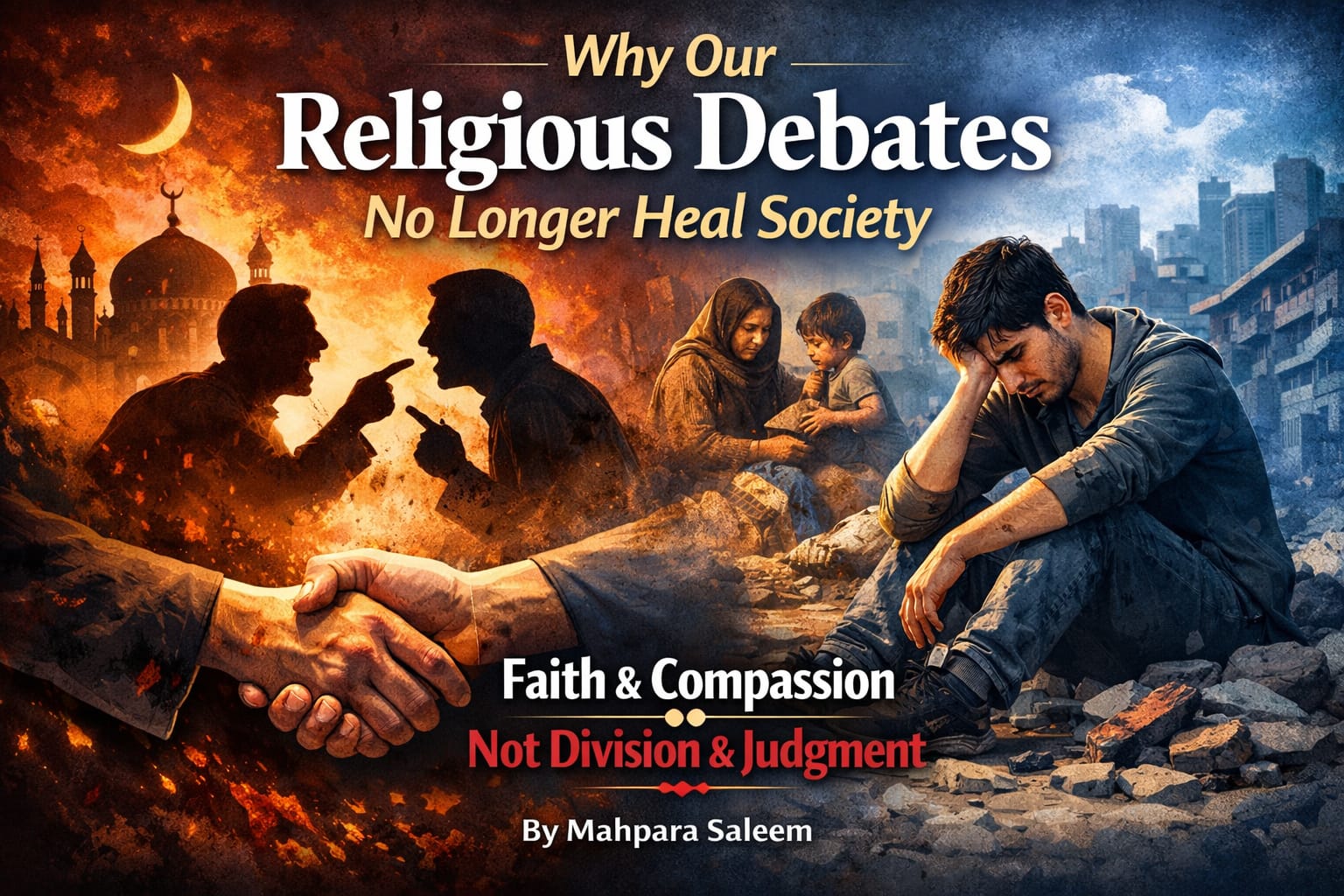

Mahpara Saleem
“Societies do not collapse because of theological debate; they collapse when compassion disappears.”
Religion, at its core, is not a mere collection of rituals, symbols, or debates over permissibility. It is a comprehensive moral and ethical framework designed to uphold human dignity, compassion, justice, and collective welfare. This principle is not exclusive to any one faith. Almost all major religions including Islam anchor their teachings in universal human values mercy (rahmah), justice (‘adl), care for the vulnerable, and responsibility toward society.
Yet, it is deeply unfortunate that contemporary religious discourse has increasingly been reduced to narrow, repetitive arguments. We argue over whether Shab-e-Barat is obligatory or optional, whether staying awake at night is right or wrong, whether a specific act earns sawab or leads to gunah. Soon, we will witness fresh conflicts over whether Taraweeh is eight or twenty rak‘ahs, debates that spill from mosques into streets, homes, and social media, continuing relentlessly until Eid-ul-Fitr.
This obsessive fixation is astonishing. Islamic tradition itself reassures believers that Allah is Most Forgiving, even when Sunnah or optional acts are missed, intentionally or unintentionally. The Qur’an repeatedly opens doors of divine mercy. Yet instead of emphasizing this balance, we have crippled ourselves in divisive discourse, prioritizing form over substance and argument over action.
Allama Iqbal captured this crisis with piercing clarity:
زبان سے کہہ بھی دیا لا اِلٰہ تو کیا حاصل
دل و نگاہ مسلماں نہیں تو کچھ بھی نہیں
And again, warning against intellectual rigidity:
خود بدلتے نہیں قرآں کو بدل دیتے ہیں
ہوئے کس درجہ ملا صاحبِ فتوٰی تفسیر
Why have religious conversations turned into endless declarations of “this is wrong” and “that is forbidden,” instead of asking why society is hurting and how it can be healed?
From a legal and ethical standpoint, religion is meant to serve the public good (maslahah). Islamic jurisprudence explicitly prioritizes protection of life, intellect, family, property, and human dignity. When these objectives are ignored, something is fundamentally misaligned. Even many scholars and preachers, despite their learning, remain trapped in criticism without solutions, delivering the same sermons year after year. They often forget that the divine message is dynamic, meant to be communicated in a language that addresses contemporary realities, including mental health, addiction, ethical leadership, technology, and social responsibility. Instead, public discourse remains confined to repetitive fazā’il-based sermons focused solely on individual reward and paradise, detached from lived human suffering. Criticism without guidance, and rules without empathy, may create fear, but they never create reform. Religion was never intended to function as a tool of constant judgment; it was meant to provide moral leadership. We must therefore ask ourselves honestly: Is religion only about gunah and sawab?Or is it about being responsible humans in a suffering world? What is the value of religiosity if it lacks humanity? What is the purpose of prayer if it does not soften the heart?What is the benefit of faith if it does not make us sensitive to pain around us?Look at the realities we are ignoring:
Countless young people trapped in drug addiction, without guidance or hope. A silent epidemic of depression, anxiety, and despair among our youth. Families crushed under poverty, unemployment, and debt while sermons remain
disconnected from their reality.
Has this suffering truly become central to our religious priorities or is it mentioned only as a ritual slogan?
Has anyone seriously addressed the mental-health crisis, moral confusion, erosion of trust, and widening gap between religious rhetoric and social reality?
Religion loses its credibility when it speaks loudly on minor differences but remains silent on major injustices.
Societies do not collapse because people debate theology; they collapse when compassion disappears and responsibility is abandoned. True religion does not distract us from reality it demands engagement with it. It does not narrow vision ,it broadens concern. It does not produce harsh judges,it produces caretakers of humanity.
The Qur’an is explicit:
لَيْسَ الْبِرَّ أَنْ تُوَلُّوا وُجُوهَكُمْ قِبَلَ الْمَشْرِقِ وَالْمَغْرِبِ
(البقرۃ 2:177)
Righteousness is not merely turning faces in worship, but living moral responsibility.
َقُلِ اعْمَلُوا فَسَيَرَى اللَّهُ عَمَلَكُمْ
(التوبہ 9:105)
Say: Act Allah will see your deeds.
أَتَأْمُرُونَ النَّاسَ بِالْبِرِّ وَتَنسَوْنَ أَنفُسَكُ
(البقرۃ 2:44)
Do you preach righteousness to others and forget yourselves?
The message is unmistakable: faith without human values is hollow. Humanity without responsibility is fragile. The real test of religion is not how fiercely we argue, but how sincerely we heal, protect, and uplift those around us.
Religion was never meant to be fought over in small issues. It was meant to save humanity from moral collapse.
Comments are closed.