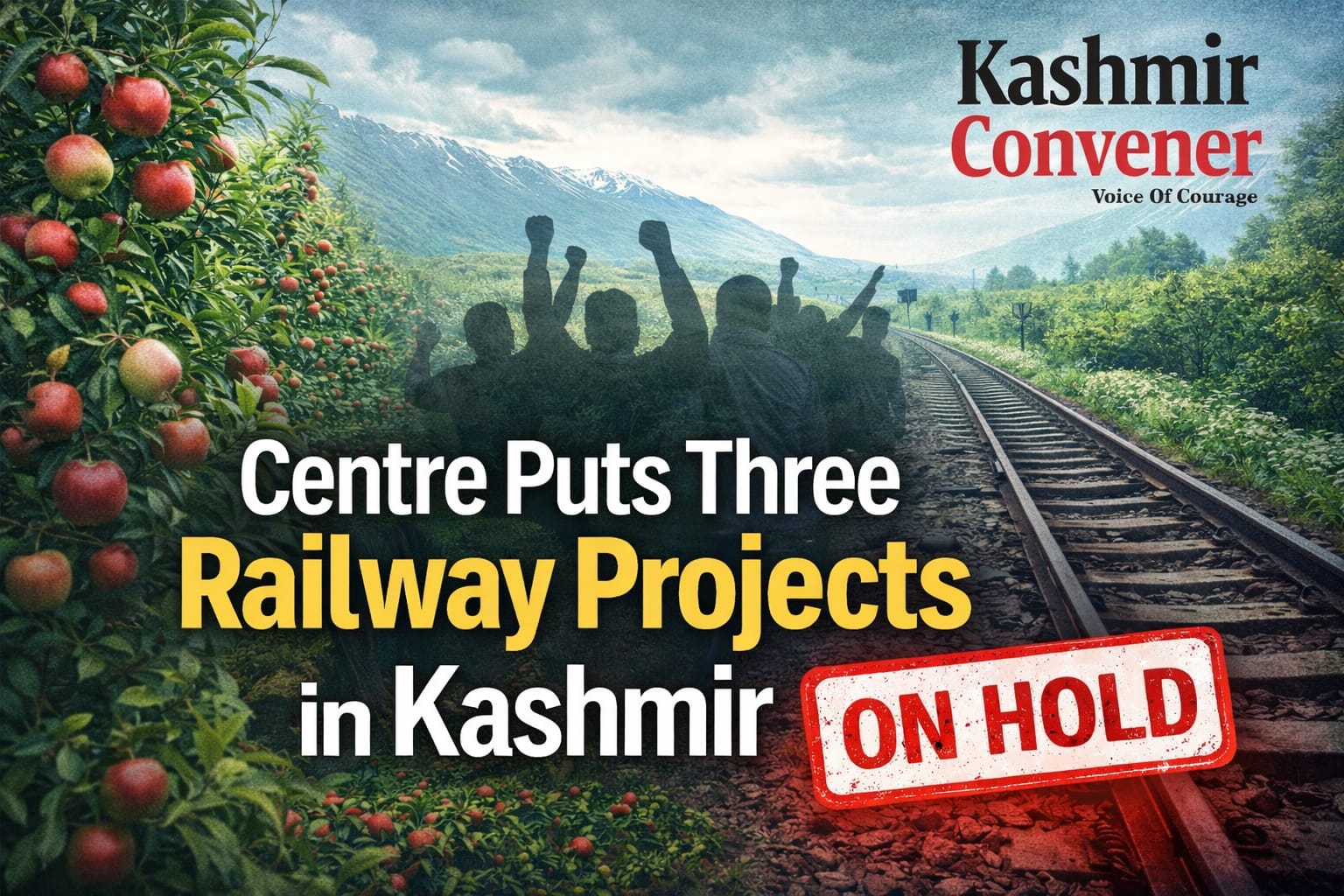
Srinagar, Feb 03: The Central Government on Tuesday put three proposed railway projects in Kashmir on hold following strong objections from locals and elected representatives over the potential damage to apple orchards and concerns about large-scale land acquisition.
The projects, planned for parts of the Pulwama, Shopian, and Anantnag districts, had sparked sustained protests by apple growers and residents. They feared the loss of fertile agricultural land, the destruction of orchards, and the displacement of families.
In a video statement accessed by Kashmir Convener, Union Railway Minister Ashwini Vaishnaw said: “There is already a railway line from Srinagar to Baramulla, and there was a demand to set up three more lines. Later, the Jammu and Kashmir government and Members of Parliament raised concerns that these lines must not be built, as they would significantly impact apple orchards. Now, the government has decided to put these proposed projects on hold.”
Vaishnaw also stated that the Centre has allocated approximately Rs 1,086 crore to Jammu and Kashmir under the rail budget, underscoring the government’s focus on strengthening rail connectivity in the region. He added that efforts are ongoing to expand railway infrastructure, particularly in remote areas of the Union Territory.
Highlighting the role of Vande Bharat trains, the minister said the semi-high-speed services have played a crucial role in maintaining connectivity and public service in Jammu and Kashmir, especially during the winter months when road links are often disrupted.
He also said that the trains promote regional identity by offering local cuisines on board. “Dogri cuisine is served on the Vande Bharat train operating from Jammu, while Kashmiri dishes are served on the return journey from Srinagar to Jammu,” he said.
He further informed that the railway infrastructure work on the Baramulla–Uri section has been completed and is currently awaiting approval. He added that survey and Detailed Project Report (DPR) work for the proposed Jammu–Rajouri rail project is progressing at a fast pace.
The decision comes after months of protests across southern Kashmir, with demonstrators demanding the rerouting of the projects, fair compensation, and proper consultation before any land acquisition. Several rallies were held by apple growers, who argued that the railway lines would cut through prime horticultural land, which is the backbone of the region’s economy.
Legislator Tanvir Sadiq said the move followed high-level engagements initiated by former Chief Minister Omar Abdullah.
“This is a very auspicious occasion for the people, especially those of Anantnag, Shopian, and Kakapora,” Sadiq said. “Due to the personal intervention of Chief Minister Omar Abdullah, our MPs met the Railway Minister. The project has now been kept on hold, as it would have caused massive losses to apple orchards, amounting to lakhs, and had a severe economic impact.”
Former Chief Minister Mehbooba Mufti welcomed the decision, stating it brings “much-needed relief to Kashmir’s agrarian economy.” In a post on X, she wrote: “These projects threatened to destroy scarce fertile land and push over a million rural families into uncertainty. Development that uproots farmers is not progress. Any future plans must be reviewed transparently, with farmers and local communities taken on board to protect Kashmir’s economy and social fabric.”
Farmers in the affected areas termed the decision a major relief.
In Kakapora, apple grower Bashir Ahmad told Kashmir Convener: “It’s a relief. This announcement was much needed. Our centuries of hard work were being destroyed. We only have these orchards. If these were also taken away, what would we be left with?”
Another grower, Umar Rashid, said: “We raised our voices many times for this, without fear. Thank God, today we can finally breathe in relief. It’s not about whether the government pays a good amount or not—it’s about the fact that our entire life is in these orchards. Our very survival would have ended.”
Mohammad Ismail Dar, a third-generation orchard owner from Shopian, stated: “They wanted to lay tracks through the heart of our gold. These trees are not just crops; they are our legacy, our pension, and our children’s future. Putting the project on hold is a victory for every farmer who stood guard over his land.”
He added, “This was a fight for existence. We are not against development, but development that comes at the cost of erasing our prime horticultural zone is self-defeating. The government must now engage in a genuine dialogue to find alternative routes that don’t sacrifice our food security and economy.”
Saima Jan, whose family owns orchards in Anantnag, said: “For months, sleep was a stranger. The anxiety of losing everything our forefathers built was crushing. Today’s decision feels like a heavy weight lifted. We hope this pause becomes permanent and teaches a lesson that projects cannot be imposed without the free, prior, and informed consent of the people.”
Similar sentiments were echoed from other parts of southern Kashmir, with residents appreciating the decision and thanking legislators for their timely intervention.
A group of young farmers from Pulwama told Kashmir Convener: “This is our generation’s fight. We don’t want to be forced into migration or daily-wage labour after being land-owning farmers. The railway line, as proposed, was a threat to our identity. The hold is a relief, but we remain vigilant. Our demand remains: ‘No railway line through our orchards.'”
Notably, Kashmir’s apple industry supports lakhs of families and contributes significantly to the regional economy.
The proposed railway lines were part of infrastructure expansion plans but faced fierce resistance over environmental and livelihood concerns.


Comments are closed.