
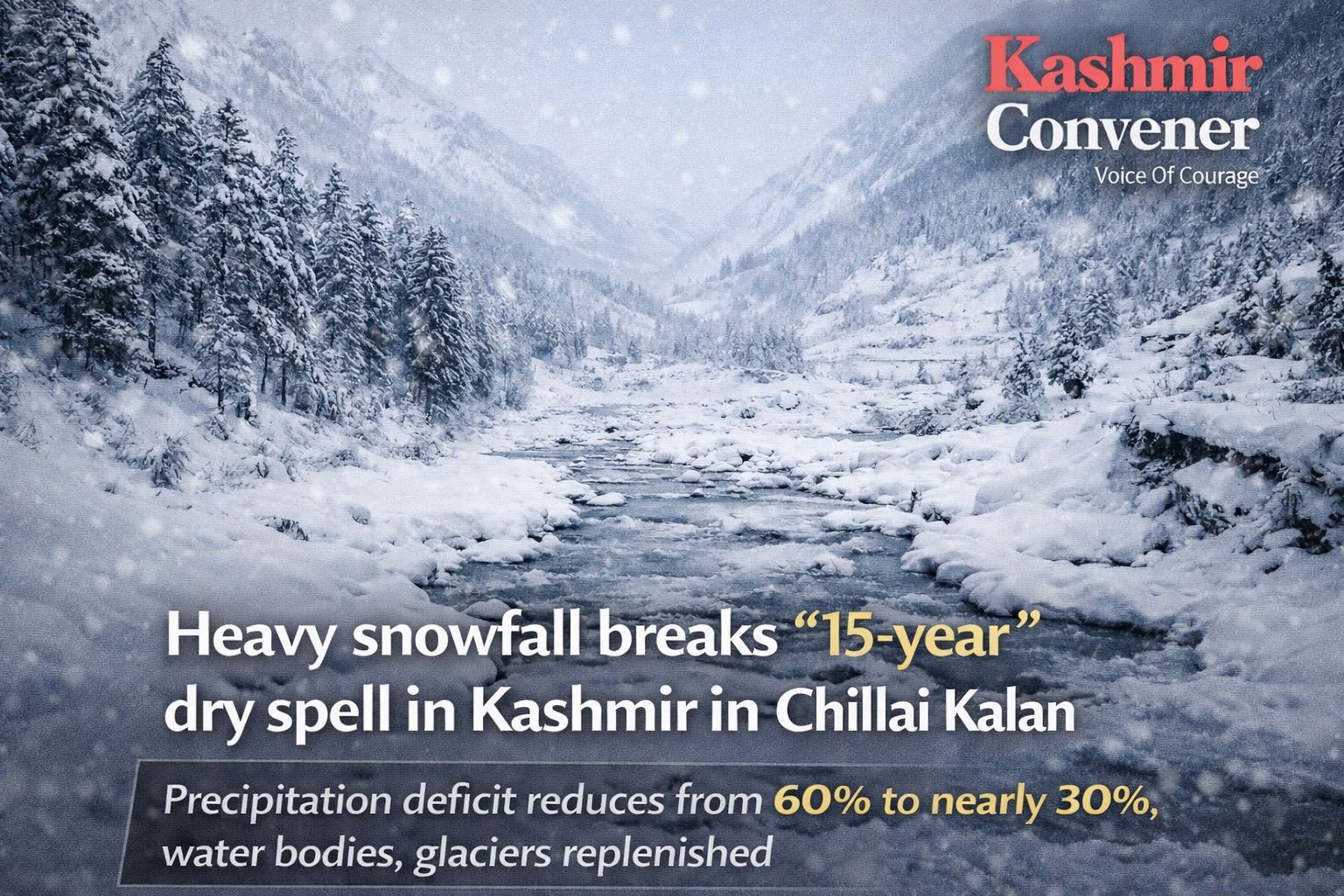
Heavy snowfall breaks “15-year” dry spell in Kashmir in Chillai Kalan
Precipitation deficit reduces from 60% to nearly 30%; water bodies, glaciers replenished

Suhail Khan
Srinagar, Jan 31 ; A persistent and heavy spell of snowfall across Kashmir has broken 15-year record for snow accumulation during the Chillai Kalaan period and bringing crucial respite from a prolonged dry spell.
While the fresh snow has significantly rejuvenated water reserves and brought relief to the agricultural sector, nearly 50% of Kashmir’s area continues to grapple with the aftermath of the extreme weather, including sharply plummeting temperatures.
Mukhtar Ahmad, Director of the India Meteorological Department (IMD) in Srinagar, told Kashmir Convener that the snowfall had broken a 15-year dry spell in the Kashmir. “Significant snowfall was observed in many places, with people stating they had not seen this much snow in years,” he said, specifying low-lying areas of Budgam and Pulwama, the higher reaches of Kupwara, and Shopian as key recipients. While snowfall is annual in Shopian, this event set records across the Valley.
Mukhtar stated that such major snowfall had not been witnessed for many years, particularly during the core winter period. “This snowfall was significant due to the prolonged dry spell witnessed in recent months. In terms of the intensity of snow accumulation, it was special in many ways,” he noted, citing heavy snow in the middle and higher reaches of Budgam and many parts of Kupwara and Baramulla.
The director confirmed that the snowfall has substantially improved the precipitation deficit. “This has reduced the precipitation deficit from 60 percent to nearly 30 percent in many parts of the valley. In the Jammu Division, rainfall is now almost in the normal category,” he said.
However, the snow cover has triggered a sharp drop in temperatures, exacerbating hardships. Sonamarg recorded a low of -10.6°C and Gulmarg -9.0°C. Dry weather is forecast to persist until January 31, but a fresh western disturbance is predicted to bring more rain and snow on February 1 and 2.
The recent snowfall has brought much-needed respite to a Kashmir confronting what experts had termed a “silent emergency.” Prior to the snow, an alarming 83% shortfall in rainfall—categorized as “very low”—had drastically reduced flows in the region’s rivers, tributaries, and natural springs, jeopardising water supplies across all ten districts and threatening the summer water supply.
Mukhtar Ahmad described the snowfall as “significant,” stating it would “allay fears of water scarcity in summer by rejuvenating water bodies and glaciers.” He added that it would also help boost apple production this year. Kashmir has recently witnessed increasingly erratic weather, including prolonged dry spells, intense rainfall, and record heat last year, which had triggered a growing water crisis.
Chief Minister Omar Abdullah earlier said the snowfall would benefit tourism, as visitors had been eagerly awaiting snow, and would help avert a drought-like situation. “If we had not received this snow, there would have been a very severe shortage of water during the summer,” he said.
The snowfall thus marks a critical hydrological intervention, replenishing the Kashmir’s vital water reserves amidst a broader pattern of climatic shifts that have threatened both its iconic landscapes and the foundations of its economy and food security.
Comments are closed.