

Mohammad Arfat Wani
“Paying Anganwadi workers with dignity is not charity—it is justice, recognition, and an investment in the future of Jammu and Kashmir.”
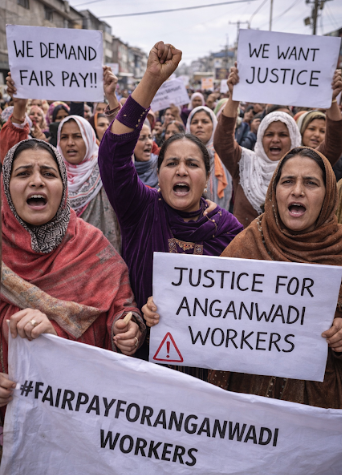
The Jammu and Kashmir Anganwadi workers are the pillars of child health, maternal welfare, and early childhood education, but their tireless efforts remain unseen, underpaid, and ignored. Every day, they rise before dawn, walk miles in inclement weather, and dedicate themselves to ensuring that children are fed, mothers are advised, and villages remain healthy. Despite the fact that the work has a direct impact on the smooth running of the nation in the days to come, the employees are paid as little as ₹5,100 every month. This is alarmingly less compared to even the minimum requirements needed to lead a satisfactory life. Moreover, the majority of the women are graduates, with a few dedicating more than three decades to the development of the nation. Their hard work is being compensated at a mere fraction of the amount received by the junior employees in the government.
Anganwadi workers do work which decides the health and wellbeing of thousands of people. They weigh the children, monitor the growth chart, prepare diet charts, counsel the mothers on nutrition and health, monitor pregnancies, vaccinate in a timely manner, verify documents, and fill official reports with utmost care. It requires patience, precision, compassion, and one’s vigilance at all times. But the compensation they receive barely covers their travel expense, forcing some of them to spend half of what they earn merely to reach their centers. Their losses are enormous, and their services to child survival and maternal health are priceless.
The injustice becomes more apparent when compared with other professions. A casual laborer could be earning ₹1,000 a day, earning him a figure of well over ₹30,000 a month, while a primary school teacher could earn above ₹80,000. While a worker in an Anganwadi, whose work ensures that children grow up healthy and mothers survive childbirth, gets less than a sixteenth of a teacher’s remuneration, this is not economic abandonment alone but also deep gender inequality, signifying that caregiving, the cornerstone of society, is not being valued.
Despite all this, the women continue with persistence and determination. Many female health workers walk long distances every day, even in snow, to reach their centers. Some spend nearly half of their salary on transportation, yet they persevere because they believe in improving their neighborhoods. Others monitor pregnant women with severe anemia and ensure timely treatment, saving both mother and baby. There are thousands of such women in Kashmir—unspoken yet irreplaceable—working behind the scenes to shape the health and future of their communities
Ignoring Anganwadi workers has consequences that extend far beyond individual misery. If they did not work, children’s malnutrition would rise, vaccination campaigns would fail, and early education would be lost. Anganwadi workers are not just workers—they are a lifeline to communities, families, and the future of Jammu and Kashmir. Acknowledgment is insufficient; proper wages, travel allowances, health allowances, and timely payment are needed to make their work worthwhile morally and economically.
It is also my humble opinion, after due consideration of the subject, that senior Anganwadi workers, who have dedicated their lives and decades of service to public service, should also be regularized with a view towards acknowledging their dedication and service. However, at the same time, the honorarium for junior Anganwadi workers should also be significantly elevated so that they may live with dignity. This suggestion is humbly offered by me with due recognition of the higher wisdom and vision that the government may have. Indeed, it is hoped that the policy framework that is adopted may be just and beneficial for each and every Anganwadi worker so as to ensure justice for every generation and lay strong foundations for this system as a whole.
It is up to the leadership of Jammu and Kashmir, which includes the Honourable Chief Minister Omar Abdullah, Honourable Lieutenant Governor Manoj Sinha, and Members of Parliament, but most importantly the Department of Social Welfare, which is responsible for ICDS and Anganwadi services. The Department, headed by the Minister for Social Welfare Sakeena Masood Itoo, is key to introducing and implementing meaningful and long-overdue reforms. A structured and phased increase in wages, allowances, and timely monthly payments would not only restore the dignity and integrity of Anganwadi workers but would also vastly enhance child nutrition and education outcomes in the Union Territory.
Real development is not measured in terms of infrastructure. It can be measured in terms of society’s willingness to treat with respect the guardians of its most vulnerable members. The abandonment of Anganwadi workers indicates misplaced priorities, and turning back is a moral, social, and economic imperative. These women are entitled to dignity, justice, and the right to earn their bread to work for society. Anything short is a betrayal of our collective conscience.
Empowering the Anganwadi employees is also to promote gender equality, empower women, and inspire girls to love education and hard work. By rewarding them with appropriate compensation and recognition, we are rewarding the community for being strong, persistent, and hardworking. By living an integral and participatory lives to provide nutrition to the growing babies, guidance to the mothers, and keep the babies alive, we are laying the foundations of strong and robust communities. If we fail to pay attention to the Anganwadi employees, we are jeopardizing the very existence of our babies.
Their stories are heartbreaking and inspiring. They save lives, drive education, and strengthen families, but they are invisible heroes. They are the unsung heroes, without whom rates of child malnutrition would rise, vaccination rates would decline, and early childhood programs would collapse. Their work is critical but undervalued. To value their worth and provide fair pay is not only a moral responsibility—it is an urgent moral requirement.
In conclusion, the Jammu and Kashmir Anganwadi workers are silent pillars of society. They protect children, mothers, and the future. They demand only their rightful dues: justice, dignity, and recognition of their toil. Society, the government, and policymakers must move quickly. They must grant them just wages, prompt allowances, and social recognition. This is not only needed for their survival but for the welfare and prosperity of future generations. Anything less is a failure of conscience, a failure to honor those who quietly and with courage nurture life itself, and a failure of the society we hope to become. The time to act is now because the women who serve, contribute, and care for our society deserve justice, respect, and most of all, fairness.
Author is a writer, social activist, and nursing student from Kuchmulla, Tral. He is also a B.Sc. Nursing student at Ramzaan College of Nursing & Paramedical Sciences, Galander Pampore. He can be mailed at wania6817@gmail.com
Comments are closed.