

Majid Marouphay
“What I witnessed at SKIMS was not just a hospital routine, but a living portrait of human vulnerability and an unspoken social crisis—one unfolding silently in crowded corridors filled with wheelchairs, whispered prayers, and exhausted faces searching for hope.
There are moments when life forces us to pause and confront our own vulnerability. Moments when illness reduces all worldly certainties to a hospital corridor and a whispered prayer. Hospitals are not merely buildings of concrete and corridors; they are spaces where human strength quietly collapses and faith struggles to hold on. A single visit can expose truths we spend a lifetime avoiding – the fragility of the body, the uncertainty of survival, and the quiet heroism of those who stand beside the sick.
Last week, I accompanied my ailing brother Khan Zahoor to Kashmir’s premier medical institution, the Sher-i-Kashmir Institute of Medical Sciences (SKIMS), Soura. He has been battling a chronic kidney ailment for the past few years and was scheduled for a follow-up at the Nephrology Department. What I witnessed there was not merely a hospital visit. It was a stark reminder of human fragility and an unspoken social crisis unfolding quietly around us.
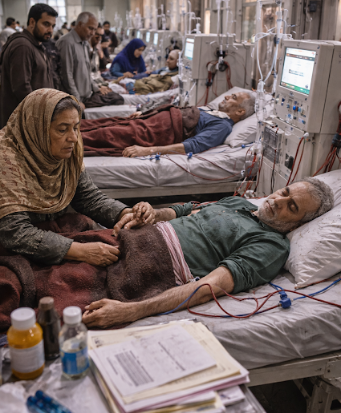
As we waited for our turn, the corridor outside the Nephrology ward told its own painful story. Patients and their attendants crowded the narrow space, jostling, waiting, running from one counter to another, each clinging to a thin thread of hope that they might get a moment with the specialist. The number of kidney patients was overwhelming, far more than one would expect, and each face carried a silent tale of suffering.
Most patients looked painfully weak. Pale grey faces, lifeless eyes, fragile bodies slumped in wheelchairs. Many murmured ‘Allah, Allah’ under their breath – not loudly, not in complaint, but as a final refuge. Their eyes constantly searched for reassurance, often settling on the worried faces of their attendants, as if silently asking whether the doctor had arrived, whether relief was near.
What shook me most was seeing young patients – men and women in their late thirties and forties, already ravaged by kidney disease. It felt unreal, already reduced to pale shadows of themselves. People who should have been at the peak of their productive lives were now dependent for even the smallest needs. To go to the toilet, they needed help. To stand for a few moments, they needed support. Their physiques had weakened, their stamina drained, their independence stolen mercilessly by disease. Their eyes carried an unbearable tiredness, and their bodies looked defeated long before their age. A few of them looked at me briefly, only to turn their gaze away, as if words were unnecessary. In that fleeting exchange of eyes, I sensed an unspoken confession: these were once our youthful days. We too were vibrant, handsome, graceful, with shining faces and hopeful eyes. We were meant to be working, creating, dreaming – building careers, nurturing ambitions, discovering the hidden potentials waiting to be explored.
Life had promised them movement, purpose, and recognition. Instead, a cruel chronic illness arrived unannounced, arresting their youth, shattering their plans, and leaving their dreams stranded in hospital corridors. What should have been years of achievement had been replaced by dialysis schedules, medical reports, and endless waiting.
One by one, some patients were finally called in. After brief consultations, they emerged with new prescriptions, fresh investigations, and further tests advised. Then began another ordeal – being taken to laboratories for blood samples, kidney and liver function tests, ECGs, ultrasounds, echo scans. Each test meant more waiting, more anxiety, more pain.
The entire process felt exhausting even to observe. In the labs, I noticed elderly husbands supporting their equally frail wives, daughters holding their fathers’ hands, young women guiding their aged mothers. The presence of loved ones was often the only visible strength these patients had left. Without them, the journey through illness would have been unbearable.
Beyond the visible physical suffering lies an equally devastating but often ignored reality, the crushing financial burden this disease imposes on families. Chronic kidney patients require regular dialysis to survive. For some, it is twice a week; for others, three times a week without fail. This routine is not temporary, it stretches endlessly, draining not just the body but entire households.
Dialysis centres are mostly located in towns or at super-speciality hospitals, far away from many patients’ homes. Each visit means travel expenses, loss of daily wages, arranging transport, and hours of waiting. For poor and middle-class families, this becomes an unending cycle of hardship. Savings vanish, debts pile up, and families are often pushed to the brink of financial collapse. The burden does not end at the hospital gate.
At home, these patients need constant care, special handling, and a strictly prescribed diet – often expensive and difficult to manage. Medicines, injections, nutritional supplements, repeated tests, and emergency hospital visits become part of daily life. One earning member’s illness often means the entire family’s livelihood is shaken. The responsibility is enormous, the costs staggering, and the chances of complete recovery heartbreakingly limited.
What is even more alarming is the steadily rising number of kidney patients. Day by day, the queues grow longer, the corridors more crowded, the suffering more visible. Yet, behind these numbers are real lives – families silently battling despair, selling assets, borrowing money, and praying for miracles.
Those moments at SKIMS forced me into deep reflection. When health deteriorates, a person is stripped of his strength, his confidence, and often his dignity. He becomes helpless, vulnerable, and painfully dependent. Illness does not only weaken the body; it humbles the soul. And it is during such times that the importance of one’s own people – family, companions, loved ones—becomes unmistakably clear. They are not just attendants; they are lifelines.
The scenes at SKIMS were difficult to witness, but they carried a powerful lesson: health is the greatest blessing we often take for granted, and human presence is the greatest medicine when the body begins to fail. In those hospital corridors, amid wheelchairs, whispered prayers, anxious eyes, and exhausted attendants, I saw not just suffering. I saw humanity at its most fragile, and at its most compassionate.
Another painful dimension of this chronic kidney ailment is the relentless financial hemorrhage it causes within families. The cost of survival is staggering. Prolonged dialysis sessions, expensive and lifelong medicines, repeated laboratory investigations, blood donations, and frequent consultations at super-speciality hospitals together accumulate into lakhs of rupees as the illness stretches across years.
For most families, this is not an expense. They are battles fought every month to stay afloat. Gradually, savings evaporate, assets are sold, and dignity is compromised. Many patients, already crushed by illness, are forced to step into public spaces and digital platforms, appealing for financial help from strangers, a sight that has become alarmingly common and deeply distressing.
A patient fighting for life should not be compelled to beg for survival. It is here that a compassionate policy intervention becomes imperative. My humble submission is the introduction of a mandatory health insurance cover for kidney patients immediately upon diagnosis. Such a safety net would not only ease the crushing burden on families but also restore a measure of dignity to the patient. With assured financial support, families would finally breathe easier, and patients could focus on healing rather than on how to fund the next dialysis session. I earnestly appeal to the civil society of Kashmir, medical experts, and respected ulemas to come forward, deliberate, and advocate for a sustainable health insurance framework that can shield these vulnerable lives from both medical and financial collapse.
What unfolds daily in the corridors of SKIMS and other hospitals across Kashmir is not merely a medical challenge, it is a growing public health emergency that demands urgent attention.
Author is a teacher and can be reached at khanmarouphay@gmail.com
Comments are closed.