

S. Ahmad
India’s economic transformation is often narrated through large infrastructure projects, metropolitan growth centres, and headline-grabbing manufacturing corridors. Yet, beneath this macroeconomic narrative lies a quieter, more enduring story—one rooted in districts, crafts, farms, and micro-enterprises that have sustained livelihoods for generations. The One District One Product (ODOP) initiative represents a structural shift in India’s development paradigm by recognising that sustainable growth cannot be centralised; it must emerge organically from local strengths, skills, and traditions.
From Moradabad to the Nation: The Genesis of ODOP
The origins of ODOP can be traced to Uttar Pradesh in 2018, where the state government launched a pioneering effort to revitalise district-specific products. Moradabad, globally known yet locally undervalued for its brassware, was among the first districts selected. For decades, artisans in Moradabad had worked in informal settings—family-run units with limited access to finance, branding, technology, or global markets. Despite exceptional craftsmanship, their products were often sold through layers of intermediaries, eroding profits and visibility.
ODOP introduced a decisive intervention. By officially designating brassware as Moradabad’s signature product, the initiative integrated artisans into a structured ecosystem involving branding, credit facilitation, skill development, modern toolkits, quality certification, marketing support, and participation in national and international exhibitions. The result was not merely increased income but restored dignity, local pride, and economic confidence.
Moradabad soon became a model rather than an exception. As of December 2025, ODOP has been adopted nationally and expanded to over 770 districts, directly impacting millions of artisans, farmers, weavers, food processors, and micro-entrepreneurs. What began as a state-level experiment has evolved into India’s most comprehensive initiative for decentralised economic transformation.
ODOP as an Engine of Balanced Regional Development
At its core, ODOP seeks to correct a long-standing imbalance in India’s development trajectory. Economic growth has historically concentrated in select urban and industrial clusters, while districts rich in traditional skills remained excluded from formal value chains. ODOP challenges this imbalance by recognising districts as economic growth engines, each with unique productive potential.
The initiative promotes:
- Balanced regional development by unlocking district-level strengths
- Empowerment of artisans and producers through institutional support
- Preservation of heritage by sustaining traditional skills and crafts
- Job creation and rural entrepreneurship, particularly among women and youth
- Export promotion and global recognition of Indian products
By linking cultural heritage with economic opportunity, ODOP ensures that development does not erode tradition but strengthens it.
Institutional Framework and Governance
ODOP’s success lies in its flexible yet structured governance architecture. The initiative is coordinated at the national level by the Department for Promotion of Industry and Internal Trade (DPIIT), while implementation is driven by State governments and district administrations. Products are identified by States and Union Territories based on existing ecosystems, skill availability, and market potential, with final lists communicated to DPIIT.
Over 1,200 ODOP products are currently listed on DPIIT’s digital portal, spanning textiles, handicrafts, food products, minerals, and natural goods. This decentralised model allows states to tailor interventions while maintaining national coherence.
Market Access and Digital Integration
One of the most critical barriers faced by local producers has been market access. ODOP directly addresses this through digital integration and e-commerce expansion. A dedicated ODOP storefront on the Government e-Marketplace (GeM) enables artisans and producers to reach institutional buyers and government departments nationwide. State-level e-commerce platforms and curated online marketplaces further expand consumer reach.
These digital interventions reduce dependence on intermediaries, improve price realisation, and integrate informal producers into the formal economy—marking a decisive step toward inclusive digital commerce.
Uttar Pradesh: A Blueprint for Success
As the pioneering state, Uttar Pradesh offers the most compelling evidence of ODOP’s impact. The state has witnessed a 76 per cent increase in exports, rising from ₹88,967 crore in 2017–18 to ₹1.71 lakh crore in 2023–24. Under the ODOP Margin Money Scheme, projects worth ₹6,000 crore have been sanctioned, while over 1.25 crore artisans have received training and modern toolkits through structured skill development programmes.
Major platforms such as the Uttar Pradesh International Trade Show (UPITS) 2025 provided unprecedented national and international exposure. The ODOP Pavilion alone featured 466 stalls, generating business leads and deals worth ₹20.77 crore. Prime Minister Narendra Modi highlighted how district-specific products from Uttar Pradesh are now reaching global markets, reinforcing ODOP’s role in advancing Aatmanirbhar Bharat.
Similarly, the Mahakumbh 2025 in Prayagraj emerged as a cultural-economic convergence. A dedicated 6,000 square metre ODOP exhibition zone showcased artisans from across the country, featuring Banarasi brocade, Firozabad glassware, Kushinagar carpets, Varanasi wooden toys, metal handicrafts, and 75 GI-tagged products from Uttar Pradesh alone—34 of them from the Kashi region.
PM Ekta Malls: Permanent Gateways for Local Products
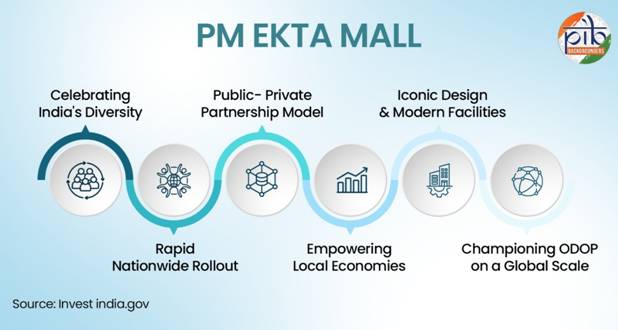
The next institutional leap under ODOP is the establishment of PM Ekta Malls (Unity Malls)—iconic retail and cultural hubs dedicated to ODOP, GI-tagged, and handicraft products. Each mall will provide earmarked space for every State and Union Territory, ensuring national representation under one roof.
Key features include:
- ₹5,000 crore interest-free financial support, with at least ₹100 crore per state
- Public-Private Partnership model with state ownership and professional management
- Iconic architecture, multilingual signage, and national branding
- Experience zones, theatres, food courts, and cultural spaces
- 29 Unity Malls approved across 27 states
These malls are envisioned not merely as marketplaces, but as living museums of Indian craftsmanship, where culture, commerce, and community intersect.
Global Outreach and Diplomatic Integration
ODOP’s global dimension further underscores its strategic importance. Indian Missions in over 80 countries have promoted ODOP products through exhibitions, showcases, ODOP walls, and diplomatic gifting, including during G20 meetings. Dedicated ODOP retail outlets in Singapore and Kuwait ensure sustained overseas market presence.
Initiatives such as the ODOP Wall at SARAS Aajeevika Stores enhance visibility for rural artisans and women-led Self-Help Groups, strengthening inclusive participation in global value chains.
Conclusion: India’s Districts on the World Stage
ODOP is no longer merely an initiative—it is a movement that has redefined how India views development, heritage, and local enterprise. From Moradabad’s brass workshops to PM Ekta Malls and international shelves, ODOP has transformed local skills into national pride and global opportunity.
By empowering districts, preserving cultural identity, generating livelihoods, and integrating artisans into global markets, ODOP demonstrates that sustainable development begins at the grassroots. As India advances toward becoming a global economic powerhouse, the success of ODOP affirms a vital truth: when local strengths are nurtured, national growth becomes both inclusive and enduring.
The article is based on the inputs and background information provided by the Press Information Bureau (PIB) Author is Writer, Policy Commentator. He can be mailed at kcprmijk@gmail.com
Comments are closed.