
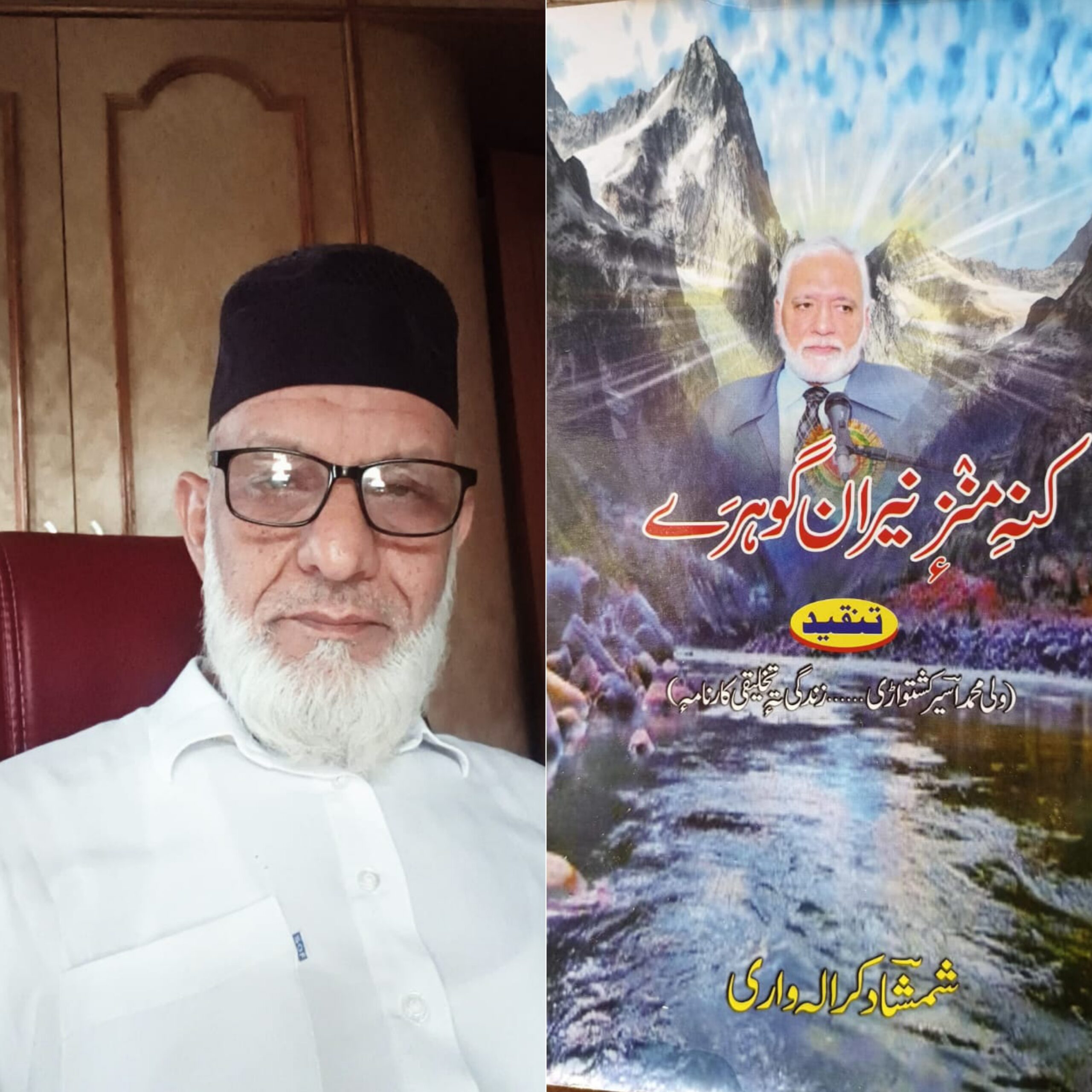

ShahNawaz Nazir
In the cultural history of contemporary Kashmir, few figures embody the convergence of literature, language advocacy, broadcasting, and public responsibility as comprehensively as Shamshad Kralawari. A poet, translator, broadcaster, literary critic, cultural thinker, and public intellectual, Kralawari’s life’s work has been devoted to the preservation, enrichment, and public dissemination of the Kashmiri language and its literary heritage. Over several decades, his contributions across creative writing, translation, media, and cultural institutions have profoundly shaped Kashmiri cultural consciousness, reaffirming language as a vessel of memory, identity, and collective resilience.
Shamshad Kralawari was born in the village of Kralawari in Chadoora, Budgam district—home to the celebrated Kashmiri Masnavi poet Maqbool Shah Kralwari. He grew up in a modest yet intellectually charged environment where books, debate, and reflective thought were integral to everyday life. This formative setting instilled in him a deep sensitivity to language, not merely as a communicative tool, but as a living archive of history, emotion, and cultural identity.
From an early age, Kralawari demonstrated an affinity for words and storytelling. His formative years unfolded at a time when Kashmiri society was grappling with the pressures of modernity while attempting to safeguard its linguistic and cultural inheritance. This tension—between continuity and change—would later become a defining theme of his literary and intellectual pursuits.
He completed his matriculation in 1973 from Government High School Zuhama, an institution established by the legendary Kashmiri poet Abdul Ahad Azad. The school’s literary legacy left a lasting imprint, reinforcing his inclination toward poetry, cultural engagement, and critical inquiry.
Kralawari pursued higher education at Amar Singh College, Srinagar, followed by the University of Kashmir, where he earned Master’s degrees in Kashmiri and Persian. He further expanded his linguistic and literary range by completing Honours in Urdu from Aligarh Muslim University (Lucknow campus). This rare combination of Kashmiri, Persian, and Urdu scholarship equipped him with a deep understanding of classical, regional, and modern literary traditions, positioning him uniquely within South Asian literary discourse.
Even during his student years, Kralawari was deeply embedded in Kashmir’s cultural life. In the early 1970s, he joined the Maqbool Theatre Club, participating actively in stage productions. One of his most notable performances was in the play Gulrez, a role he performed more than twenty times. Theatre sharpened his command over dialogue, narrative pacing, emotional nuance, and audience engagement—skills that would later define his success in broadcasting.
Remarkably, by the time he reached Class 10, Kralawari had already begun writing and staging his own plays. These early creative experiments foreshadowed a lifelong commitment to narrative form, linguistic precision, and artistic expression, and they laid the foundation for his later achievements in literature and media.
Shamshad Kralawari’s engagement with broadcasting began as a teenage aspiration shaped by his belief in the transformative power of the spoken word. In the mid-1970s, he began volunteering with Radio Kashmir and Yuvavani, contributing to programmes such as Talks, Aund Poek (weekly city round-up), and Tuhinz Pasand. These early broadcasts allowed him to experiment with content, language, and audience interaction.
Following graduation, he was empanelled as a News Reader for Radio Kashmir Srinagar and Doordarshan Kendra Srinagar, where his clarity of diction and authoritative presence quickly made him a household name.
In 1985, he formally joined Radio Kashmir Srinagar (now All India Radio) as a permanent Announcer and Compere. By 1987, he was selected as News Reader (Kashmiri) at the News Services Division, AIR New Delhi, before returning to Srinagar in 1989 as Programme Executive, selected through the UPSC (Batch 1988).
Over a distinguished career, Kralawari headed more than thirteen departments, often assuming additional responsibilities during critical periods, particularly after the 1990 upheaval, when many senior officers were forced to leave the Valley. His leadership, professionalism, and institutional commitment ensured continuity of broadcasting during some of Kashmir’s most turbulent years. He eventually rose to become Head of the Commercial Broadcasting Service (FM 102.6 MHz).
Under his stewardship, radio evolved beyond entertainment into a platform for cultural reflection, public education, health awareness, environmental consciousness, and civic dialogue. Programmes such as Baete Kath, Pragash, Sangarmal, Zuvan Pai, Hello Doctor, Vadi Ki Awaaz, Zoon Dab, Miyan Zindagi Miyune Kar, Rai Trai, and Sehri Programme became deeply embedded in everyday Kashmiri life, reaffirming radio’s role as a democratic public institution.
The catastrophic floods of September 2014 marked a defining moment in Kralawari’s career and in Kashmir’s media history. With communication networks collapsed and large parts of Srinagar submerged, the Valley faced an unprecedented information blackout.
In this moment of crisis, Shamshad Kralawari displayed extraordinary courage and civic responsibility. As Radio Kashmir’s studios were inundated, he waded through floodwaters under immense personal risk to reach the Shankaracharya Hill transmitter. With minimal equipment and a makeshift setup, he initiated the “Kashmir Flood Helpline” on FM frequencies.
These broadcasts became a lifeline—offering verified information, coordinating relief, countering rumours, and reconnecting separated families. At a time when official communication channels were paralysed, Kralawari’s voice restored trust, calm, and collective resolve. His actions stand as a powerful reminder of broadcasting’s ethical responsibility during humanitarian crises.
Parallel to his media career, Kralawari has earned recognition as a poet of rare depth and sensitivity. His Kashmiri poetry explores folklore, memory, loss, identity, and existential reflection, often employing layered symbolism and evocative imagery.
Poems such as “Wunal” (The Fog), “Zabervan”, and “Myune Bi” exemplify his lyrical precision and philosophical insight. Rooted in oral tradition yet informed by modern sensibility, his poetry captures the emotional complexity of Kashmiri experience, bridging past and present with remarkable subtlety.
Perhaps the most enduring pillar of Shamshad Kralawari’s legacy lies in translation—an endeavour he regards as cultural preservation rather than linguistic transfer.
His landmark achievement is the Kashmiri translation of Fyodor Dostoevsky’s Crime and Punishment, titled Jurm ti Saza. Initiated in 1986 and completed in 2010, it stands as the 171st translation of the Russian classic worldwide. The work has been widely praised for retaining Dostoevsky’s psychological intensity and philosophical depth while rendering it in authentic Kashmiri idiom. It is currently under consideration for inclusion in the University of Kashmir curriculum, underscoring its academic significance.
He further expanded Kashmiri’s literary horizon by translating The Brothers Karamazov as Bratheran Karmazov, reaffirming his belief that world classics must live in regional languages to remain culturally relevant.
His critical work Kani Manze Neran Gowhary – Tanqeed reflects rigorous engagement with Kashmiri literary history and criticism, positioning him as a serious literary scholar alongside his creative pursuits.
A lifelong advocate of Kashmiri, Kralawari has consistently argued for mother-tongue education, diversification of Kashmiri prose and non-fiction, and institutional backing in the digital era. Among his most awaited works is “Mehrul Ramazan”, a word-by-word Kashmiri translation of the Holy Quran, completed in 2017, which is eagerly awaited by scholars and readers alike.
He has publicly supported the inclusion of Kashmiri in Microsoft and Google translation platforms, recognising digital visibility as essential for linguistic survival. His advocacy stresses documentation of oral traditions, linguistic pride, and intergenerational transmission.
Beyond writing and broadcasting, Kralawari has played a significant role in cultural institutions, literary forums, and public debates. He has moderated scholarly discussions, mentored younger writers, and shaped discourse on language policy and cultural responsibility.
He has been honoured at institutions such as Aligarh Muslim University, and the Russian Cultural House, New Delhi, which referred to him as the “Dostoevsky of India” in recognition of his translation work. Yet, his true legacy lies not in awards but in impact.
Shamshad Kralawari represents a rare synthesis of media leadership, literary excellence, and cultural stewardship. As a broadcaster who served society in moments of crisis, a poet who gave voice to collective memory, a translator who globalised Kashmiri literature, and an intellectual who championed linguistic dignity, his contributions form a living archive of Kashmir’s cultural resilience.
His voice—on air, on the page, and in public life—continues to shape how Kashmir remembers its past, negotiates its present, and imagines its future.
Author can be mailed at ania6817@gmail.com
Comments are closed.