

Sheikh Saleem
Bandipora, Jan 26: Republic Day is meant to symbolise equality, dignity and the constitutional values that bind us together as citizens. For journalists, it is also a reminder of our role as the fourth pillar of democracy—tasked with asking uncomfortable questions, holding those in power accountable-be it a politician or civil servant and giving voice to the voiceless.
Yet, my experience at this year’s Republic Day function in Bandipora revealed a disturbing reality: the quiet and growing erosion of respect for journalism in the current system.
With the advent of the internet and the explosive rise of social media, journalism has been pushed to the receiving end of a damaging narrative. Today, anyone with a smartphone is conveniently labelled a “journalist.” Social media has blurred lines between reporting and promotion. A Facebook post, a paid reel, or a flattering write-up has replaced ground reporting and critical questioning. Whatever little credibility that remained has now been further eroded by artificial intelligence. Writers or professional journalists are no longer required now as AI has replaced them.
The only difference that distinguishes a journalist from a social media influencer is that a journalist dares to ask an uncomfortable question. A journalist did not play to power and refuse to be a puppet of any government, politician or an officer. But that difference has now become the very reason journalists are ignored, journalism discouraged and social media influencers glorified.
Civil officers, police officials, politicians and even businessmen increasingly prefer so-called “Facebook journalists” who act as stenographers and never question authority. Accountability has become inconvenient and journalism, a sin.
This degradation of profession did not happen overnight. During my early days in reporting, the profession was considered a respectable one. Reporters were respected by one and all- not because they demanded it but they earned it because they did their job religiously and with integrity. Since then a lot has changed on ground.
While politicians and civil servants benefit from this decline; the system as a whole is responsible. With all honesty and hand on my heart, journalists too must share the blame for silently accepting humiliation and indignity.
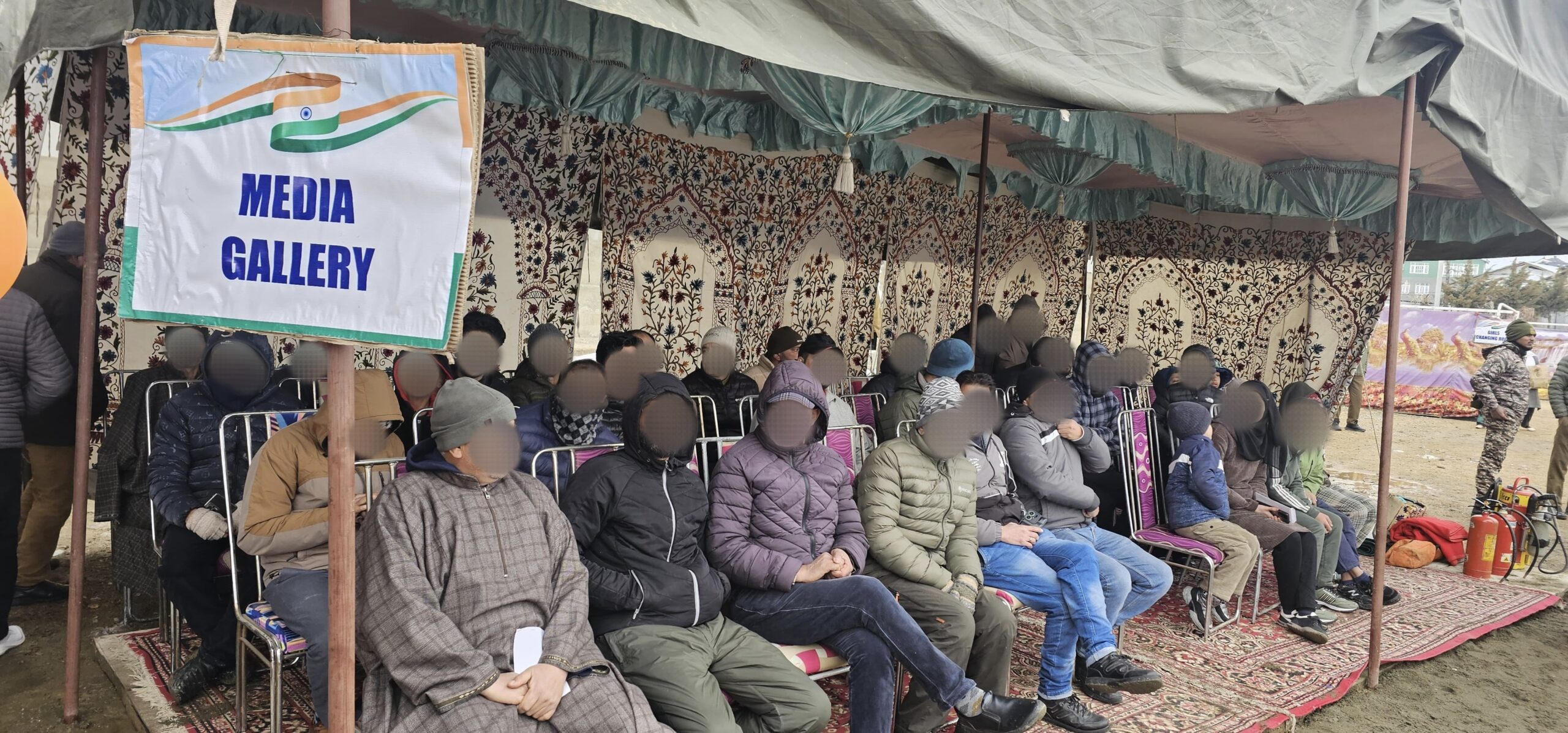
After a long gap, I attended the Republic Day function at Sher e Kashmir Stadium Bandipora. What I witnessed there was deeply disappointing. The stage arrangement told its own story. There were clearly marked well-decorated galleries for VVIPs, district officers, elected representatives of the Panchayati Raj Institutions (PRIs) even social workers and other invitees. Each section had comfortable chairs and sofas with names neatly written and seats properly reserved; Except one.
The media gallery stood out—not for visibility or importance, but for neglect. Uncomfortable, aesthetically unpleasant chairs were placed there, with no names written, no clear seating plan, and no sense of dignity. It was as if journalists were meant to sit wherever they could find a chair like the audience; unlike other galleries.
Ideally, the media gallery should have been at a location that allows journalists a clear view of both the stage and the audience, facilitating proper reporting.
What made the situation even more heart breaking was that on the eve of Republic Day, the District Information Office Bandipora had officially released a list of 26 journalists authorised to cover the event. I presume this list was shared with the nodal agencies managing the arrangements. Yet, about 40 chairs were placed in the media section. One failed to understand for whom were the remaining seats meant? This was a clear case of mismanagement by the concerned agency whose responsibility it was to ensure proper seating arrangements.
The task was neither difficult nor unreasonable. Names could have been easily printed on the seats that could have ensured that no unauthorised person occupies the media gallery—not to grant journalists special privilege, but to allow reporters to listen to the speeches without disturbance or noise and take proper notes. That is the only reason journalists demand a designated seating arrangement—separate from both the stage and the general audience—to perform their professional duties effectively and without any hindrance.
Let me be clear again: journalists do not seek special treatment. We do not ask to be treated as VIPs. But when journalists are deliberately seated away from the public and placed shoulder-to-shoulder with VVIPs only to be treated worse than everyone else, the intention appears deliberate. Keeping journalists among “special invitees” and then humiliating them through poor arrangements sends a clear message—that they are present, but not respected.
Adding to the irony, the chairs marked for media were already occupied by casual labourers deputed for arrangements. They indeed deserved dignity and warmth, having reported early in sub-zero temperatures. It was beneath my dignity to ask them to vacate seats meant for journalists.
Instead, I approached the District Information Officer, Bandipora—the nodal officer responsible for media coordination—and requested that some space be identified for journalists, since the reserved area was already occupied. The request was met with indifference. It was casually passed on to a police officer, who remarked, “They won’t sit there anyway; they will be busy shooting.”
That one sentence revealed everything.
For the system, a journalist is only someone holding a camera or smart phone. What about the Print journalists, writers, reporters without equipment. Do they not exist? Are they not journalists?
Another humiliation followed later in the programme, when the cultural performances began. After long hours of coverage, some cameramen understandably wished to sit down briefly; rest and watch the programme. As usual, the media gallery was already occupied.
To our utter disappointment a fellow journalist informed me later that even the “media gallery” nameplate had been removed to avoid any “confusion.” The message was unmistakable: rather than managing the space properly, the easier choice was to erase the media’s identity altogether.
What troubled me further was the silence. None of the journalists present objected and felt okay with this as a routine humiliation they met in government offices. No one questioned the treatment. Acceptance has become routine. I along with my another colleague representing a national news agency chose to spend time with the audience instead-listening to them, talking to them, gathering voices that truly mattered. We left with strong quotes and stronger stories.
As I walked away, I carried no complaint against any individual official. But I carried many questions for my own fraternity-especially younger journalists. When did we begin accepting this erosion of dignity? When did silence become easier than resistance?
Journalism does not lose its value because of social media. It loses value when journalists accept humiliation as fate. Republic Day should remind us not only of constitutional rights, but of self-respect. If journalists do not defend their own dignity, no system will do it for them.
Author is Editor-In-Chief of the Daily Kashmir Convener
Comments are closed.