
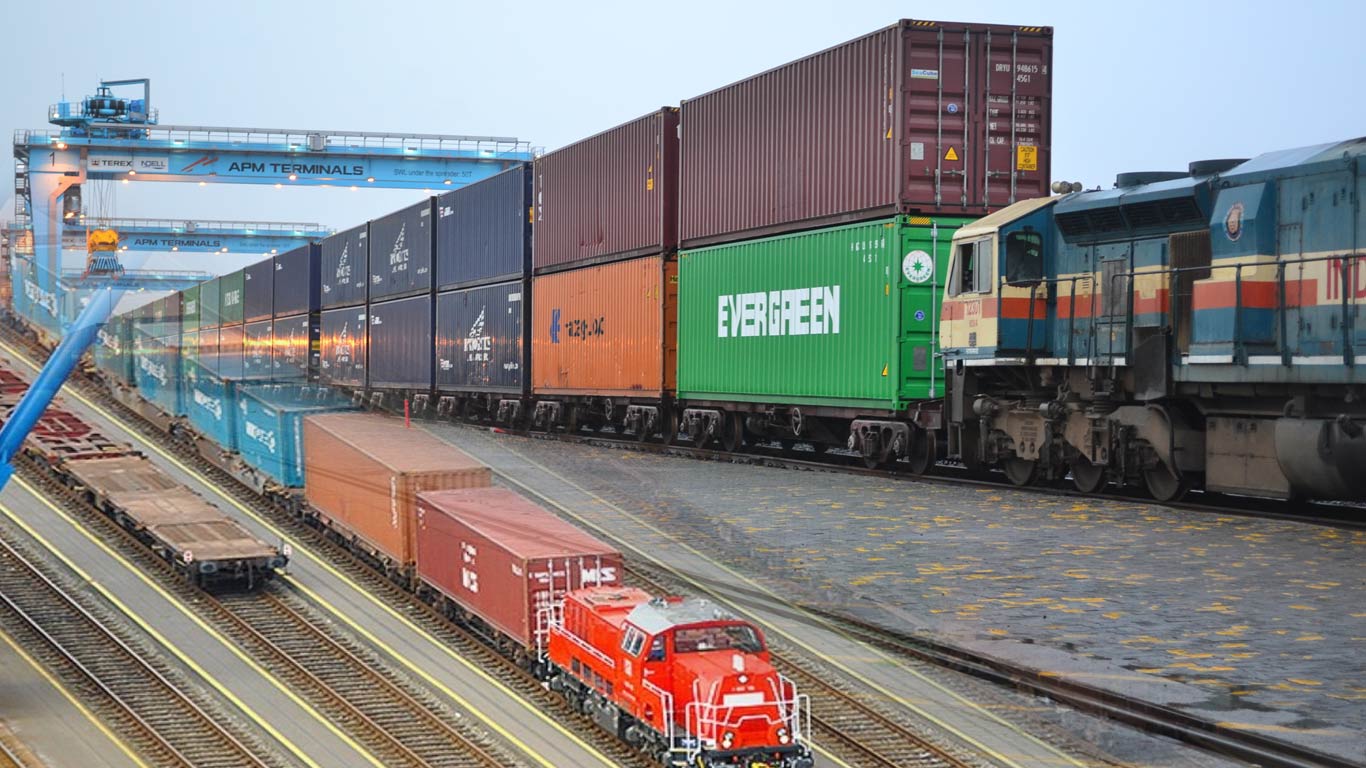
Gati Shakti Multi-Modal Cargo Terminals: How Rail-Led Logistics Is Rewriting India’s Growth Story

S Ahmad
India’s logistics sector is undergoing a quiet but profound transformation—one that may ultimately define the country’s economic competitiveness in the twenty-first century. For decades, logistics inefficiencies functioned as an invisible tax on Indian growth. High transportation costs, fragmented infrastructure, slow cargo movement, and an overwhelming reliance on road freight eroded productivity across sectors—from agriculture and manufacturing to exports and energy. While these constraints rarely made headlines, they silently inflated prices, weakened supply chains, and constrained India’s ambition to emerge as a global manufacturing and trade hub.
Today, however, the contours of this long-standing problem are changing. With logistics costs declining to 7.97 per cent of GDP, India has crossed a psychologically and economically significant threshold. This figure, once stubbornly stuck in double digits, now places India closer to global benchmarks and signals that infrastructure reforms are beginning to yield systemic results rather than isolated successes. This shift is not accidental; it is the outcome of deliberate, coordinated, and long-term planning under the PM Gati Shakti National Master Plan, a framework that seeks to integrate infrastructure development across ministries, modes of transport, and economic sectors.
At the heart of this logistics re-architecture lies a powerful but underappreciated reform instrument: Gati Shakti Multi-Modal Cargo Terminals (GCTs). More than just physical infrastructure, these terminals represent a fundamental rethink of how goods should move across a continental-scale economy. They are redefining the role of Indian Railways—from a traditional carrier of bulk commodities to a central pillar of a modern, multimodal logistics ecosystem.
The Structural Problem GCTs Were Designed to Solve
Historically, India’s freight movement was characterised by fragmentation. Goods often travelled inefficiently—loaded onto trucks, unloaded at congested railheads, reloaded onto wagons, transported to ports, and then shifted yet again. Each transfer added cost, delay, and uncertainty. The absence of integrated logistics hubs meant that rail freight, despite being cheaper, cleaner, and more energy-efficient, remained underutilised, especially for time-sensitive and high-value cargo.
Road transport filled this gap, but at a cost. Overdependence on trucks led to highway congestion, higher fuel consumption, elevated emissions, and rapid deterioration of road infrastructure. For industry, this translated into longer lead times, inventory inefficiencies, and higher logistics expenses—making Indian goods less competitive both domestically and internationally.
The Gati Shakti Multi-Modal Cargo Terminal policy directly addresses this structural inefficiency. Introduced in December 2021, the policy envisions modern, integrated freight hubs where rail connectivity is seamlessly linked with road networks, ports, inland waterways, and airports. These terminals are designed not merely as loading points, but as logistics ecosystems—capable of handling diverse cargo types with speed, reliability, and minimal human intervention.
A New Freight Philosophy for Indian Railways
GCTs mark a decisive departure from legacy freight handling practices. They are equipped with mechanised and automated systems—silos for bulk commodities, container-handling cranes, conveyor belts, digital weighbridges, and real-time data interfaces. One of the most transformative operational features is the adoption of engine-on-load (EOL) operations, where locomotives remain attached to trains during loading and unloading. This eliminates idle time, reduces turnaround dramatically, and maximises asset utilisation—a critical improvement in a network as large and capacity-constrained as Indian Railways.
From a policy perspective, this shift reflects a deeper change in mindset. Railways is no longer merely a transporter; it is positioning itself as a logistics service provider, aligned with industry needs, supply chain timelines, and global best practices.
Economic and Environmental Logic of Rail-Led Logistics
The strategic rationale behind GCTs is compelling. Rail freight costs less than half that of road transport per tonne-kilometre and produces nearly 90 per cent lower carbon emissions. In an era where economic competitiveness and climate responsibility are increasingly intertwined, shifting cargo from road to rail is both fiscally prudent and environmentally imperative.
The impact of this modal shift is already measurable. Since 2014, an estimated 2,672 million tonnes of freight has moved from road to rail, resulting in carbon dioxide savings of approximately 143.3 million tonnes. These savings are not abstract environmental claims; they represent real progress towards India’s climate commitments and reduced dependence on fossil fuels.
Scale, Speed, and Private Participation
The seriousness of the GCT reform is reflected in its scale of implementation. As of now, 306 Gati Shakti Cargo Terminals have been approved, with 118 already operational. These commissioned terminals alone account for nearly 192 million tonnes per annum of handling capacity, directly contributing to reduced logistics costs and improved freight efficiency.
Equally significant is the mobilisation of private capital. Approximately ₹8,600 crore of private investment has been committed under the policy—an indicator of growing confidence in rail-based logistics and public–private partnership models. The policy framework is deliberately designed to be industry-friendly, offering waivers on departmental charges, land licence fees, and certain staffing costs. Indian Railways, in turn, undertakes responsibility for common-user infrastructure such as track connectivity, signalling, and overhead equipment.
This balanced risk-sharing model ensures that private players focus on operational efficiency and innovation, while Railways maintains network integrity and safety. A time-bound approval process—with a 24-month construction mandate—further ensures that projects translate quickly from paper to ground.
Revenue Growth and Financial Sustainability
The financial impact of GCTs is increasingly visible. Freight revenues generated through these terminals have grown more than fourfold between 2022–23 and 2024–25, reaching ₹12,608 crore. This growth strengthens Indian Railways’ financial sustainability, enabling reinvestment into capacity expansion, technology upgrades, and passenger safety—areas historically constrained by freight inefficiencies.
Regional Integration and Sectoral Transformation
Beyond aggregate statistics, the real power of the GCT model lies in its regional and sectoral diversity. The Manesar GCT in Haryana, India’s largest automobile cargo terminal, exemplifies how rail-linked logistics can transform industrial supply chains. Integrated directly with Maruti Suzuki’s manufacturing ecosystem, the terminal significantly reduces road congestion in the National Capital Region while lowering vehicle transport costs and emissions.
In the Northeast, long constrained by geography and connectivity gaps, GCTs are emerging as catalysts of economic integration. Terminals such as Moinarband and Cinnamara in Assam support a diverse cargo mix—from petroleum products and food grains to fertilisers and automobiles—strengthening supply chains in a region historically dependent on long and costly road routes. Upcoming terminals across Assam promise to further integrate the region with national markets.
The New Sanjali GCT in Gujarat, developed on private land along the Western Dedicated Freight Corridor, represents another leap forward. It symbolises the convergence of dedicated freight infrastructure, private initiative, and high-speed logistics planning—pointing towards a future where rail freight is not just competitive, but preferred.
The Road Ahead: From Infrastructure to Intelligence
Looking forward, the success of GCTs will increasingly depend on digital integration. Real-time tracking, predictive analytics, AI-driven demand forecasting, and data-enabled planning under the Gati Shakti platform are expected to further improve reliability and transparency. The long-term objective is not merely to reduce logistics costs, but to build a resilient, intelligent, and sustainable logistics ecosystem capable of supporting India’s ambitions in manufacturing, exports, and green growth.
Conclusion: Logistics as Economic Strategy
Gati Shakti Multi-Modal Cargo Terminals represent a structural reform, not a cosmetic one. They address decades-old inefficiencies by aligning infrastructure, policy, private investment, and environmental responsibility within a single framework. As terminals proliferate, networks deepen, and technology integrates, GCTs are set to redefine India’s logistics landscape—making it faster, cleaner, and globally competitive.
In doing so, they reaffirm a fundamental truth often overlooked in policy debates: efficient logistics is not merely about moving goods—it is about moving the economy forward.
The article is based on the inputs and background information provided by the Press Information Bureau (PIB) Author is Writer, Policy Commentator. He can be mailed at kcprmijk@gmail.com
Comments are closed.