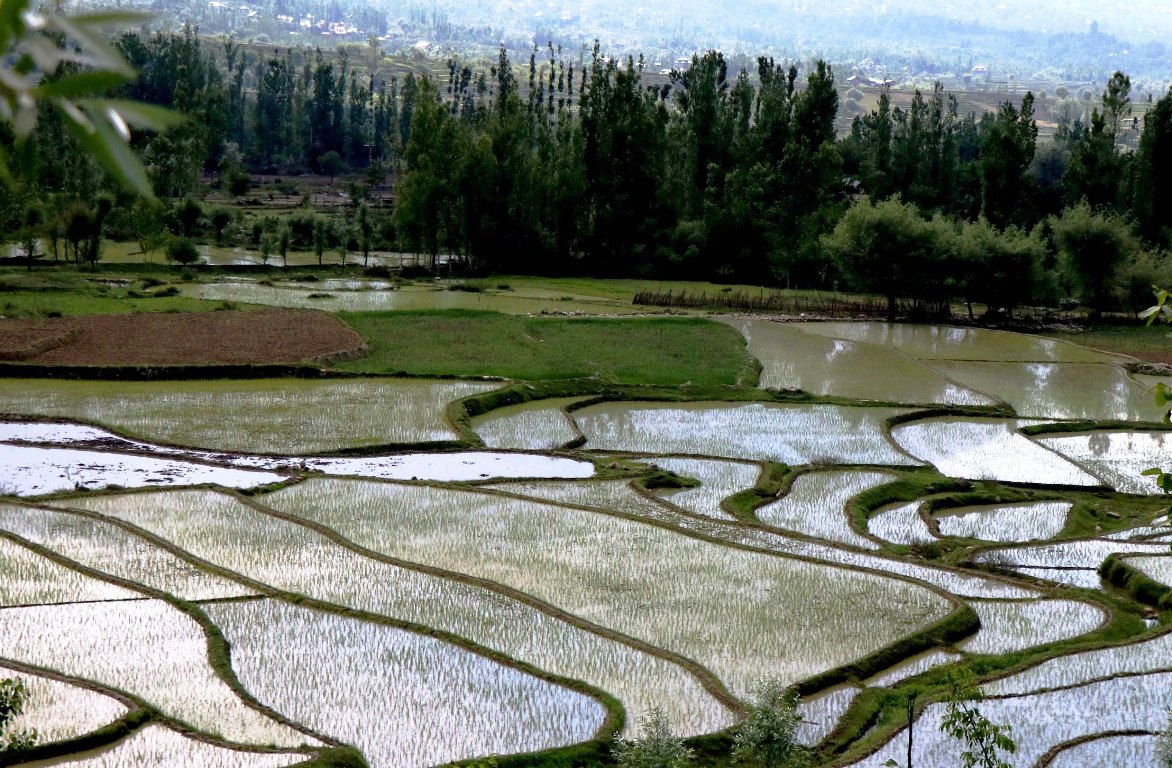

Suffocation of the Paddy Fields: Veils of Plastic Choke the Whispering Rice

A. R. Matahanji

“The plough now catches on things that should never have been buried. Plastic has gone so deep that the earth itself seems to be swallowing it, growing harder, less alive, and more hostile to those who depend on it.”

The walk to the paddy fields was usually a journey of peace for me. The wide expanses of green, framed by the distant, snow-capped mountains, were an indication of the enduring relationship between the people and the land. But today, my eyes were tuned to a different frequency. I wasn’t looking at the emerald stalks of rice; I was looking at the ground between them. As I reached the edge of the first field, I stopped. The irrigation channel that fed the rice was not a clear stream of mountain water. It was a slow-moving conveyor belt of trash. A plastic bottle bobbed along the surface, followed by a tangled mass of blue polythene. The water struggled to push past the obstructions, spilling over the banks and carrying smaller fragments of plastic directly into the mud where the rice grew.

I stepped into the field, my boots sinking into the soft earth. I didn’t have to look hard. Half-buried in the silt was a red plastic bag, its colour faded by the sun but its structure as strong as the day it was made. A few feet away, the corner of a silver snack wrapper glinted like a trap. “It is in the soil,” I whispered. I knelt down and reached into the mud, pulling out a handful of earth. Mixed in with the rich, dark soil were tiny, colourful specks, Microplastics. The larger bags and bottles were breaking down, not into soil, but into smaller and smaller pieces of themselves. These pieces were now part of the medium in which our food grew. The rice plants were surrounding these toxins with their roots, perhaps even absorbing the chemical leavings as they reached for nutrients.

Ghulam Qadir Sahib, an elder of the village, was working nearby, his back bent from decades of labour. He looked up as I approached. “The earth is getting harder to work’’ son, the old man said, his voice like dry parchment. “The plow catches on things that should not be there. We find the plastic deep down now, as if the ground is swallowing it.” It is suffocating the land, Ghulam Qadir Sahib, I said, showing him the handful of mud. “Look at these specks. This is what we are eating. This is what we are giving to our children.” Ghulam Qadir Sahib nodded slowly. “In my father’s time, everything we used came from the earth and went back to the earth. The baskets were willow, the wraps were leaves, the clothes were wool and cotton. When a thing was finished, it rotted and became the next year’s crop. Now, we use this ghost-stuff. It does not die. It just stays and makes the land sick.

I looked across the vast expanse of the fields. I saw other farmers working, and at the edge of every plot, there was a small pile of plastic that had been pulled from the mud. But for every piece they pulled out, ten more seemed to take its place. The wind blew more from the roadside dumps, the water brought more from the village canals. The paddy fields, the very source of our life, were becoming a landfill in slow motion.

I thought about the academic studies I had read concerning soil health. Plastic in the soil altered the way water moved. It prevented the natural aeration that roots needed. It acted as a host for harmful chemicals, concentrating them near the plants. The ‘poisonous things’ I had noted in my ledger were not just metaphors, they were literal contaminants. The scale of the disaster was most evident at the boundaries where the village roads met the fields. Here, the accumulation was massive. The ditches were overflowing with a mix of household waste diapers, bags, bottles, and discarded shoes. During the rains, this toxic soup would overflow, washing the concentrated filth of the village into the agricultural heartland. “We are killing the very thing that keeps us alive, I said, my voice filled with a sudden, sharp grief.

“The people do not see it,”  Ghulam Qadir Sahib replied. They see the convenience. They see the bright colours. They do not see the suffocation. They think the lake will take it away. They think Wullar is big enough to hide our sins.  I looked toward the horizon, where the shimmer of the great lake was just visible. Wullar was the largest freshwater lake in Asia, a majestic body of water that had sustained civilizations for millennia. But I knew from my studies that the lake was not a bottomless pit. It was a living organism, and it was being poisoned by the very veins that fed it. Every canal, every stream, every irrigation ditch was a needle injecting plastic into the heart of the valley.

I left the fields and walked toward the shore of the lake. I needed to see the giant. I needed to see if the rumours of its death were true. As I walked, I passed a school playground. The ground was not covered in grass, but in a layer of shredded plastic and discarded wrappers. Children were playing in the midst of it, their hands touching the same poisonous things that were choking the rice.

The irony was bitter. We taught the children about science and health in the classrooms, while the very ground they played on was a testament to their failure to apply that knowledge. I felt a renewed sense of urgency, The count in my notebook was no longer a private obsession; it was a battle plan. I had to show the people what I had seen, I had to make the invisible shroud visible to everyone.

I reached the crest of the final hill before the lake. The view was breathtaking, but as he looked down at the water’s edge, his heart sank. The blue mirror was fringed with a thick, multicoloured crust of waste.

I witness the devastating impact of plastic on the village’s paddy fields and realize the soil itself is being poisoned. A journey to the shores of Wular Lake will soon reveal the true extent of the environmental collapse.

—To be continued

The Author, hailing from Wullar fringe Village of Bandipora, is a writer and can be reached at saltafrasool@yahoo.com       

Comments are closed.