

S. Ahmad
“The power of youth is the commonwealth for the entire world.”
– Swami Vivekananda
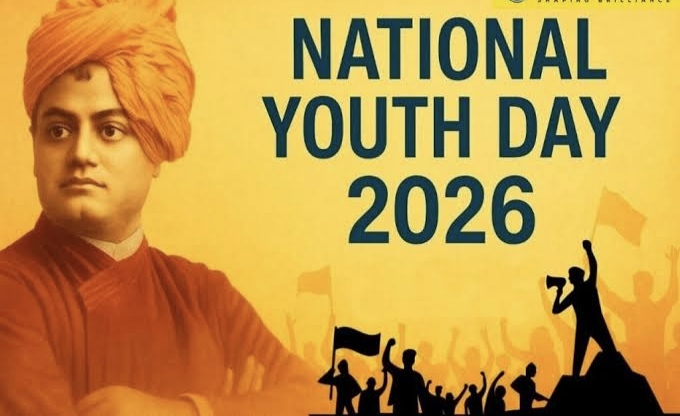
Every year on January 12, India pauses to remember Swami Vivekananda—not merely as a monk or philosopher, but as a visionary who understood the power of youth long before demography became a subject of policy debate. For Vivekananda, youth was not defined by age alone but by fearlessness, discipline, character, and a deep sense of service to society. His belief that “the power of youth is the common wealth for the entire world” was not aspirational rhetoric; it was a blueprint for national renewal. As India marks National Youth Day in 2026, this vision acquires renewed urgency, for the country stands at a decisive historical moment—on the threshold of the centenary of its Independence.
India today is not merely the world’s most populous nation; it is also one of its youngest. More than 65 per cent of Indians are below the age of 35, and nearly half are under 25. This demographic reality is often described as a dividend, but history shows that a dividend is never automatic. It can become a strength or a liability, depending on how effectively it is nurtured, educated, skilled, and engaged. In 2026, India’s youth challenge is no longer about numbers alone; it is about direction, opportunity, and purpose. National Youth Day thus becomes more than a commemorative occasion—it becomes a mirror through which the nation examines how well it is transforming youthful energy into enduring national strength under the long-term vision of Viksit Bharat @2047.
Over the past decade, there has been a visible shift in how youth policy is framed in India. Young citizens are no longer viewed simply as recipients of government schemes or beneficiaries of welfare. Instead, they are increasingly seen as co-creators of governance, innovation, and social change. This shift reflects a deeper understanding: sustainable national progress cannot be imposed from above; it must be built from within society, with youth as active participants rather than passive observers.
This philosophy finds its clearest expression in Mera Yuva Bharat (MY Bharat), a landmark initiative that has redefined youth engagement in India. Conceived as an autonomous, technology-enabled platform under the Ministry of Youth Affairs and Sports, MY Bharat functions as a national digital ecosystem that connects young people with opportunities for volunteering, leadership development, skill acquisition, and civic participation. Launched by the Prime Minister on October 31, 2023, the platform embodies the idea of “Yuva Shakti se Jan Bhagidari”—the belief that governance becomes stronger when young citizens are meaningfully involved.
The scale and depth of MY Bharat signal a new seriousness in youth engagement. By November 2025, more than 2.05 crore young Indians had registered on the platform. Over 14.5 lakh volunteering opportunities were created, linking youth with more than 16,000 youth clubs and nearly 60,000 partner institutions, including government departments, educational institutions, civil society organisations, and corporate entities. These numbers matter not merely for their size but for what they represent: a systematic attempt to institutionalise volunteering as a pathway to leadership, learning, and social responsibility.
The launch of the MY Bharat Mobile App in October 2025 further strengthened this ecosystem. Designed as a mobile-first, inclusive platform, the app enables young people—especially those from smaller towns and rural areas—to participate without bureaucratic barriers. With multilingual interfaces, AI-driven chatbots, voice-assisted navigation, smart CV builders, and digital certification, the app allows youth to convert service into verifiable credentials. By the time of its launch, the platform already hosted more than 1.81 crore youth and over 1.20 lakh organisations, reflecting how deeply it had already embedded itself into the institutional fabric of youth governance.
The next phase of this transformation is unfolding through MY Bharat 2.0, developed in collaboration with the Digital India Corporation under the Ministry of Electronics and Information Technology. Formalised through a Memorandum of Understanding in June 2025, this upgraded platform aims to integrate artificial intelligence, mentorship networks, career services, and fitness modules into a unified digital experience. By linking youth aspirations with national digital infrastructure, the initiative reflects a broader governance philosophy: technology should not merely drive efficiency, but also inclusion and empowerment.
While digital platforms represent the future, legacy institutions continue to anchor youth engagement in lived social experience. The National Service Scheme (NSS) remains one of India’s most enduring youth programmes. Since its launch in 1969 with just 40,000 volunteers, NSS has grown into a vast nationwide network spanning 657 universities, over 20,000 colleges, and nearly 12,000 senior secondary schools. Today, more than 3.9 million volunteers participate annually in activities ranging from community service and disaster response to national integration camps and rural outreach. NSS demonstrates that nation-building does not always require grand announcements; it often unfolds quietly through sustained service and social commitment.
Youth leadership is also being reimagined through the Viksit Bharat Young Leaders’ Dialogue (VBYLD), which replaces the traditional National Youth Festival with a problem-solving and policy-oriented forum. The second edition, scheduled from January 9 to 12, 2026 at Bharat Mandapam in New Delhi, will bring together nearly 3,000 participants, including youth leaders, international delegates, and policy stakeholders. What sets this initiative apart is its scale of participation: more than 50 lakh young people took part in the nationwide digital quiz that forms the entry pathway. This democratisation of leadership dialogue ensures that youth voices from diverse regions and backgrounds can directly engage with national priorities.
Employment and economic opportunity form the second major pillar of India’s youth strategy. Programmes such as Skill India, Pradhan Mantri Kaushal Vikas Yojana (PMKVY), National Apprenticeship Promotion Scheme (NAPS), Deen Dayal Upadhyaya Grameen Kaushalya Yojana (DDU-GKY), and PM-SETU collectively address the long-standing gap between education and employability. Since 2014, more than six crore Indians have benefited from skill development initiatives, marking one of the largest human capital interventions in the world.
The evolution of PMKVY illustrates how youth skilling has matured over time. As of October 2025, over 1.76 crore candidates had been enrolled, with 1.64 crore successfully trained. Nearly half of the beneficiaries are women, reflecting growing gender inclusivity. The programme’s expansion into advanced domains such as artificial intelligence, robotics, drones, and the Internet of Things signals a forward-looking approach aligned with future economic demands. Similarly, the Jan Shikshan Sansthan scheme has empowered over 32.5 lakh beneficiaries since 2018, with women constituting more than 80 per cent—demonstrating how skills can also become instruments of social transformation.
A particularly transformative intervention is PM-SETU, launched in October 2025 with an investment of ₹60,000 crore to modernise 1,000 Industrial Training Institutes across India. By adopting a government-owned but industry-managed model, PM-SETU directly addresses the credibility gap that has long plagued vocational education. For youth in smaller towns, tribal regions, and aspirational districts, this initiative holds the promise of dignified employment and local opportunity.
Entrepreneurship has emerged as a parallel engine of youth empowerment. Startup India, launched in 2016, has recognised nearly 1.97 lakh startups by October 2025, many emerging from Tier-II and Tier-III cities. Complemented by the Startup India Seed Fund Scheme and incubator networks, the ecosystem encourages innovation at early stages. At the grassroots level, the Pradhan Mantri MUDRA Yojana has democratised access to credit, sanctioning over 53.85 crore loans amounting to ₹35.13 lakh crore in its first decade. For women, minorities, and first-generation entrepreneurs, this access represents not just capital, but dignity and self-belief.
Equally important is the recognition that youth empowerment must be holistic. Physical fitness, mental well-being, and substance-free living are essential for sustained productivity. The Fit India Movement seeks to normalise daily physical activity, while adolescent-focused initiatives like RKSK address nutrition, mental health, and substance abuse through prevention rather than cure. The Youth Spiritual Summit and the Kashi Declaration of 2025, with their focus on combating drug addiction, represent a moral and cultural intervention that blends civic responsibility with inner strength.
As India observes National Youth Day 2026, a larger truth becomes evident. Youth policy in India has evolved from isolated schemes into a connected ecosystem—where volunteering leads to leadership, skills translate into livelihoods, entrepreneurship fuels growth, and well-being sustains ambition. Inspired by Swami Vivekananda’s belief in character-driven nation-building, India’s youth are no longer waiting for the future to unfold. They are actively shaping it.
The journey toward Viksit Bharat @2047 will ultimately be written by young Indians—not as passive inheritors of progress, but as its architects. National Youth Day 2026 stands as a reminder that when youthful energy is guided by purpose, discipline, and opportunity, it becomes not just a demographic advantage, but a defining national strength.
Author is Writer and Policy Commentator. He can be mailed at kcprmijk@gmail.com
Comments are closed.