

S. Ahmad
“The Repealing and Amending Act, 2025 performs the quiet but essential work of editing the Republic’s legal framework. It prioritises continuity with clarity rather than disruption through spectacle.”
Every nation carries its history not only in monuments, archives, and collective memory, but also in its laws. Statutes are living records of political priorities, social anxieties, economic needs, and administrative thinking of their time. In India, this legal inheritance is unusually vast and layered. Colonial regulations from the nineteenth century coexist with post-Independence emergency laws, sector-specific enactments of later decades, and countless amendment Acts passed to correct, supplement, or temporarily adjust earlier legislation. Over time, many of these laws lost relevance. Some fulfilled their purpose and quietly became redundant; others were overtaken by new realities, technologies, or constitutional values. Yet they continued to remain on the statute book, formally alive even when practically meaningless.
The Repealing and Amending Act, 2025 emerges from this historical accumulation. It is not a dramatic reform promising instant change. Instead, it performs a subtler but equally important function: it clears legal clutter, corrects outdated language, and restores coherence to the body of law that governs the Republic. In doing so, it reminds us that a modern democracy must not only create new laws but also periodically clean its legal house.
India’s legal system has long suffered from what scholars describe as “statutory congestion.” Thousands of laws enacted under colonial rule were never systematically reviewed after Independence. Early governments, focused on nation-building, economic planning, and social reform, added new laws rapidly. Amendments followed amendments, often passed to meet immediate administrative needs. Rarely was there time or political incentive to formally repeal laws that had outlived their utility. The result was a statute book crowded with enactments that no longer reflected social realities but continued to complicate legal interpretation.
This problem is not abstract. When obsolete laws remain formally in force, they generate confusion at every level. Courts must spend time determining whether a particular statute still applies. Lawyers are forced to cite repealed or redundant provisions only to have them dismissed. Administrators hesitate, unsure which rules govern their actions. For ordinary citizens, the law begins to appear distant, complex, and intimidating. A legal system that should offer clarity instead becomes a maze.
The Repealing and Amending Act, 2025 directly addresses this condition. It recognises that governance efficiency and the rule of law depend not only on progressive legislation but also on systematic pruning. Repeal, in this sense, is not destruction; it is renewal. It allows the legal system to breathe.
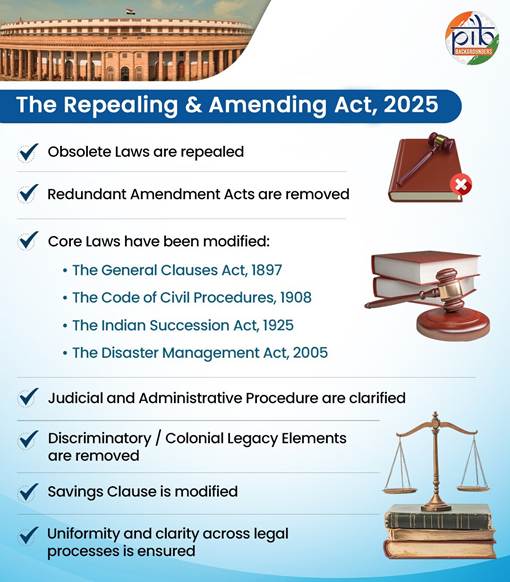
The Act performs two interconnected functions: repeal and amendment. Repeal formally removes laws that no longer serve any legal purpose. Amendment updates existing laws to align them with present-day administrative, technological, and constitutional realities. Together, these functions operate like careful editing rather than radical rewriting. The objective is continuity with clarity, not disruption.
One of the most significant features of the Act is the repeal of 71 Central Acts enacted between 1886 and 2023. Many of these were amendment Acts whose sole purpose was to modify principal legislation at a particular moment. Once those changes were absorbed into the main law, the amendment Acts themselves became legally redundant. Others were special-purpose laws meant for limited periods or specific circumstances that no longer exist. Their continued presence on the statute book added nothing except confusion.
This clean-up is part of a broader legislative trend. Since 2014, more than 1,500 obsolete Central laws have been repealed. This signals a conscious shift in governance philosophy. Instead of allowing the law to accumulate endlessly, the State has begun to recognise the importance of legal minimalism—keeping only what is necessary, functional, and relevant.
Beyond repeal, the Act introduces targeted amendments that reveal how deeply legal language affects everyday governance. Laws often fail not because of bad intent, but because they do not keep pace with administrative reality. For instance, several older statutes referred to “registered post” as the standard mode of official communication. In practice, India Post has long moved toward “speed post with registration and proof of delivery.” Courts and administrators adapted informally, but the law remained frozen in older terminology. This gap between text and practice created unnecessary procedural disputes.
By amending the General Clauses Act, 1897 and the Code of Civil Procedure, 1908 to reflect current communication methods, the Repealing and Amending Act, 2025 removes ambiguity. It ensures that service of notice, deadlines, and procedural compliance are judged according to contemporary standards. Such changes may appear minor, but procedural clarity is the backbone of justice delivery. Countless cases are delayed or dismissed due to technical defects that arise from outdated legal language.
Another amendment of deeper constitutional significance is the deletion of Section 213 of the Indian Succession Act, 1925. This provision imposed different probate requirements on different communities, reflecting colonial assumptions rather than constitutional values. Over time, such distinctions came to appear increasingly unjust and inconsistent with the principle of equality before law. By removing this section, the Act moves succession law closer to the constitutional promise of uniform treatment and fairness.
The amendment to the Disaster Management Act, 2005, replacing the word “prevention” with “preparation,” demonstrates how legal precision shapes institutional behaviour. Disasters, whether natural or human-made, cannot always be prevented. Expecting institutions to “prevent” them sets unrealistic standards and invites blame rather than preparedness. “Preparation,” on the other hand, focuses attention on readiness, early warning, response capacity, and resilience. This single-word change aligns the law with global best practices and ground realities, making disaster governance more realistic and effective.
A critical feature of the Repealing and Amending Act, 2025 is its careful use of savings clauses. Law reform, if poorly designed, can create uncertainty. People may fear that rights acquired under repealed laws will vanish, or that ongoing cases will be disrupted. The Act addresses these concerns explicitly. It protects past actions, existing rights and liabilities, and pending proceedings. Courts retain their authority, and legal continuity is preserved. In this way, reform strengthens the system rather than destabilising it.
From a constitutional perspective, this approach reflects maturity. A confident legal system does not fear revision. It understands that stability does not mean stagnation. As society evolves, the law must be periodically reviewed—not only to add new protections but also to remove obsolete burdens.
Legal housekeeping also has broader democratic implications. Complexity in law often benefits only those who can afford expertise. Ordinary citizens suffer when rules are unclear or contradictory. Businesses face compliance uncertainty. Courts are burdened with avoidable disputes. By simplifying the statute book, the State improves access to law and strengthens public trust. Transparency is not achieved merely by passing new laws; it is achieved by ensuring that existing laws are understandable and relevant.
Comparative experience supports this view. Mature democracies regularly undertake statute law revision exercises. The United Kingdom, Canada, and Australia periodically repeal outdated enactments to maintain clarity. India, with its vast and diverse legal system, arguably needs such exercises even more urgently. The Repealing and Amending Act, 2025 signals that India is beginning to institutionalise this practice.
Ultimately, the importance of this Act lies not in any single repeal or amendment, but in the philosophy it represents. It acknowledges that law is a living instrument. It accepts that progress requires subtraction as much as addition. It recognises that governing well sometimes means letting go.
Nation-building is often imagined as grand projects, landmark judgments, and transformative legislation. But equally important is the quieter work of maintenance—reviewing, refining, and correcting the legal framework that underpins everyday life. By clearing obsolete laws and updating essential ones, the Repealing and Amending Act, 2025 strengthens the foundations of the Indian Republic.
In doing so, it offers an important lesson: a modern democracy is not defined only by how many laws it makes, but by how wisely it manages the laws it already has.
The article is based on the inputs and background information provided by the Press Information Bureau (PIB) Author is Writer, Policy Commentator. He can be mailed at kcprmijk@gmail.com
Comments are closed.