

S. Ahmad
“The strength of AMCS lies not in software alone, but in its end-to-end integration—from village societies to national dashboards.”
India’s dairy story has long been celebrated as a triumph of cooperative enterprise and smallholder resilience. Millions of farmers, many owning just two or three animals, together built the world’s largest milk-producing system. Yet for decades, this vast sector ran on paper registers, manual measurements, delayed payments, and fragmented data. What is unfolding now—largely away from public attention—is a fundamental shift in how this system is governed, managed, and experienced by farmers. At the centre of this change is a deliberate push by the National Dairy Development Board (NDDB) to digitalise India’s dairy ecosystem, not as a technology experiment, but as a tool for farmer welfare, transparency, and long-term sustainability.
India today produces nearly 25 per cent of the world’s milk. This scale is both its strength and its challenge. Managing animal health, breeding, milk procurement, processing, payments, and distribution across such a vast landscape requires more than goodwill and cooperative spirit; it requires reliable data, traceability, and systems that work in real time. Digital platforms, when designed carefully, can bridge the gap between the village cattle shed and national policy planning. NDDB’s recent initiatives show how this bridge is being built—layer by layer, system by system.
One of the most ambitious of these efforts is the National Digital Livestock Mission (NDLM), implemented by NDDB in collaboration with the Department of Animal Husbandry and Dairying. At its core is the idea of giving every animal a verified digital identity—much like Aadhaar for citizens. This identity, known as “Pashu Aadhaar”, takes the form of a unique 12-digit, bar-coded ear tag. It acts as a permanent digital key, linking an animal to its entire life record: vaccination history, breeding details, artificial insemination, treatment, and productivity data.
As of November 2025, more than 35.68 crore animals have already been issued Pashu Aadhaar. This is not a symbolic achievement; it is foundational. For the first time, farmers and veterinarians can view all information about an animal at a single place, rather than relying on memory or handwritten notes. Behind this sits the Bharat Pashudhan database, which has already logged over 84 crore field transactions, covering breeding, health services, and nutrition-related interventions. Field veterinarians and extension workers play a crucial role here, helping farmers—many of whom are first-time digital users—access and trust this system.
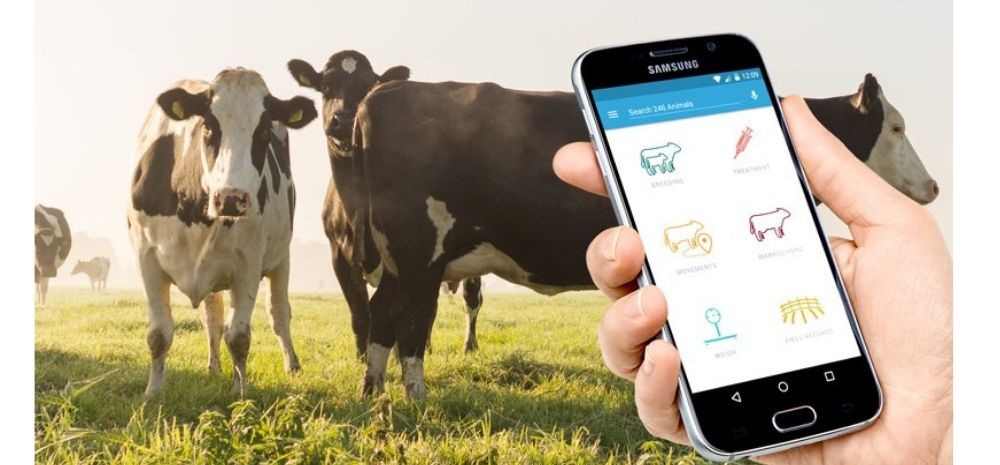
What makes NDLM particularly farmer-centric is that it does not stop at data collection. Through the 1962 mobile app and toll-free helpline, farmers receive authenticated information on best practices and government schemes, and can call for veterinary services through Mobile Veterinary Units that reach their doorstep. In a sector where delays in treatment can mean the loss of an animal and a family’s income, this integration of digital records with on-ground service delivery is transformative.
If NDLM focuses on the animal, the Automatic Milk Collection System (AMCS) focuses on the farmer’s daily economic interaction with the cooperative. Milk collection is the heartbeat of the cooperative dairy model. Every morning and evening, millions of farmers pour milk at their local Dairy Cooperative Society (DCS). Traditionally, disputes over quality testing, fat content, and payment delays have eroded trust at this crucial point. AMCS addresses this directly by automating the entire process.
Developed by NDDB using open-source technology, AMCS digitally records the quantity, quality, and fat content of milk at the point of collection and ensures that payments are calculated transparently and transferred directly to farmers’ bank accounts. Farmers receive real-time SMS alerts detailing their milk supply and earnings, turning what was once an opaque process into a transparent transaction. As of October 2025, AMCS is operational across over 26,000 cooperative societies in 12 states and Union Territories, benefiting more than 17.3 lakh milk producers across 54 milk unions.
What is often missed in headlines is the depth of this system. AMCS is not a single software but an integrated ecosystem. There is a common, multilingual application at the society level that works on Windows, Linux, and Android; centralised portals at union, federation, and national levels; and dedicated mobile apps for society secretaries, dairy supervisors, and farmers. The farmer’s mobile app effectively acts as a digital passbook, while supervisors and secretaries receive alerts and operational data in real time. Registration figures—over 2.43 lakh farmers, 1,374 supervisors, and 13,644 secretaries—suggest growing acceptance and trust in the system.
Beyond procurement lies the complex world of dairy processing, finance, inventory, human resources, and distribution. Here, NDDB has introduced the NDDB Dairy ERP (NDERP), a comprehensive, web-based enterprise resource planning platform built on the open-source Frappe ERPNext framework. Unlike proprietary software, NDERP requires no installation and no recurring licensing fees, making it accessible and cost-effective for cooperatives.
NDERP integrates all major functional modules—finance and accounts, purchase, inventory, sales and marketing, manufacturing, HR, and payroll—into a single workflow-driven system with maker-checker controls to ensure accountability. Its dashboards and analytical tools enable managers to move from intuition-based decisions to data-driven planning. Crucially, NDERP is integrated with AMCS, creating an end-to-end digital chain—from milk collection at the village to processing, packaging, and distribution to consumers.
For distributors, the iNDERP portal and mNDERP mobile app (available on Android and iOS) allow seamless management of orders, invoices, delivery challans, and payments. A distributor can track deliveries, monitor outstanding balances, and download invoices on the go. This level of transparency reduces friction between unions and distributors and improves cash-flow discipline across the value chain. As one observes this integration, it becomes clear that digitalisation here is not about replacing people but about reducing inefficiencies that quietly drain cooperative resources.
Another less visible but equally critical area is breeding. The Semen Station Management System (SSMS) digitises the entire lifecycle of frozen semen dose production, ensuring compliance with government-mandated Minimum Standard Protocols and Standard Operating Procedures. From bull management and biosecurity to quality control and sales tracking, every step is digitally monitored. SSMS integrates with laboratory equipment and RFID bull tags, ensuring precision and traceability.
SSMS is linked to the national Information Network for Semen Production and Resource Management (INSPRM) and field-level systems like INAPH (Information Network for Animal Productivity and Health). This integration allows authorities to trace semen doses from production to field use, strengthening India’s artificial insemination network. Developed under the World Bank-funded National Dairy Plan I, SSMS is currently used by 38 graded semen stations across the country, quietly underpinning productivity gains that farmers experience years later in healthier, higher-yielding animals.
Data, however, is only useful if it informs decisions. This is where the Internet-based Dairy Information System (i-DIS) plays a pivotal role. i-DIS provides a unified platform for milk unions, federations, cattle-feed plants, and marketing dairies to report and analyse operational data. Today, 198 milk unions, 29 marketing dairies, 54 cattle-feed plants, and 15 federations contribute to what has become a national cooperative dairy database. Organisations can benchmark their performance against peers, identify inefficiencies, and plan expansions based on evidence rather than guesswork. NDDB’s regular training workshops for MIS officials ensure that this data does not sit unused but actively shapes strategy.
Even logistics—often the biggest hidden cost in dairying—are being reimagined. NDDB’s GIS-based milk route optimisation replaces manual route planning with scientific mapping of procurement and distribution paths. By visualising routes on digital maps, cooperatives can reduce travel distance, fuel consumption, and time. Pilot projects, such as those under the Vidarbha Marathwada Dairy Development Project and in unions in Varanasi, Assam, Jharkhand, and Indore, have already delivered measurable savings. The web-based route planning software developed by NDDB is available free of cost to cooperatives, lowering the barrier to adoption and promoting sustainable logistics.
Taken together, these initiatives represent more than digital modernisation. They signal a shift in philosophy. The farmer is no longer just a supplier at the end of a long chain, but a connected participant in a transparent system. As an analyst observing this transformation, one is struck by how deliberately these tools are aligned with cooperative values—equity, trust, and shared growth. “Technology, when rooted in the cooperative ethos, does not alienate the farmer,” one might reflect. “It restores dignity to daily transactions and confidence in institutions.”
India’s dairy sector is often invoked in discussions on food security and rural livelihoods. What is less discussed is how digital infrastructure can protect these gains in an era of climate stress, market volatility, and rising costs. By linking every animal, every litre of milk, and every transaction to a traceable digital record, NDDB is laying the groundwork for a system that is not only efficient but resilient.
In this sense, India’s dairy digitalisation is not about catching up with global trends; it is about setting its own benchmark. A system where the world’s smallest milk producer is connected to the world’s largest dairy database is a powerful statement of intent. If sustained and expanded, this quiet digital revolution could become one of the most enduring legacies of India’s cooperative movement—proof that nation-building today often happens not through grand slogans, but through well-designed systems that work, day after day, for the common farmer.
The article is based on the inputs and background information provided by the Press Information Bureau (PIB). Author is Writer, Policy Commentator. He can be mailed at kcprmijk@gmail.com
Comments are closed.