

Javaid Jawad
“Our education system has quietly shifted from learning to scoring, from understanding to outperforming. In this race, children from privileged backgrounds start ahead, armed with resources and support. Those from underprivileged families run the same race carrying heavier burdens. The gap widens not because of ability, but because of circumstance.”
There were two quick knocks on the kitchen door. I was taking slow sips of nun chai, enjoying it with makki da roti. An egg and three walnuts lay on the sheet beside me, waiting to be eaten. It was one of those quiet winter mornings when time seems to move gently. Another knock followed, slightly louder. I looked at my spouse, who was busy rolling rotis in one corner of the kitchen. Without a word, she wiped her hands and went to open the door.
A middle-aged man stepped inside. He wore a topi and a pheran, his shoulders slightly hunched, as if carrying an invisible weight. After exchanging customary greetings, I asked him to sit beside me. We offered him tea. He declined politely, yet firmly, as many people do when they arrive with a purpose heavier than hospitality. My spouse returned to her work. The man was both my neighbour and a distant relative, someone I had known for years.
After a brief pause, he finally spoke. His daughter had passed her Class 8 examination with an impressive score—890 out of 900—from a private institute. The pride in his voice was unmistakable, but so was the anxiety that followed. She had now been admitted to a government school. He wanted me to give tuition to his daughter.
I understood immediately what lay behind his request. Knowing his modest financial condition, and considering our relationship, I agreed without hesitation. His eyes reflected genuine relief, the kind that comes when a burden is lifted, even slightly. As he stood up to leave, I offered him a walnut and the egg lying beside me. He accepted them with quiet grace, as if receiving more than food—perhaps reassurance, perhaps dignity.
This small episode reflects a much larger reality of our times. Across Kashmir, and indeed across India, parents with limited incomes are under relentless pressure to arrange private tuition for their children. This pressure does not usually come from teachers or school authorities. It comes from whispered conversations outside classrooms, from neighbourhood comparisons, and from the constant fear of being left behind.
When children hear that their classmates attend coaching centres, they begin to feel inadequate. At a vulnerable age, especially during adolescence, this sense of exclusion quickly turns into insistence. Parents, even those struggling to meet basic needs, feel compelled to comply. Some borrow money. Others cut down on food, clothing, or medical expenses. Education, which should be a path to dignity and empowerment, becomes a source of financial stress and emotional anxiety.
Ironically, many of these students gain very little from coaching centres. The issue is not lack of intelligence or effort. The real problem lies in weak academic foundations that have gone unnoticed for years. Large group coaching classes rarely address individual learning gaps. A child who does not understand division or fractions cannot benefit from advanced problem-solving sessions. Without personal attention, students continue to move from one class to the next while their basic concepts remain unclear.
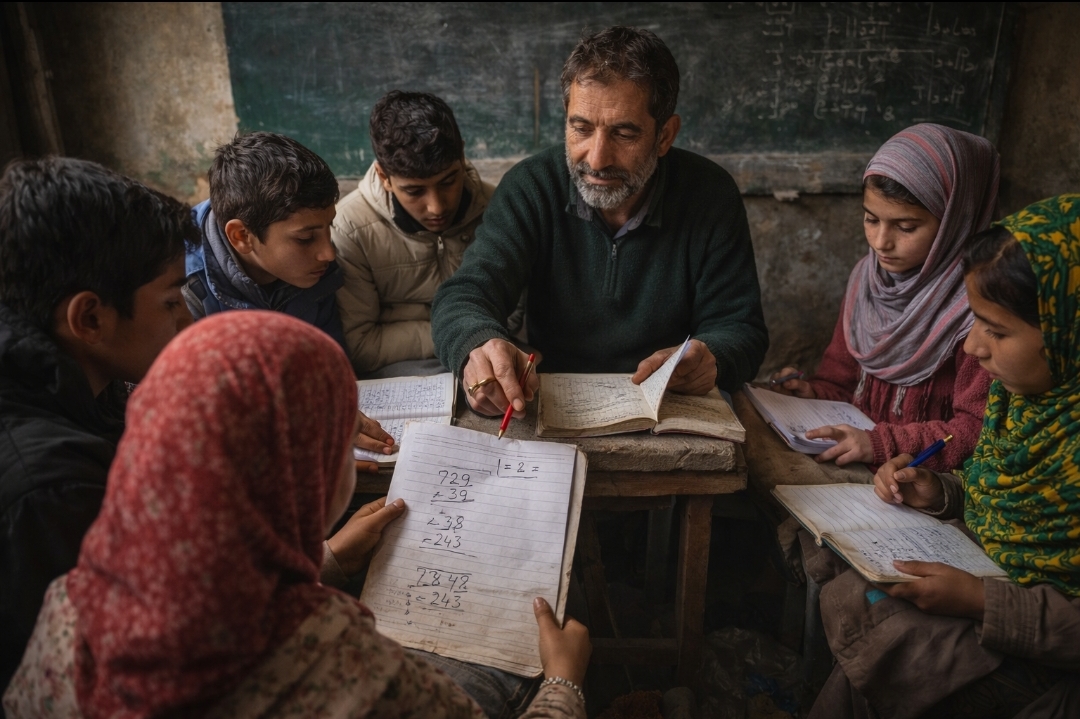
A few hours after that morning visit, the girl joined my class. Seven students from underprivileged families were already seated there, all studying in government schools. As is my practice, I conducted a simple assessment test. It was not meant to judge her, only to understand where she stood academically. She was unable to divide even two-digit numbers.
This did not surprise me. In my 28 years of teaching experience, I have encountered countless students who score high marks in examinations yet struggle with basic arithmetic and comprehension. Marks, in many cases, have become poor indicators of learning. They often reflect short-term memorisation, coaching strategies, or exam-oriented drilling rather than genuine understanding.
This contradiction raises uncomfortable questions about our education system. How do students move forward year after year without mastering foundational skills? Why do examination results rarely reflect actual learning levels? And why are parents made to believe that private tuition is the only solution?
Coaching centres promise success. They promise ranks, marks, and confidence. But real learning is slower and quieter. It requires patience. It requires continuity. Most importantly, it requires individual attention—especially for children coming from modest backgrounds, where academic support at home is limited.
The story of this girl is not an exception. It is a symptom of a deeper structural problem. Our education system has gradually shifted its focus from learning to scoring, from understanding to outperforming. In this race, children from privileged backgrounds have a head start. They have educated parents, access to resources, and financial flexibility. Those from underprivileged families are forced to run the same race with heavier burdens.
Government schools, despite having committed teachers, are often constrained by large class sizes, administrative pressures, and curriculum overload. Teachers are expected to complete syllabi, conduct assessments, manage records, and perform non-teaching duties. In such conditions, foundational gaps are easily overlooked. Students pass examinations, but learning deficits quietly accumulate.
Until we shift our collective focus from marks to mastery, this cycle will continue. Parents will keep spending beyond their means. Students will keep moving forward without truly understanding. Coaching centres will flourish, not because they are always effective, but because they fill a vacuum created by systemic shortcomings.
Education should lighten lives, not weigh them down. It should reduce inequality, not deepen it. Foundational learning—basic literacy, numeracy, and comprehension—is not a luxury. It is the minimum guarantee every child deserves, regardless of family income or school type.
If we are truly serious about addressing this issue head-on, all stakeholders must act together. Teachers, school administrations, education departments, and society at large must join heads and hearts to support underprivileged government school students in achieving minimum learning levels. This is not an optional reform. It is an ethical obligation.
As teachers, especially those drawing handsome salaries and enjoying social respect, we must ask ourselves difficult questions. Are we doing enough for the weakest learners in our classrooms? Are we identifying learning gaps early enough? Are we offering support where it is most needed?
Ensuring foundational learning is not merely a professional responsibility. It is an act of accountability. It is also, in the deepest sense, an act of shukr—gratitude for the trust placed in us by parents who knock on our doors with hope in their eyes and dignity in their hands.
The author is a Best Teacher Awardee.
Comments are closed.