
Political Storm in J&K Over Fresh Call for Jammu Statehood
Minister Rana Predicts Ladakh's Return

Suhail Khan
Srinagar, Jan 06: A fresh political controversy has erupted in Jammu and Kashmir following a public appeal by senior Bharatiya Janata Party (BJP) leader and former minister Sham Lal Sharma for separate statehood for the Jammu region. The statement has reignited a longstanding, though largely dormant, debate over the territorial reorganization of the former state.
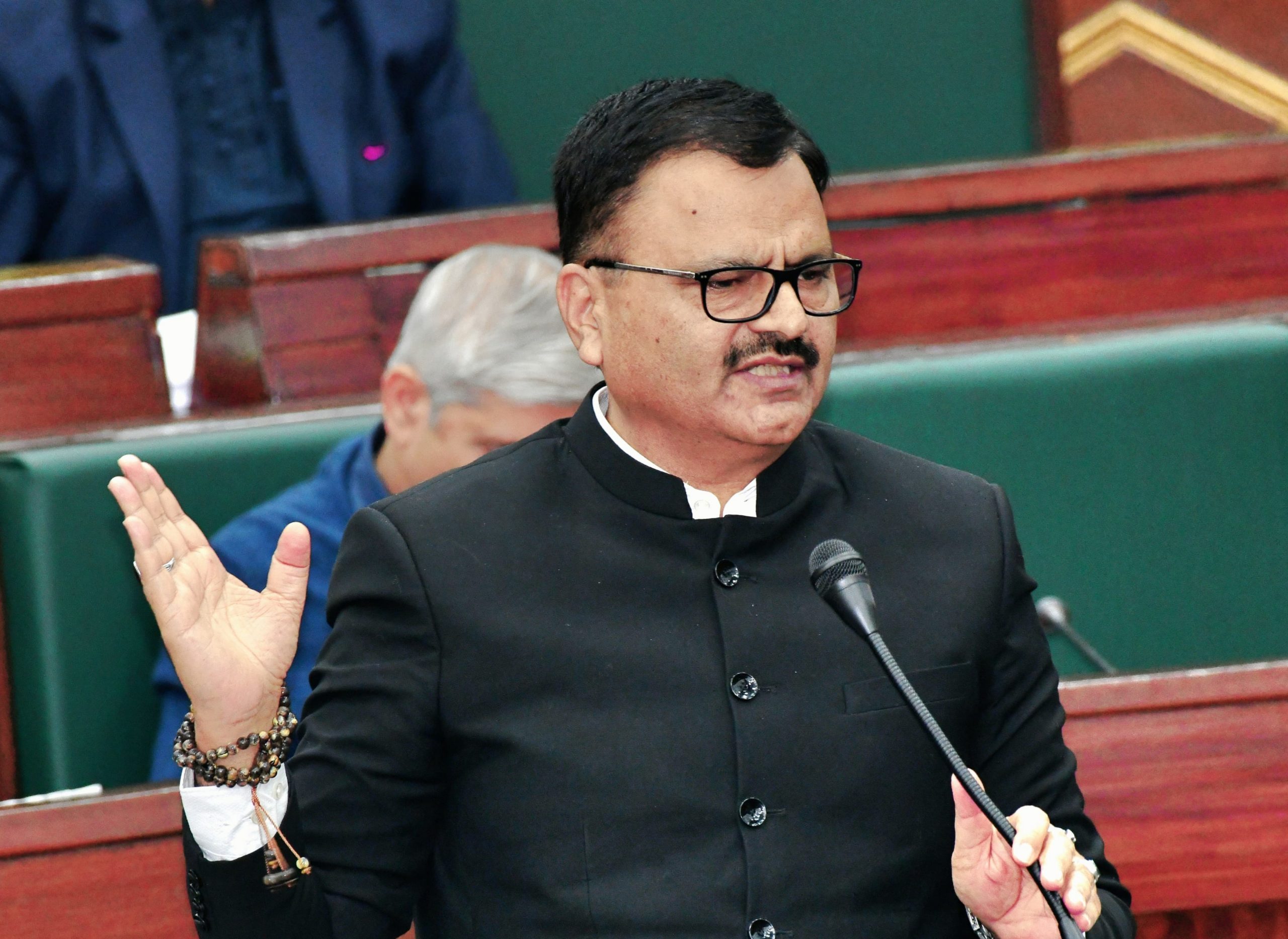
In a firm response, Minister for Jal Shakti, Forests, Ecology & Environment, and Tribal Affairs, Javed Rana as per Kashmir Convener Correspondent countered that Ladakh would be reunited with Jammu and Kashmir in the near future.
Speaking to this newspaper, Rana asserted that the Union government has no feasible alternative to reintegrating the region. “The day is not far when Ladakh will again become part of a unified Jammu and Kashmir. The Government of India has no other option,” he stated.
Reflecting on the historical status of Jammu and Kashmir as a full-fledged state, Rana argued that the region has already undergone multiple partitions and that further division lacks public mandate and viability. “One portion was ceded to Pakistan… Gilgit-Baltistan was also handed over. Then Ladakh was separated. What remains is Jammu and Kashmir. Now, those who partitioned the land seek to make even Kanak Mandi in Jammu a state,” he said.
The minister highlighted the irony of earlier advocates of division now proposing new states, stating the absence of popular demand from regions like Pir Panjal or the former Chenab area. “If a state is to be carved out of Kanak Mandi, who will prevent it? But there is no such public sentiment driving this,” Rana added, questioning the grassroots support for the proposal.
The Centre reconfigured the former state into two Union Territories—Jammu and Kashmir, and Ladakh—on August 5, 2019, concurrently revoking Article 370 of the Constitution, which had endowed the region with special autonomous status.
Sharma’s comments have redirected attention to a 2002 resolution by the Rashtriya Swayamsevak Sangh (RSS), which formally endorsed the trifurcation of Jammu and Kashmir into Jammu, Kashmir, and Ladakh. Passed on July 1, 2002, the resolution contended that such a division would help resolve the Kashmir dispute, enable the rehabilitation of displaced Kashmiri Pandits, and ensure compensation for farmers in border areas affected by prolonged military deployment.
This demand previously galvanized the Jammu State Morcha (JSM), a political group that actively campaigned for separate statehood. The JSM secured the Bishnah assembly seat twice when its candidate, Ashwani Kumar Sharma—now a BJP member—won elections in 2002 and 2008.
Although the push for a separate Jammu state had receded from mainstream political discourse in recent years, the BJP leader’s intervention has returned it to the forefront of public debate, drawing pointed reactions from across party lines.
The call assumes added significance as it surfaces alongside broader cross-party demands for the restoration of full statehood to Jammu and Kashmir, which was reduced to a Union Territory in the 2019 reorganization.
Deputy Chief Minister Surinder Choudhary promptly criticized Sharma, questioning the timing and motive behind his statement. Choudhary suggested the former minister was seeking to “consolidate his position within BJP ranks” by reviving a sensitive regional issue.
In a pointed rebuttal, the Deputy Chief Minister emphasized the economic interdependence between Jammu and Kashmir. He argued that Sharma had neglected the economic impact on Jammu after the discontinuation of the Darbar Move—the biannual rotation of the civil secretariat between Jammu and Srinagar. Choudhary observed that ending this practice led to a “contraction in trade and commerce” in Jammu, illustrating the region’s reliance on economic ties with the Kashmir Valley.
This is not the first instance of Sharma adopting this stance. In December 2010, while a Congress party member, he made similar remarks advocating separate statehood for Jammu, which sparked controversy at the time.
Notably, the BJP leadership has remained silent on Sharma’s recent comments. The lack of an official denial or clarification has spurred speculation in political quarters. Observers suggest the party’s reluctance to disavow the statement could imply a level of tacit endorsement or, at minimum, a strategic tolerance for allowing the issue to gain traction among certain voter bases.
Comments are closed.