

Malik Nazir
“In Kashmir, success is too often measured by job titles rather than competence or character. Manual work is dismissed as failure, while office jobs are glorified. This artificial division of dignity weakens society and leaves youth unprepared for real life.”
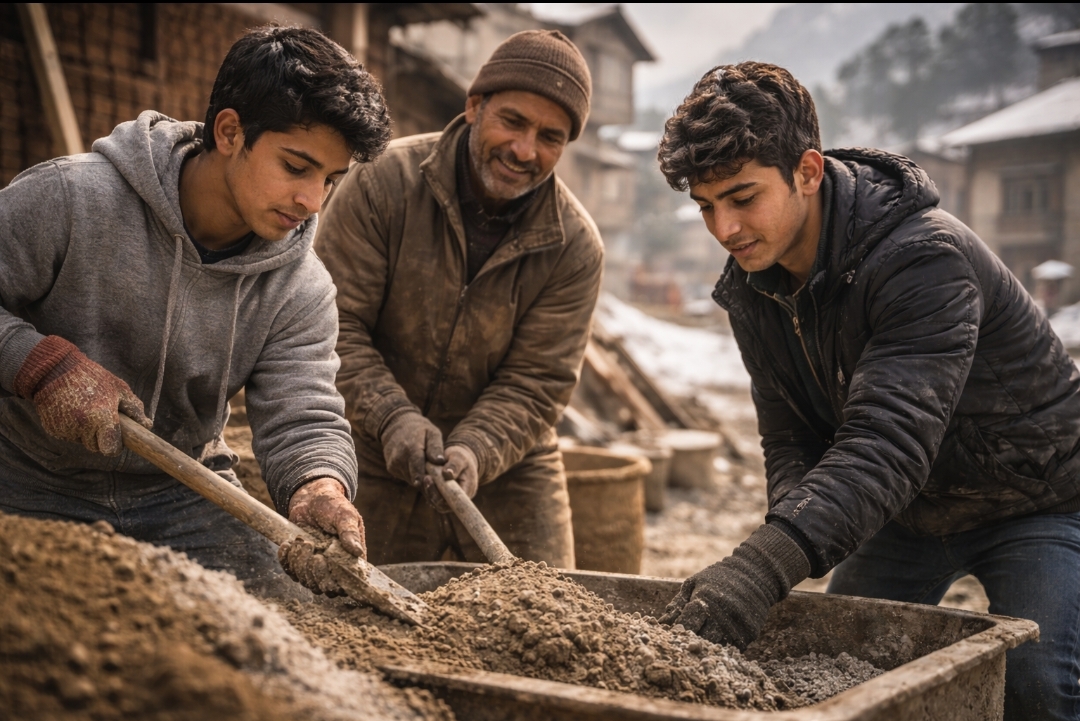
On a bitter winter morning in Bandipora, I met two teenage boys mixing sand and cement at a construction site, their hands red and stiff from the cold. My immediate, middle-class instinct was to wonder: shouldn’t they be in school?
A brief conversation corrected that instinct. One of the boys was a fourth-semester Computer Engineering student at Kashmir University eyeing on IIT after his B.tech with clarity of thoughts and vision. The other was a Class 12 science student with a dream of cracking NEET. Both belonged to our Pahari community and had returned home for the winter break. They were working voluntarily alongside their father.
Their father, a labourer by profession, had taken a difficult decision years ago to move his family from a rural area to Srinagar so that his children could access better educational opportunities. The choice was driven by conviction rather than comfort. While he valued education and ambition, he ensured that learning remained grounded in effort, responsibility, and respect for labour.
That winter morning exposed a bias many of us quietly carry. Education is often viewed as a route away from physical work rather than something that can coexist with it. Office jobs are celebrated as success, while manual labour is dismissed as failure. This misplaced hierarchy weakens society by creating artificial divisions of dignity and by teaching young people to look down upon honest work.
This mindset is particularly visible in Kashmir, where social status is frequently measured by job titles rather than competence or character. Parents dream of white-collar success for their children and often discourage any form of manual or part-time work. Ironically, this leaves many young people ill-prepared for the uncertainties and pressures of real life.
Across the world, students commonly work in cafes, farms, construction sites, retail outlets, and offices while pursuing education. Such experiences are considered to teach resilience, independence, time management, and adaptability. More importantly, they prepare young people for professional life, where persistence, teamwork, and practical understanding matter as much as academic credentials.
In our context, however, similar work is often viewed with embarrassment. Students are discouraged from working because such labour is considered beneath their social standing. The result is a widening gap between education and employability. Degrees increase, but confidence, flexibility, and practical wisdom remain in short supply.
What stood out that day was the calm confidence of the two boys. Mixing cement had not diluted their ambitions; it had anchored them. The aspiring engineer did not view the work as something to be ashamed of. He understood that dignity lies not in the nature of work, but in the honesty with which it is done and the responsibility with which it is carried out.
By working alongside their father, the boys were absorbing lessons no classroom & syllabus can fully impart: discipline, empathy for workers, respect for effort, and patience. Such experiences nurture humility and dismantle the illusion that success arrives without struggle.
At a time when educated unemployment is rising and stress among youth is deepening, reconnecting education with the dignity of labour is essential. Parents and institutions must move beyond narrow definitions of success and recognise the value of honest work in shaping confident, resilient, and socially grounded citizens.
In Kashmir, where aspirations are high but opportunities are limited, this balance is especially important. Encouraging students to respect all forms of work helps reduce entitlement, promotes self-reliance, and restores dignity to those who build our homes, roads, and institutions. When education goes hand in hand with labour, ambition finds direction, and society gains citizens who understand both privilege and perseverance.
Strong futures are shaped by people who are not afraid of honest work. Societies that respect labour do more than create infrastructure; they nurture responsible and grounded citizens. Such understanding is essential for lasting progress and social harmony in today’s times.
The writer is a teacher from Plan Bandipora and can be reached at maliknazir.a@gmail.com
Comments are closed.