

Aadil Zeffer
“A few rupees earned from a cigarette or intoxicant may seem insignificant, but its true cost is paid by children who adopt addiction early, adults who battle disease, and communities crushed under preventable harm. Every such sale is not a transaction of goods, but a transaction with loss.”
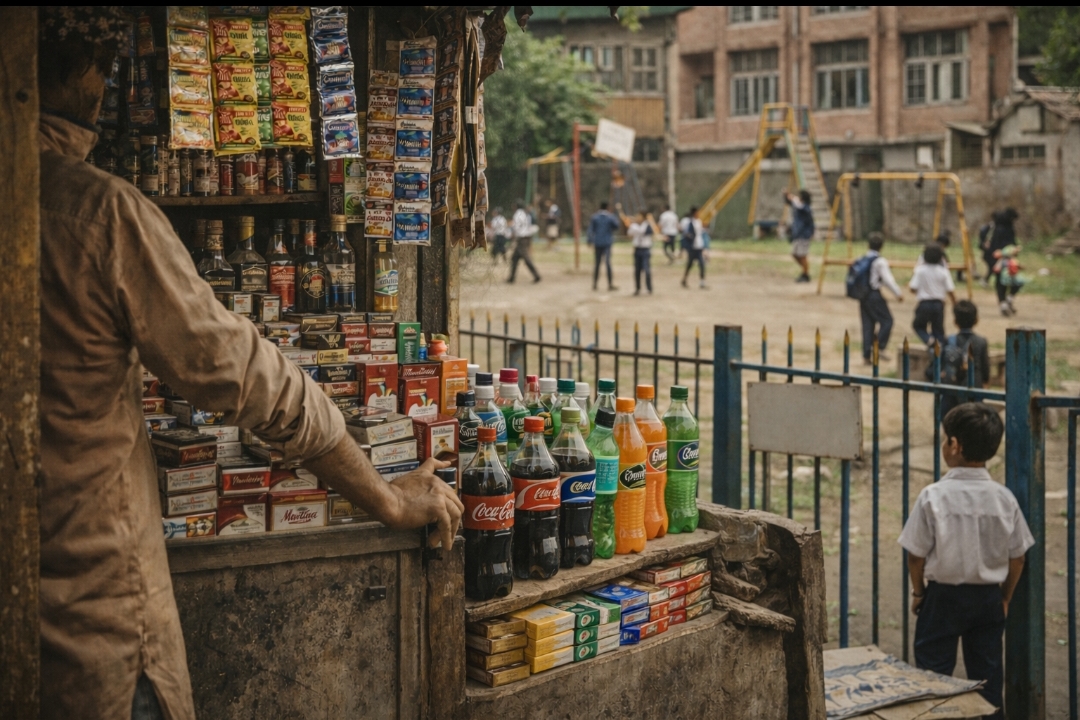
In the narrow lanes of our marketplaces, between the aroma of fresh bread and the cheerful bustle of schoolchildren, stand the “shops of shame” (#Shame Shop). These are not sellers of nourishment or necessities, but merchants of harm- offering cigarettes, gutkha, intoxicants, and harmful drinks that corrode the young body and cloud the young mind. They line our streets openly, many operating right outside our homes, schools, colleges, and playgrounds. Their presence reflects not just a commercial choice but a moral failure. They are silent accomplices in the physical and ethical decline of an entire generation. A small puff, a seemingly harmless sip, a quick sale that earns a few rupees- yet behind these transactions lie lives derailed and futures diminished. Every shopkeeper who knowingly sells such items stands supported by a conscience lulled into deep slumber. And behind every young consumer stands a society that has allowed temptation to be placed within arm’s reach.
The profit from a pack of cigarettes may appear trivial, but the real cost is recorded elsewhere: in the child who adopts a habit after school, in the adult who battles disease, and in the community whose health collapses under the weight of preventable harm. According to the World Health Organization, tobacco claims more than eight million lives worldwide every year. Every cigarette sold is not merely a commodity exchanged; it is a transaction with death. It burns not only the lungs of the smoker but the moral fabric of the society that permits its sale with indifference. To claim, “If I do not sell it, someone else will,” is not commerce but cowardice. As someone poignantly puts it, sin lies not only in wrong actions but also in enabling wrongdoing. When harmful products are sold in the open, especially to minors, society participates in a collective moral negligence.
Islamic ethical principles draw a clear boundary around harm. The Prophet Muhammad (Sallallahu alayhi wa sallam) stated, “There should be neither harming nor reciprocating harm” (Ibn Majah), a foundational rule that prohibits any trade or behaviour that injures individuals or communities. Islam’s economic teachings are rooted in accountability, compassion, and fairness. The Qur’anic injunction, “Help one another in righteousness and piety, but do not help one another in sin and transgression” (Qur’an 5:2), is a powerful moral compass. Selling products that weaken bodies, enslave wills, and burden society is an act that aids transgression- and the income derived from such trade carries no blessing. The Prophet (Sallallahu alayhi wa sallam) warned, “When Allah forbids something, He forbids its price” (Abu Dawood), reminding believers that money earned from harming others is neither pure nor permissible. The Qur’an praises honest livelihood while condemning exploitation. “Woe to those who give less than due… who cause loss to others” (Qur’an 83:1-3). To sell harmful products, especially to youth, is to violate the trust inherent in trade. Commerce, in its noble form, builds society; in its corrupted form, it destroys it. The Prophet (Sallallahu alayhi wa sallam) elevated the ethical merchant to the companionship of prophets and martyrs (Tirmidhi), illustrating how righteousness in business can be a path to immense honour. Yet the distance between this ideal and the reality of many markets today is painfully wide.
Examples from around the world show that transformation is possible. Countries such as Japan, Singapore, and Sweden enforce stringent regulations on the sale of cigarettes and intoxicants, strictly prohibiting sales near educational institutions and penalizing the sale to minors. Age-verification technologies and restricted zones ensure that harmful products remain far from young hands. Even within our own region, towns in Kerala and parts of Indonesia have voluntarily banned tobacco sales near schools after collective efforts by imams, teachers, and parents. Their success demonstrates that moral conviction, when united with communal action, can reshape public behaviour.
This article is also an earnest appeal to shopkeepers, who play a pivotal role in shaping the environment our children grow up in. The youth who purchase these harmful items are not strangers; they are the children of our own neighbourhoods, our own families. Every harmful product sold carries with it the potential to bring ruin to a household. Is such profit worth the spiritual and social cost? If sustenance is sought, then let it come from what benefits society- food, books, fruits, stationery, clothing- items that uplift rather than degrade. As the Prophet (Sallallahu alayhi wa sallam) taught, “No soul will die until it receives its complete provision” (Ibn Hibban). Sustenance comes from Allah, not from the sale of harm. Communities too must act with urgency and unity. Local councils and mosque committees can call for restrictions on the sale of harmful substances near schools and religious centres. Parents and teachers can engage in awareness campaigns that use art, theatre, and social media to warn young people about the consequences of addiction. Providing economic alternatives, small grants to shopkeepers, can help them gradually transition away from selling such products. Friday sermons and public discourses can reinforce the moral responsibility of traders and the collective duty to protect the vulnerable.
A generation stands at a critical crossroads. Our youth are an amanah- a trust granted by Allah- and their well-being is our shared responsibility. To allow addiction and illness to spread unchecked is to fail in that trust. The hand that lights a cigarette is guided by a society that permitted its easy sale. It is time to reclaim our shops/markets as spaces of care, mercy, and integrity. Let them become places that support growth, health, and dignity. The Qur’anic warning resounds with relevance: “Do not throw yourselves into destruction with your own hands, but do good; indeed, Allah loves the doers of good” (Qur’an 2:195). May we find the courage to reject the lure of harmful profit, to uphold the sanctity of health and youth, and to cultivate a society that chooses life over loss. This is not only a call to reform but a step toward collective reward- a path toward healthier communities, cleaner marketplaces, and a generation capable of fulfilling its promise. May Allah grant us the wisdom to sell what benefits, the courage to quit what harms, and the sincerity to protect the future entrusted to us. Aameen.
Author Dr. Aadil Zeffer is a Former Cultural Ambassador to the USA (FLTA) and a former Faculty, TVTC, Saudi Arabia. He can be mailed at aadil.sofi@fulbrightmail.org
Comments are closed.