
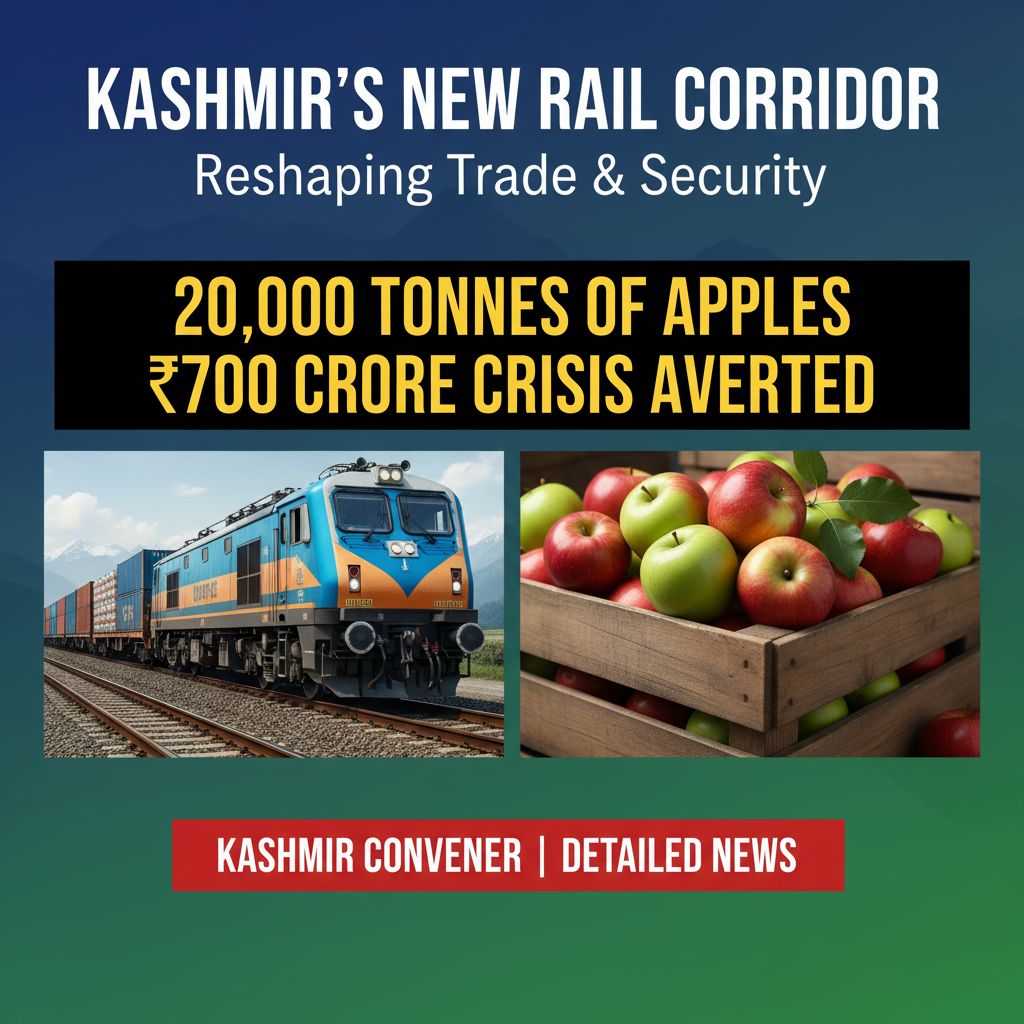
How Kashmir’s New Rail Corridor Is Reshaping Trade and Security
New Rail Service Ships 20,000 Tonnes of Apples

Suhail Khan
Srinagar, Jan 3 : The inaugural dedicated freight service in the Kashmir Valley has transported more than 20,000 metric tonnes of apples since its launch last autumn, marking a transformative shift in the region’s agricultural logistics.
Inaugurated by Lieutenant Governor Manoj Sinha on September 15, 2025, the service has been hailed as a “critical milestone” in modernising transport infrastructure in Kashmir.
The railway proved especially vital during highway closures, enabling farmers to ship apples to markets across India and serving as a crucial alternative when the sole national highway linking Kashmir to the rest of the country was blocked by landslides.
Uchit Singhal, Senior Divisional Commercial Manager (Jammu Division) of Northern Railway, highlighted the movement of apples and cement as flagship achievements over the past year.
“The launch of the Joint Parcel Product–Rapid Cargo Service on September 15 fundamentally altered the supply chain,” Singhal told Kashmir Convener. “Operations from the Anantnag goods shed have moved vast quantities, with apple exports alone exceeding 20,000 tonnes to date, and volumes continue to grow steadily.”
The service addresses a longstanding logistical challenge for Kashmir’s fruit industry, which contributes approximately 8% to Jammu & Kashmir’s Gross Domestic Product.
Kashmir produces more than 2.2 million metric tonnes of fruit annually, predominantly apples. Historically reliant on unpredictable road transport, growers faced severe losses—estimated at ₹700 crore last year alone due to disruptions. The rail network now offers a reliable, high-capacity alternative for both domestic distribution and export to markets such as Bangladesh and Nepal.
Beyond fruit exports, railway data indicate strengthened reverse logistics into the Valley. Since August, the network has moved over 150,000 tonnes of cement inward and introduced automobile delivery via specialised rail wagons. It has also handled Food Corporation of India foodgrain shipments, along with consignments of plastic crates, insulated panels, and salt, underscoring its operational versatility.
In related passenger service developments, the two pairs of Vande Bharat Express trains inaugurated by Prime Minister Narendra Modi in June 2025 have carried nearly 375,000 passengers to date.
The strategic value of the rail network was further demonstrated during emergencies. It provided critical support after the Pahalgam security incident through special trains and a 24-hour monitoring cell, maintained operations during the security-sensitive Operation Sindoor, and carried out relief missions during severe floods in late August.
Furthermore, rigorous ticket-checking efforts in the newly formed Jammu Division, conducted from April to December 2025, detected approximately 54,098 cases of ticketless or irregular travel. The enforcement drive generated around ₹3.73 crore in additional revenue—a notable achievement for the young division.
Outlining priorities for 2026, Singhal said, “Our focus will be on enhancing revenue integrity while implementing passenger-centric reforms. These include greater transparency, stronger measures to curb ticket fraud, and wider adoption of digital payment systems.”
Local stakeholders have welcomed the rail freight initiative. “This rail service has helped us transport apples to different parts of India at lower costs, and it proved essential during floods and landslides,” said Ghulam Sadiq, a grower from Sopore town.
Akhter Lone another apple exporter, said, “It’s a promising sign for the future. The railway can play a very important role in helping us expand our business outside Kashmir, as we can now easily transport apples to different states.”
Comments are closed.