

Convener News Desk
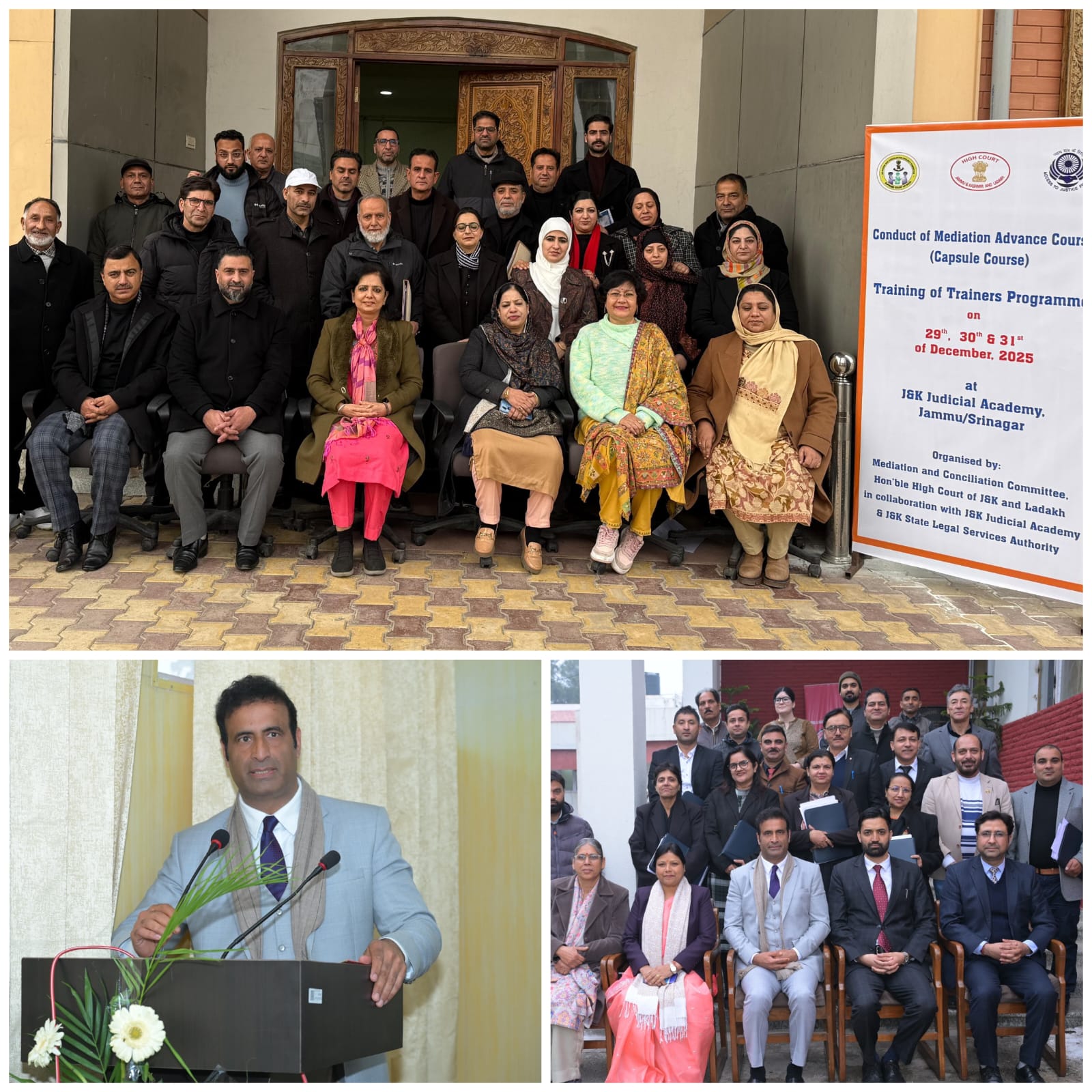
Jammu/Srinagar, December 31: The Mediation and Conciliation Committee of the High Court of J&K and Ladakh, on Wednesday concluded the three-day “Conduct of Mediation – Advanced Course (Capsule Course), Training of Trainers Programme.”
An official spokesperson said the programme was conducted simultaneously at the Jammu and Srinagar campuses of the J&K Judicial Academy under the patronage of Chief Justice of the High Court of Jammu & Kashmir and Ladakh, Justice Arun Palli and in collaboration with the Jammu & Kashmir Judicial Academy and the J&K Legal Services Authority.
Spokesperson said the programme marked the successful culmination of a 20-hour advanced mediation training course, designed for mediators and advocates. ‘It focused on strengthening advanced mediation skills through a structured blend of theoretical inputs, role-play exercises, and reflective practice”.
The concluding day’s sessions were conducted by Ms Puneeta Sethi, Advocate, Punjab and Haryana High Court, and Ms Rita Das Mouzumdar, Advocate, Gauhati High Court—both accredited mediation trainers with the Mediation and Conciliation Project Committee (MCPC) of the Supreme Court of India.
On the final day, participants engaged with advanced aspects of mediation practice. The sessions commenced with a detailed module on Negotiation, covering negotiation styles, core negotiation skills, barriers to effective negotiation, cognitive biases, and the role of the mediator in facilitating principled and effective negotiations. The module included a role-play exercise followed by discussion and reflection.
Subsequent sessions focused on impasses in mediation, examining their nature, causes, and various stages. Participants were guided through the mediator’s role in managing deadlocks, including assessment strategies, option generation, lateral thinking, reframing, and the appropriate use of external resources.
The programme also addressed false impasses, avoidance strategies, and techniques for guiding parties toward resolution. A dedicated session on ethics and standards of conduct for mediators highlighted issues of professional responsibility, neutrality, and accountability in mediation practice.
Throughout the day, the sessions combined lectures, role-plays, and interactive discussions, enabling participants to consolidate learning from the previous two days and apply advanced concepts to practical mediation scenarios.
Participants described the concluding sessions as highly reflective, noting that they offered a comprehensive understanding of advanced mediation techniques and reinforced the importance of structured, ethical, and skill-based mediation practice.
At both the Jammu and Srinagar wings, a formal vote of thanks was conveyed, expressing gratitude to the Hon’ble Chief Justice, the Governing Committees of the J&K Judicial Academy, the J&K Legal Services Authority, the resource persons, and participating officers for ensuring the success of the programme.
Across both centres, participants appreciated the hands-on, simulation-based approach, observing that the structured role-plays provided practical clarity on integrating mediation tools into everyday judicial work.
The simultaneous conduct of the programme at Jammu and Srinagar reflects the ongoing efforts of the High Court of J&K and Ladakh to broaden mediation awareness and strengthen Alternative Dispute Resolution (ADR) capacity across the Union Territory.
The programme concluded on a dignified and purposeful note at both centres.
Comments are closed.