
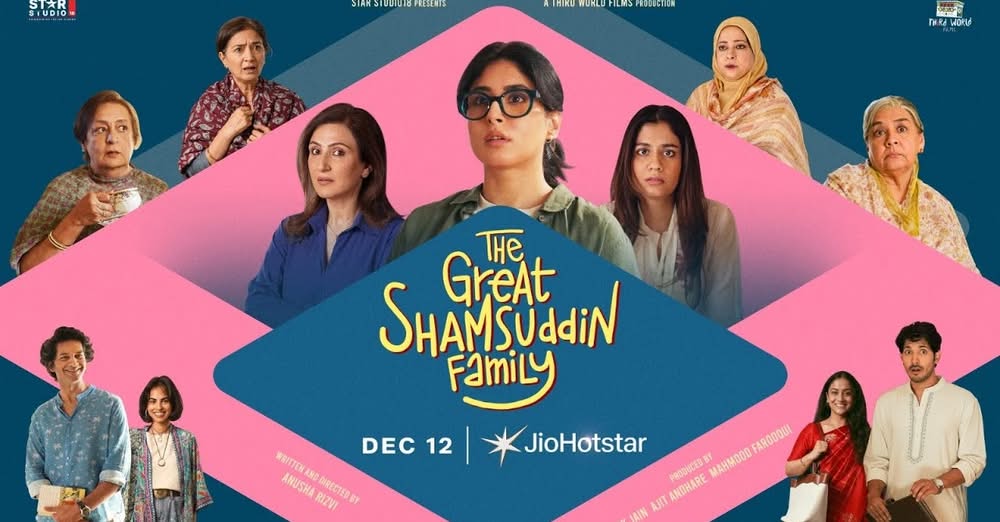

Why Ordinariness Matters? Realism and Resistance in The Great Shamusddin Family

Dr. Toyeba Mushtaq

“In contemporary Indian cinema, Muslim representation is frequently mediated through spectacle, moral polarisation, and ideological excess. The Great Shamusddin Family offers a deliberate departure from these dominant regimes. It replaces spectacle with ordinariness, insisting that everyday life itself can be a mode of political resistance.”

In contemporary Indian cinema, Muslim representation is frequently mediated through spectacle, moral polarization, and ideological excess. The Great Shamusddin Family, directed by Anusha Rizvi, offers a deliberate departure from these dominant representational regimes.
The film constitutes an instance of ethical realism and minor cinema, wherein ordinariness itself becomes a mode of political resistance. Through spatial minimalism, dialogue-driven narrative, and restrained performances, the film addresses pressing socio-political issues like triple talaq, love jihad, mob lynchings, career precarity, and familial affect without resorting to didacticism or stereotype. Situating Rizvi’s filmmaking practice within traditions of realist cinema and theories of minor literature and ethical representation, The Great Shamusddin Family expands the representational possibilities of Muslim life in Indian cinema by insisting on complexity, intimacy, and everydayness.
The representation of Muslims in contemporary Indian cinema has increasingly been shaped by a narrow repertoire of tropes: suspicion, exceptionalism, moral testing, and ideological overdetermination. Muslim characters are frequently rendered legible only through narratives of extremism, victimhood, or national loyalty, often framed within binaries of the “good” versus the “bad” Muslim. Such representational strategies not only flatten lived realities but also align cinema with broader socio-political discourses that seek to regulate minority existence through visibility and surveillance. Against this backdrop, the Great Shamusddin Family emerges as a rare and necessary intervention.
Directed by Anusha Rizvi, the film resists spectacular modes of storytelling and instead situates its narrative within the intimate space of a family gathering, largely unfolding in a single room. This aesthetic choice is not incidental. It allows the film to foreground ordinariness; conversation, disagreement, affection, and ethical ambiguity as a cinematic and political strategy.
The film exemplifies a practice of ethical realism that aligns with traditions of minor cinema. Drawing on theories of realism, ethics of representation, and Deleuze and Guattari’s notion of the “minor,” Rizvi’s filmmaking dismantles dominant representational logics while refusing both victimisation and moral heroism. In doing so, the film offers a quiet yet radical reimagining of Muslim subjectivity in Indian cinema.
Realism in cinema has long been contested as both an aesthetic and ideological mode. Rather than treating realism as a transparent reflection of reality, scholars have emphasised its ethical dimensions: what is shown, how it is shown, and to what end. In the film, realism functions less as a stylistic commitment to verisimilitude and more as an ethical orientation toward representation.
Rizvi’s realism is grounded in research, observation, and restraint. The film does not announce its politics through exposition or spectacle. Instead, it allows political realities to surface through everyday speech.
Conversations around triple talaq legislation, anxieties about mob lynchings, fears generated by “love jihad” discourse, and tensions surrounding career aspirations are embedded within familial interaction rather than isolated as thematic set pieces.
This refusal of didacticism is central to the film’s ethical force. Rather than instructing the viewer on how to think, the film creates a space for listening. Silence, interruption, hesitation, and unresolved disagreement become as significant as dialogue.
In this sense, Rizvi’s realism aligns with what might be termed ethical minimalism, a cinematic mode that resists explanatory excess and trusts both its subjects and its audience. The film’s decision to situate most of its narrative within a single room is a crucial formal strategy.
The domestic interior operates as a microcosm of the nation, where ideological conflicts are refracted through intimate relationships. This spatial constraint intensifies rather than limits the film’s political engagement. Within this confined space, discussions of triple talaq intersect with generational anxieties; debates about romantic autonomy unfold alongside concerns about social surveillance; and fears of mob violence coexist with everyday gestures of care.
The room becomes a site where public discourse enters private life, illustrating how national politics are lived, negotiated, and resisted within the domestic sphere. By privileging the domestic over the spectacular, the film challenges the cinematic tendency to externalise Muslim life as a problem to be solved. Instead, it insists that Muslim existence, like any other, is shaped by love, frustration, aspiration, and contradiction.
One of the most striking aspects of the film is the authenticity of its performances particularly given that only one of the actors is Muslim in real life. This fact, rather than undermining the film’s representational ethics, highlights the seriousness with which the actors approach their roles.
Performances by (Kritika Kamra, Farida Jalal, Shreya Dhanwanthary, Sheeba Chaddha, Juhi Babbar, Dolly Ahaluwalia, Natasha Rastogi, Anup Soni, Purab Kohli, Manisha Gupta) are marked by restraint and emotional precision. There is no reliance on accent, costume, or gestural excess to signal identity. Instead, character emerges through rhythm, hesitation, and relational dynamics.
This mode of performance reinforces the film’s central claim: that identity is lived through everyday practice rather than symbolic display. The actors’ work also reaffirms a foundational cinematic principle that a simple script, rooted in lived realities and carried by skilled performers, can achieve a depth and political resonance that spectacle cannot. In a cinematic culture increasingly driven by excess, The Great Shamusddin Family reminds us of the enduring power of performance grounded in truth.
Drawing on Deleuze and Guattari’s concept of minor literature, the film can be understood as an instance of minor cinema. Minor cinema does not necessarily operate outside dominant structures; rather, it deterritorialises them from within. It uses modest means to articulate collective concerns, transforming private speech into political utterance.
The film’s engagement with issues such as triple talaq, mob lynchings, and Islamophobic moral panics does not seek resolution or narrative closure. Instead, these issues remain unresolved, mirroring their persistence in lived reality.
This refusal of narrative resolution is central to the film’s minor status; it resists the comfort of catharsis in favour of ethical discomfort. By situating major political debates within everyday conversation, the film renders the national intimate and the intimate political. In doing so, it challenges dominant cinematic scales that equate political significance with magnitude and spectacle.
Rizvi’s broader filmmaking practice has consistently been characterised by a commitment to research-driven storytelling and an attentiveness to social reality. In this film, this sensibility manifests in the film’s precision through its dialogue, pacing, and refusal to sensationalise. Rizvi does not frame her characters as representatives or symbols. They are not tasked with standing in for a community or resolving a political question. Instead, they are allowed to be contradictory, flawed, and unresolved.
This ethical stance is particularly significant in the context of Muslim representation, where characters are often burdened with representational excess. In insisting on ordinariness, The Great Shamusddin Family performs a radical representational gesture. At a time when Muslim lives are frequently framed as exceptional or threatening, the film’s commitment to everydayness becomes a form of resistance.
A film’s power lies not in what it proclaims but in what it withholds: spectacle, moral binaries, and narrative closure. Films such as this are not merely artistically significant; they are politically consequential. They demand to be seen, supported, and critically engaged with because they remind us that cinema’s most transformative power often lies in its quietest moments.
The writer is a researcher and film programmer of South Asian Cinema. She can be mailed at toyebapandit@gmail.com

Comments are closed.