

Convener News Desk
Srinagar, Dec 30:India in 2025 has embarked on an ambitious and wide-ranging reform programme under the leadership of Prime Minister Narendra Modi, aimed at increasing disposable incomes, simplifying governance, strengthening investor confidence and firmly shifting the country from a control-based regulatory system to a trust-driven, citizen-centric economy.
With the Prime Minister declaring that India has boarded the “Reform Express”, the government has positioned reforms as a continuous national mission, building on the foundation laid over the past eleven years. The reform agenda spans taxation, labour laws, trade, infrastructure, education, energy and rural employment, and is designed to accelerate growth while ensuring inclusivity and institutional clarity.
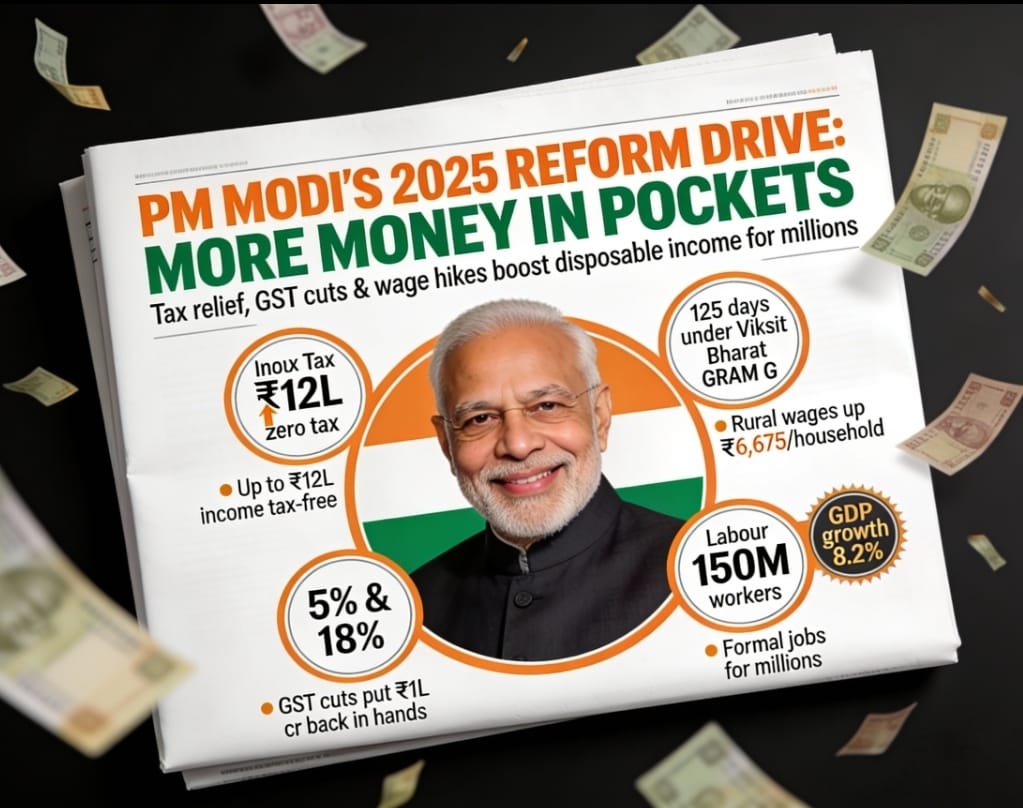
A landmark relief for the middle class has been announced through the decision to exempt individuals earning up to ₹12 lakh annually from income tax. In another significant step, the Income-tax Act of 1961 has been replaced with the modern and simplified Income Tax Act, 2025, signalling a decisive shift towards a transparent, technology-driven tax administration.
In indirect taxation, the Goods and Services Tax has been rationalised into a two-slab structure of 5 per cent and 18 per cent. The move is expected to ease the burden on households, farmers, MSMEs and labour-intensive sectors, reduce disputes and improve compliance. The impact of the reform has already been reflected in strong consumer demand during the recent festive season, officials said.
To boost small and medium businesses, the government has expanded the definition of “small companies” to include firms with an annual turnover of up to ₹100 crore. This measure is expected to significantly reduce compliance costs and regulatory pressures on thousands of enterprises, enabling them to focus on growth and job creation.
In a major liberalisation move, the government has allowed 100 per cent foreign direct investment in Indian insurance companies. The decision is expected to enhance insurance penetration, improve service delivery, increase competition and provide better financial security to citizens.
Reforms have also been introduced in the securities market, with the Securities Market Code Bill tabled in Parliament to strengthen governance norms within SEBI, enhance investor protection, reduce compliance burdens and promote a technology-driven capital market ecosystem aligned with the vision of a Viksit Bharat.
A series of landmark maritime reforms were carried out during the Monsoon Session of Parliament, with five key legislations passed — the Bills of Lading Act, 2025; the Carriage of Goods by Sea Bill, 2025; the Coastal Shipping Bill, 2025; the Merchant Shipping Bill, 2025; and the Indian Ports Bill, 2025. These laws replace colonial-era Acts dating back to 1908, 1925 and 1958, and are expected to simplify documentation, ease dispute resolution and reduce logistics costs.
Under the Jan Vishwas framework, the government has repealed hundreds of archaic provisions, including 71 Acts through the Repealing and Amendment Bill, 2025, effectively ending the era of criminalisation for minor and technical economic offences.
To further improve ease of doing business, 22 Quality Control Orders have been revoked across sectors such as synthetic fibres, yarns, plastics, polymers and base metals, while 53 QCOs have been suspended across steel, electrical, engineering and consumer product categories. Officials said the move will lower production costs, boost exports — particularly in apparel and footwear — and ensure lower prices for domestic consumers.
Labour reforms remain a cornerstone of the reform agenda, with 29 fragmented labour laws consolidated into four modern labour codes. The framework aims to secure fair wages, timely payments, smoother industrial relations, social security and safer workplaces, while encouraging formalisation and greater participation of women in the workforce. Coverage under ESIC and EPFO has also been extended to unorganised and contract workers.
On the global front, India has expanded market access for its products through new trade agreements with the United Kingdom, New Zealand and Oman. The Free Trade Agreement with the European Free Trade Association — comprising Switzerland, Norway, Iceland and Liechtenstein — has also been operationalised, marking India’s first such pact with developed European economies.
In the energy sector, the SHANTI Act has been introduced to create a robust framework for the safe and responsible expansion of nuclear science and technology. The reform is aimed at meeting the rising energy demands of emerging sectors such as artificial intelligence, data centres, green hydrogen and advanced manufacturing, while opening new avenues for private sector participation and skill development.
A significant reform has also been announced in rural employment, with the Viksit Bharat–GRAM G Act, 2025, increasing the employment guarantee from 100 to 125 days. The move is expected to boost rural incomes, strengthen village infrastructure and create durable community assets.
In education, a Bill has been introduced to establish a single higher education regulator — the Viksit Bharat Shiksha Adhishthan — replacing multiple bodies such as the UGC, AICTE and NCTE. The reform seeks to enhance institutional autonomy while promoting innovation and research.
Officials said the significance of the 2025 reforms lies not only in their scale but also in their philosophy, which prioritises collaboration over control and facilitation over regulation. Anchored in extensive consultation and data-driven policymaking, the reforms aim to place the citizen at the centre of governance and set India firmly on the path towards becoming a developed nation.
Comments are closed.